 拾光
Gleanings Series · 008 | By Heisenberg
Muscle Strength, the Best Insurance for Kids
Evidence, myths, and an action list for youth strength and conditioning
Prologue: A Tale of Two Papers
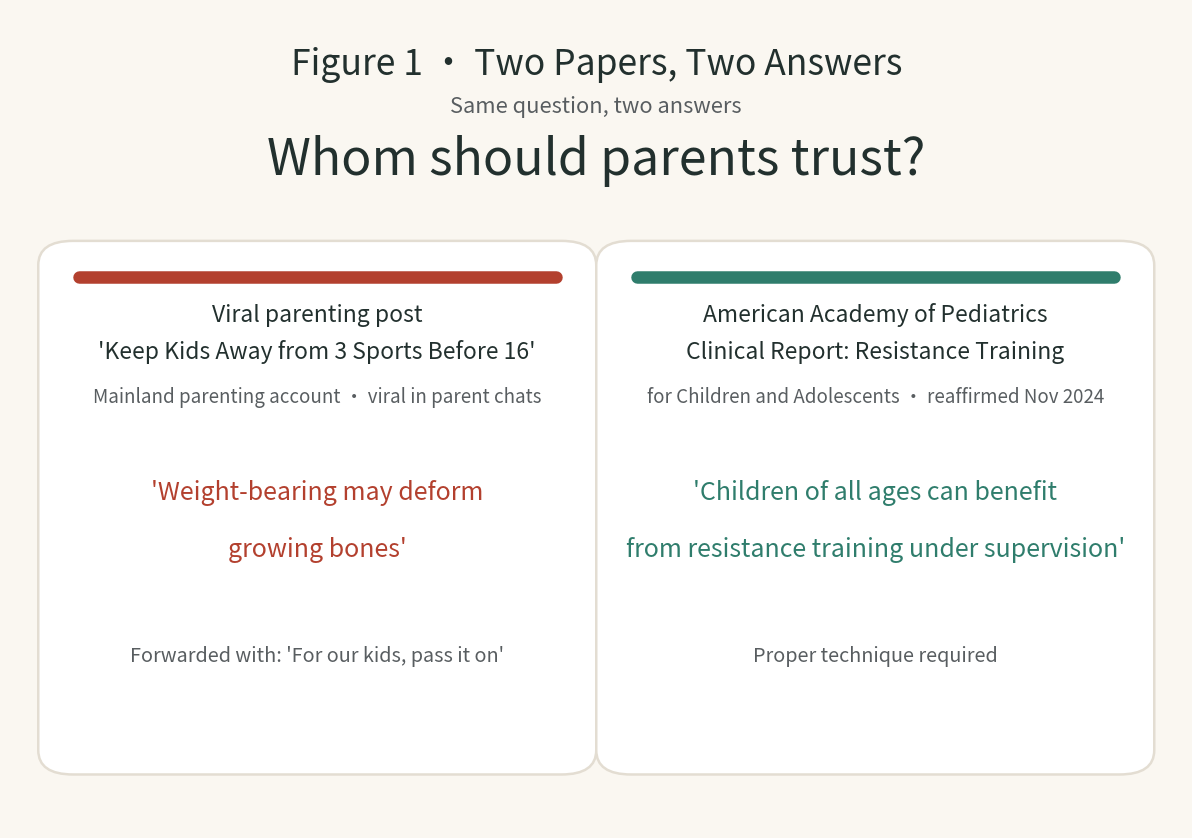
A parenting article circulating on 360doc titled "Don't Want Your Kid to End Up Short? Stay Away From These 3 Types of Exercise Before 16" has been making the rounds in parent group chats. It claims that weightlifting "should be avoided before age 16," that "growing bones may become deformed under prolonged loading," and that "height development may be stunted." The caption people share it with is usually: "For the sake of the kids — pass it on to more parents."
In November 2024, the American Academy of Pediatrics (AAP) reaffirmed its clinical report, *Resistance Training for Children and Adolescents* — with a very different conclusion:
"Children of all ages can benefit from resistance training, provided it is supervised and performed with proper technique."
On one side, a parent group chat flooded with forwards; on the other, forty years of evidence. Who should parents believe?
This isn't the private anxiety of a few parents. A Dutch survey (n=314) found that 29.6% of parents would forbid their children from strength exercise — while only 4% would forbid aerobic exercise. Fear isn't the minority here; it's the mainstream.
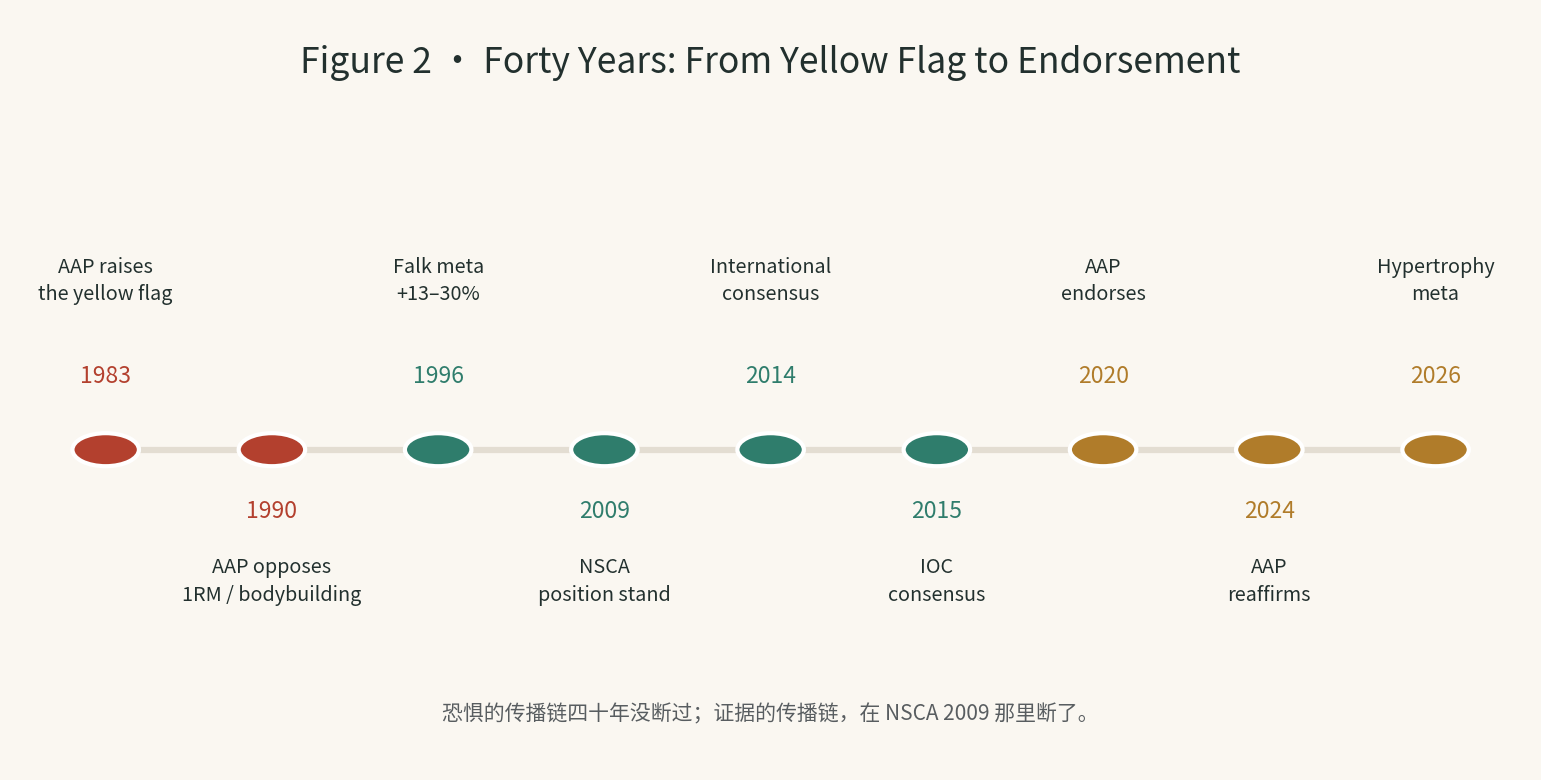
Believing the forwarded article is perfectly reasonable — who would gamble with their child's height? But behind that second piece of paper stand forty years of evidence, and one complete reversal. In 1983, it was the AAP itself that first waved a yellow flag at youth strength training. The position paper it issued that year struck exactly the same tone as the article circulating in group chats today.
But before we get to those forty years, hold one child in mind. Every class has one like him: the 800-meter test, the whole class finished, and he's out there alone on the track, running the final lap. Some kids in the stands are laughing; others have already left. Head down, he runs it to the end. The scorer calls out his time — dead last, loud enough for the whole class to hear.
This piece is written for his parents. And for you.
Forty years. The same institution. From a yellow flag to a full endorsement — what happened in between? That is what 008 is about.
Chapter 1: First, Get the Words Right — the "Muscle Training" You Fear Isn't the "Strength Training" We Mean
Start with a vocabulary quiz. When you hear "muscle training," what picture appears in your head?
Probably a beefed-up lifter pumping iron in the gym, quadriceps on a bodybuilding stage, or the "King Kong Barbie" meme. What you actually fear is that image — grafted onto your child.
But "strength and conditioning" — what we're actually talking about — isn't that. The Mayo Clinic's Chinese site has a page written specifically for parents, titled "Strength Training: Is It OK for Kids?", and its very first sentence draws the line:
"Don't confuse strength training with weightlifting, bodybuilding or powerlifting. … The goal is to build muscle strength and endurance. Adding muscle bulk — known as muscle hypertrophy — is another matter entirely."
Adding bulk is another matter entirely. That sentence deserves three readings.
The 2017 *Physical Activity Guidelines for Chinese Children and Adolescents* puts it more plainly. Its definition of resistance training: "Resistance training, also known as strength training, is active exercise performed against external resistance. That resistance can come from dumbbells, medicine balls, resistance bands or other equipment — or from one's own bodyweight." Bodyweight squats, push-ups, hanging off a pull-up bar, climbing games — all of it counts. The guidelines add one more line: "The iron-pumping you see in gyms counts as resistance exercise — but resistance exercise is not only iron-pumping."
So the first misunderstanding happened at the level of words. The "muscle training" you fear (the bodybuilding-style bulk) and the "strength training" we mean (the ability to generate force, to land safely, to have strong bones) are simply not the same thing.
The second misunderstanding happened in history. What did the AAP's 1990 statement actually oppose? The original text lists them plainly: bodybuilding-style training, 1-repetition-maximum attempts, and explosive Olympic lifting movements. Later generations misread "against those three" as "all strength training is harmful" — and that misreading lasted thirty years. Forty years of fear: half a misunderstanding of words, half a misreading of history.
Once the words are aligned, then we can argue about right and wrong.
Chapter 2: Three Myths, Dismantled One by One — and the Supply Chain Behind Them
Words aligned — now the evidence. The three sentences parents fear most, taken apart one by one.
Myth 1: "It'll stunt their height — they'll never grow tall."
In 1986, Weltman's team put 26 prepubescent boys through 14 weeks of strength training, monitoring their epiphyses with bone scans throughout — zero injuries. In 2001, Sadres followed a group of prepubescent boys who trained for two full years: height grew normally, strength went up, and self-perception improved. In 2019, Alves pooled 16 studies covering 1,008 children into a systematic review: training versus no training showed no difference in height gain (p=0.46).
Three layers of evidence, one conclusion: properly conducted training does not stunt height. Faigenbaum put it more bluntly in *The New York Times*: "It will not stunt growth or lead to growth-plate injuries."
Myth 2: "It'll injure the growth plates — the bones are still tender."
The National Strength and Conditioning Association (NSCA) 2009 position statement — note, this is the current statement; it has never been updated since — puts it this way in the original: "No prospective study has reported a growth-plate injury from supervised youth resistance training." Every traceable growth-plate injury case comes from retrospective reports of the 1970s and '80s: unsupervised, maximal loads, faulty technique — all three poisons at once.
And one more set of numbers. Pierce's team followed 70 youth weightlifters aged 7 to 16 for a full year — 1,224 competition lifts — and the count of injuries requiring medical attention or time off: zero.
Myth 3: "The injury rate is high — too dangerous."
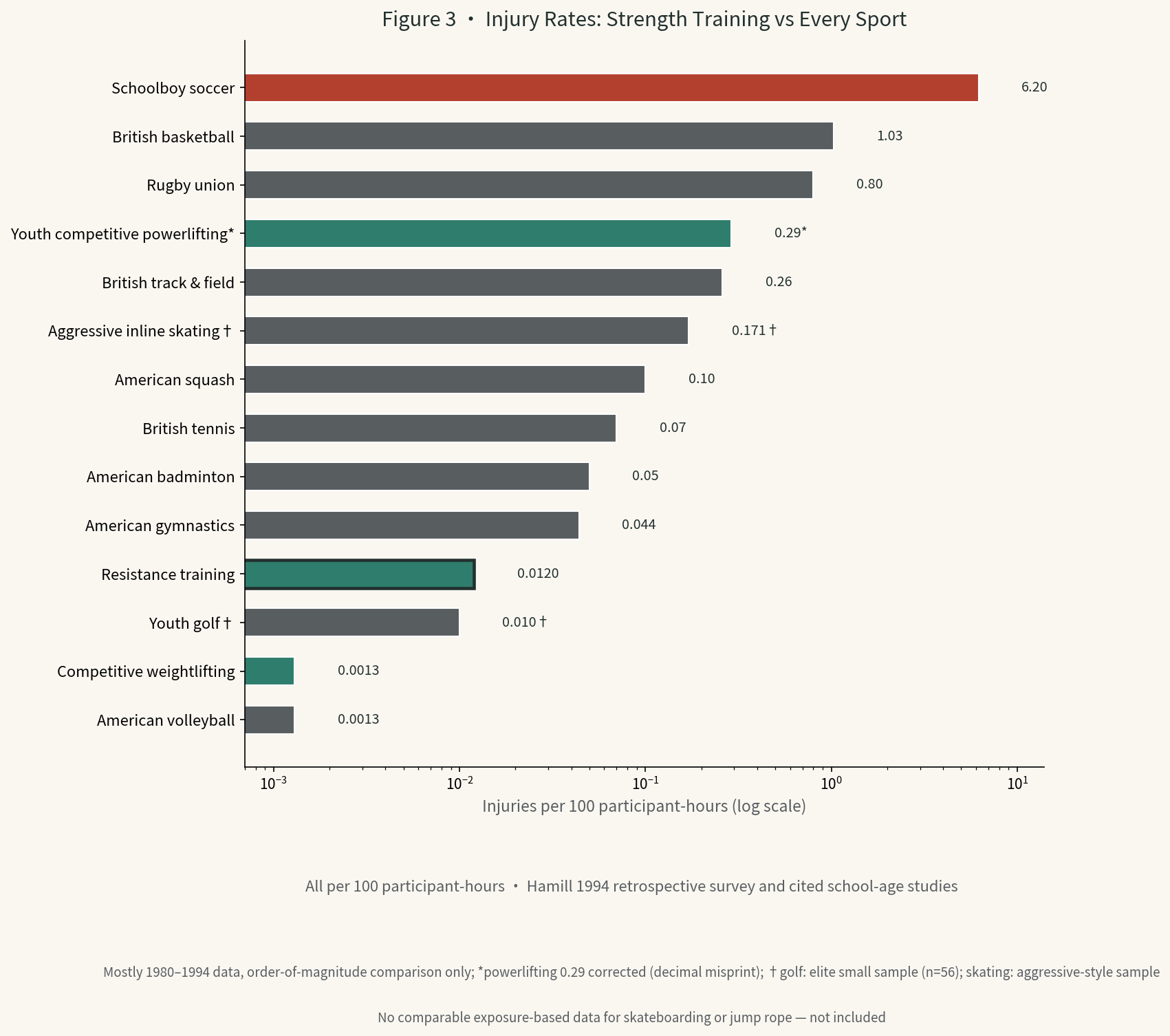
The original data comes from Hamill's 1994 study in the *Journal of Strength and Conditioning Research* — a retrospective questionnaire survey of British school-age children. Its Table 2 was always a multi-sport comparison table; earlier citations cherry-picked just 3 numbers, so this time the full table is laid out. Per 100 hours of exposure: school-age soccer 6.20, British basketball 1.03, English rugby 0.80, youth competitive powerlifting 0.29, British track and field 0.26, aggressive in-line skating 0.171, American squash 0.10, British tennis 0.07, American badminton 0.05, American gymnastics 0.044, resistance training 0.0120, youth golf 0.010, weightlifting 0.0013, American volleyball 0.0013. Skateboarding and jump rope were searched exhaustively, but no published data used a comparable exposure-hours measure — this isn't a claim they're safe, just that nobody has counted them that way, so no forced comparisons.
Mind the boundaries: this is a retrospective questionnaire, not prospective tracking; the data are all from 1980–1994, and serve only for order-of-magnitude comparison. One more correction must be stated openly: powerlifting's 0.29 is a corrected value — Hamill's original misprinted the decimal point (0.0027); recomputed from Brown & Kimball's 1983 original data it is 0.29, which also matches the figures in Faigenbaum 2010 and Aasa 2017. When a number is wrong, flag it; no covering up.
Even using the most conservative table values, resistance training's injury rate is less than one five-hundredth of soccer's. Even youth competitive powerlifting (0.29) is only one twenty-first of soccer's. Look at the last line: volleyball 0.0013, weightlifting 0.0013 — the "gentle" volleyball in your eyes and the "terrifying" weightlifting have exactly the same injury rate.
The U.S. NEISS emergency-room database also records how these injuries happen: among youth strength-training injuries, 65% are weight plates dropped on hands and feet — concentrated in unsupervised settings. What fails is the environment, not the training itself.
Three myths dismantled. But dismantling myths is only the first half. The second half asks: where are these myths sourced from?
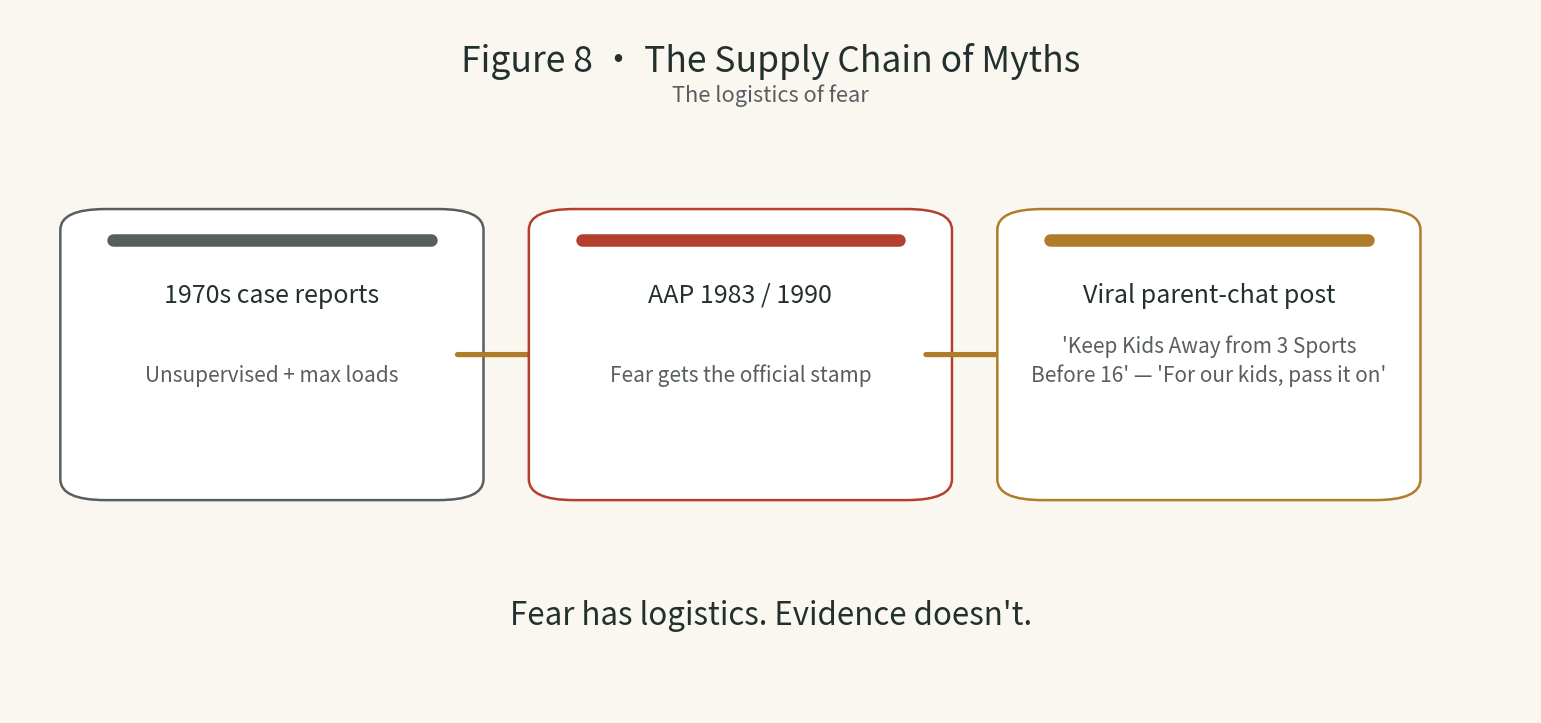
Myths have a complete supply chain. In the 1970s, a few retrospective case reports (unsupervised + maximal loads) planted the fear; in 1983 and 1990, two AAP statements stamped it with official seals; today, "Stay Away From These 3 Types of Exercise Before 16" still circulates in parent group chats, with the same "for the sake of the kids" caption. The fear's distribution chain has never broken in forty years. The evidence's distribution chain broke at NSCA 2009 — no parent ever read that statement. So the problem was never "ignorant parents." It's that fear has a complete logistics system, and evidence doesn't.
Chapter 3: Kids Get Stronger Without Growing Bigger Muscles
The myths are dismantled. But "not harmful" is not the same as "worth doing." Whether it's worth doing comes down to mechanism — what, exactly, are kids training when they strength-train?
The answer may run against your instincts: what grows isn't muscle — it's the nervous system.
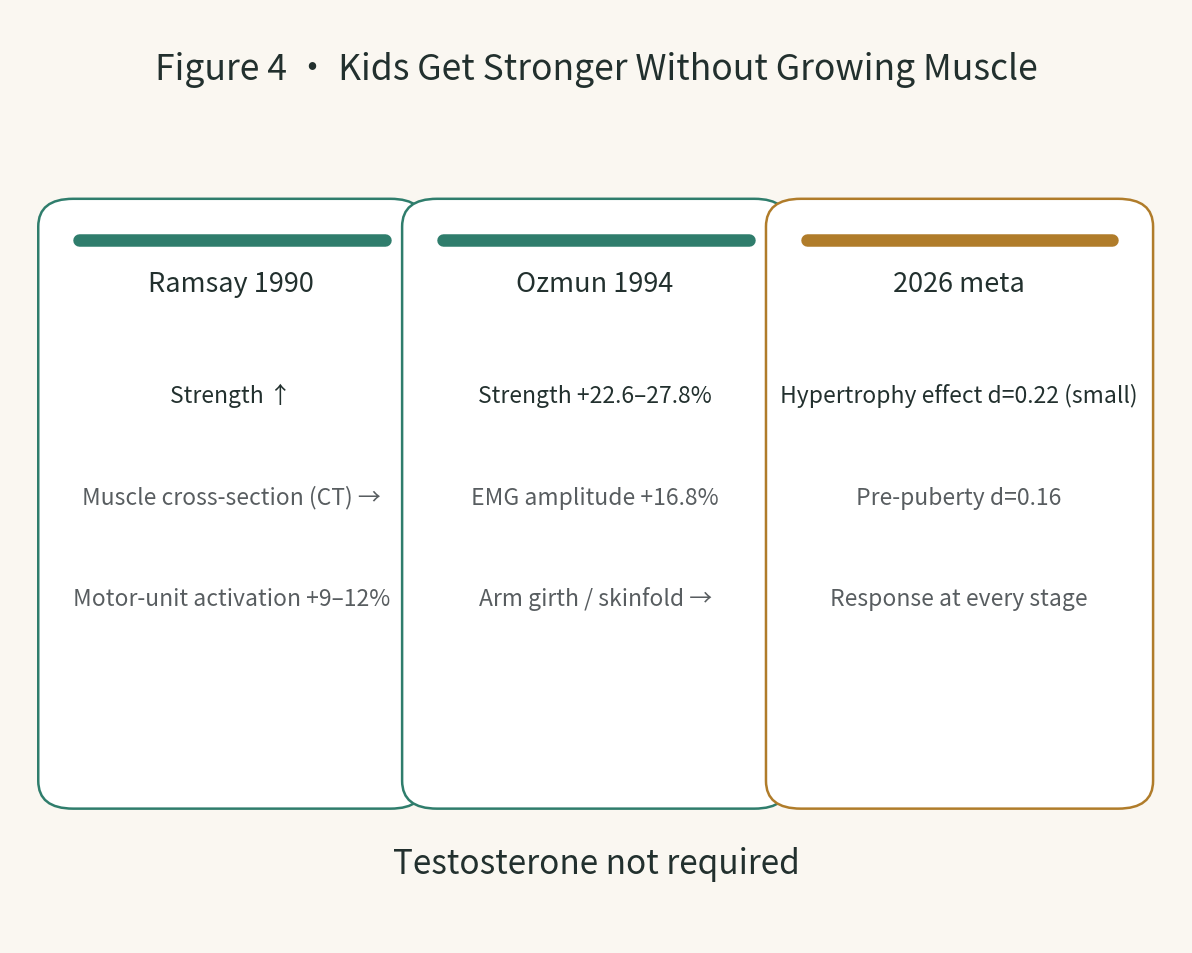
In 1990, Ramsay published a study in Medicine and Science in Sports and Exercise: a group of boys, average age ten and a half, strength-trained for twenty weeks, three sessions a week. Strength went up; the CT-measured muscle cross-sectional area — didn't budge. The interpolated twitch test showed motor unit activation up by 9 to 12 percent. Where did the strength come from? From the ability to recruit.
In 1994, Ozmun ran an even shorter eight-week dumbbell study, average age 10.3: isotonic strength up 22.6%, isokinetic strength up 27.8%, EMG amplitude up 16.8% — arm circumference and skinfolds, zero change. The conclusion was blunt: the early strength gains come from improved muscle activation.
In 2026 — this year — Sports Medicine published the first meta-analysis of muscle hypertrophy in children using only imaging methods: 23 studies, 1,443 kids. Conclusion: overall hypertrophy effect d=0.22 (small), d=0.16 (trivial) before puberty, widening only after puberty. But the paper added one crucial sentence: "Hypertrophic responses exist at every developmental stage." — Not zero. Just small.
Three generations of evidence, one story: before puberty, kids gain strength mainly through neural drive, muscular coordination, and motor learning. Testosterone? Not required.
That explains the judgment in your original draft — the "critical window for neural adaptation." Only the evidence is more precise than the word "window." We'll get to that in the next chapter.
First, two lines that come up constantly in parent group chats.
"If a girl strength-trains, will she turn into the 'King Kong Barbie' meme?" Getting bulky takes three things: post-pubertal hormones, heavy loads, and a calorie surplus. Kids have none of the three. Pre-puberty hypertrophy effect d=0.16 — translated into plain words: she couldn't get bulky if she tried. And even if, years from now, she reaches an age where she could bulk up, that will be her own choice a decade-plus from now — not something decided by today's set of squats.
"Strength training is useless for kids — puberty will build the muscle on its own?" I hear this one all the time; Huxiu (Chinese business media) even ran an article debunking it, which tells you how widespread it is. The response has three layers. First: the 2026 meta-analysis says hypertrophic responses exist at every developmental stage — trained beats untrained, always. Second: neuroplasticity is like this — starting early buys you efficiency. Same movement pattern, learned at eight versus learned on the spot at eighteen: the cost is not the same. Third: Myer's 2013 research found that neuromuscular training for preventing anterior cruciate ligament (ACL) injuries works best in mid-adolescence (OR=0.28), and has almost no effect by early adulthood (OR=1.01). Some benefits, once that moment passes, never come back.
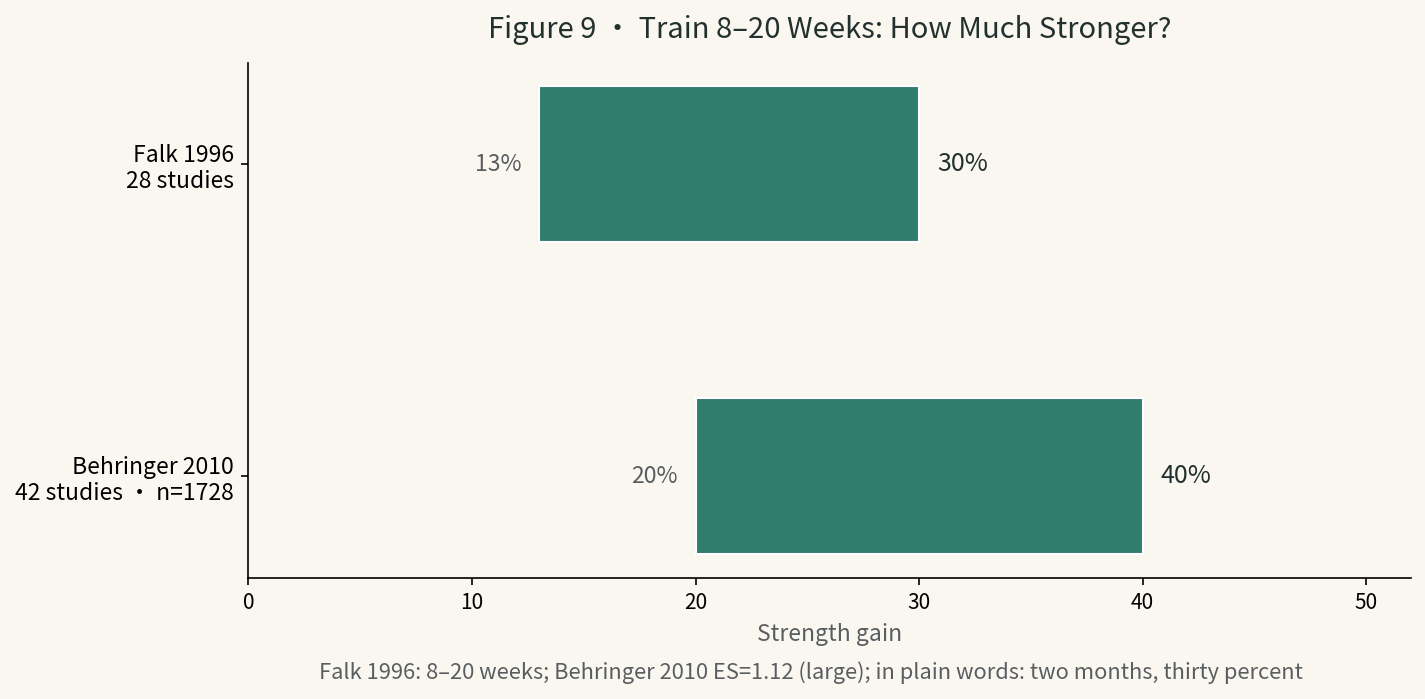
One more word on "how much." Falk's 1996 review of 28 studies: 8 to 20 weeks, gains of 13% to 30%. Behringer's 2010 review of 42 studies, 1,728 kids: effect size 1.12, gains of 20% to 40%. In plain words: two months, roughly a third more strength. This isn't the consolation of "training beats not training" — this is meta-analysis-grade certainty.
Chapter 4: The "Window of Opportunity," Marked Down
Last chapter ended with a loose thread — the "critical window for neural adaptation." The evidence is more precise than the word "window." Here's the full picture.
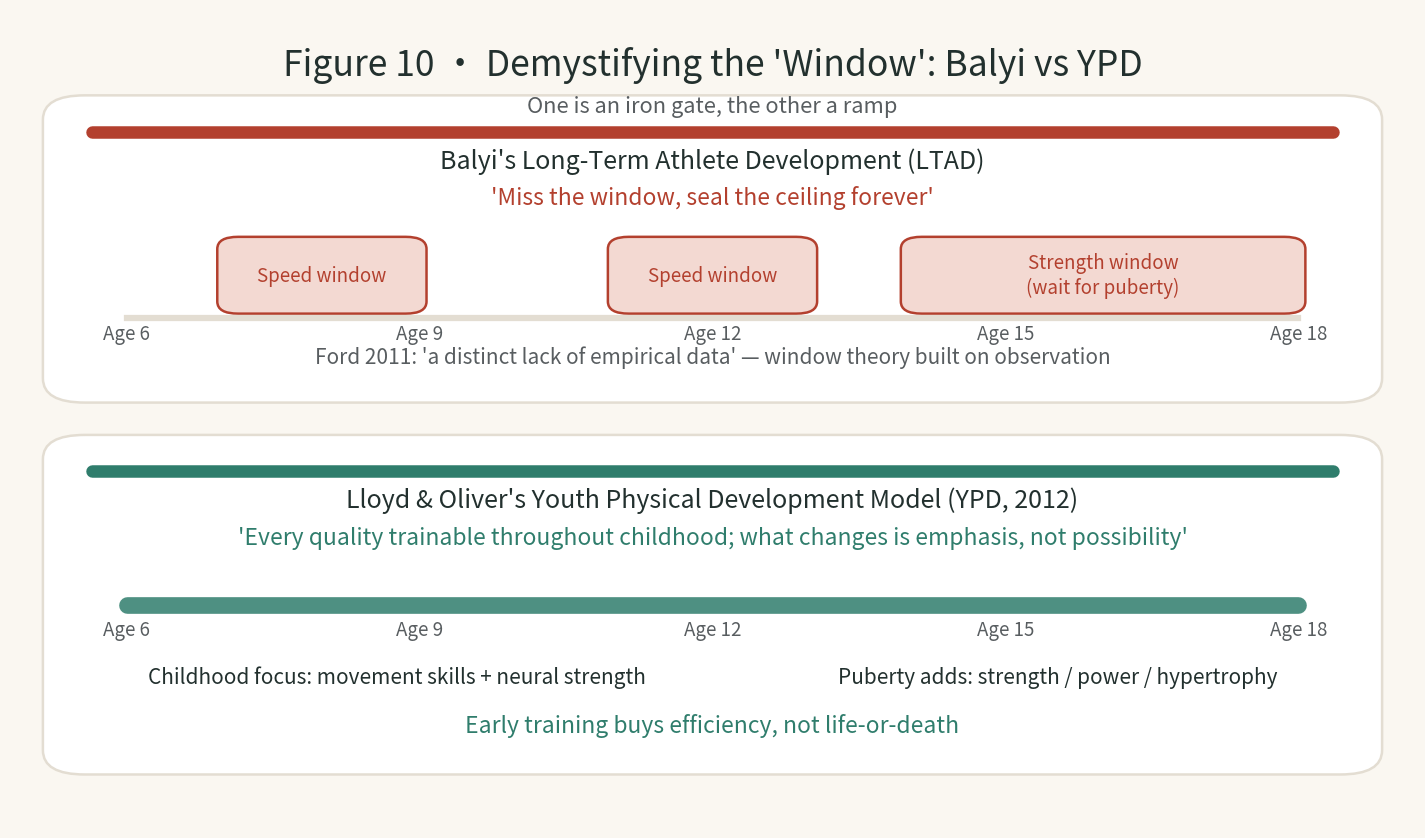
The "window of opportunity" idea comes from Balyi's Long-Term Athlete Development (LTAD) model. It drew a few windows: speed windows at ages 7–9 and 11–13, a strength window that had to wait for puberty — and it went further, claiming that "damage" done between 6–10 and 10–16 could never be undone. Miss the window, and your ceiling is sealed forever.
Sounds intimidating. In 2011, Ford's team dismantled it in the Journal of Sports Sciences: a "conspicuous lack of empirical data." The entire window theory rests on anecdotal observation — no evidence that missing a window creates a ceiling, and some of its arguments are extrapolated from animal studies.
Its replacement is the Youth Physical Development (YPD) model, proposed by Lloyd and Oliver in 2012. The core is one sentence: every physical quality can be trained throughout childhood; what changes with maturity is the *emphasis*, not the *possibility*. Childhood emphasizes movement skill and neural-driven strength development; puberty adds load on strength, power, and hypertrophy. Not "miss it and the door closes" — every stage has its own focus.
So the honest version: childhood really is a period of high neuroplasticity, and Ramsay's and Ozmun's data both support a "neural-dominant" picture; but framing it as a use-it-or-lose-it deadline is an overstatement. The accurate formulation is — starting early buys efficiency, not life or death.
Why insist on getting this right? Because "too late if you miss it" is marketing language, not science. It manufactures anxiety and pushes parents to sign up for classes. Whereas "starting early pays off better" is a fact — it gives parents options, not pressure. The readers of this piece are parents, and the balance has to be exactly right.
The mechanisms are covered. Now the accounting.
Chapter 5: The Price of Not Training
The first four chapters all answered the same question: is it safe? This chapter flips the question: what does *not* training cost?
In 2016, Faigenbaum published a commentary in the *British Journal of Sports Medicine* titled "Citius, Altius, Fortius" (faster, higher, stronger), and did something elegant: he reframed the question from "does training carry risks" to "who bears the risk of *not* training?" In 2017, he and MacDonald formally proposed pediatric dynapenia (childhood muscle decline) in *Acta Paediatrica* — children whose muscular strength and power are low enough to limit function. Not a disease. Just "not trained."
The concept exists. What about the bill? Chinese children are paying it in data.
In 2025, Wang's team published a study in *The Lancet Regional Health – Western Pacific* covering five rounds of China's National Survey on Students' Physical Fitness and Health from 2000 to 2019 — 1.33 million students. The conclusion was staggering: the median standing long jump among 22-year-old men fell from 234.3 cm in 2010 to 219.4 cm in 2019 — nearly 15 cm lost in a decade. Women dropped from 172.8 to 162.5. Grip strength, pull-ups, sit-ups — all sliding. Fewer than two in five Chinese students meet the WHO's muscle-strengthening activity recommendations.
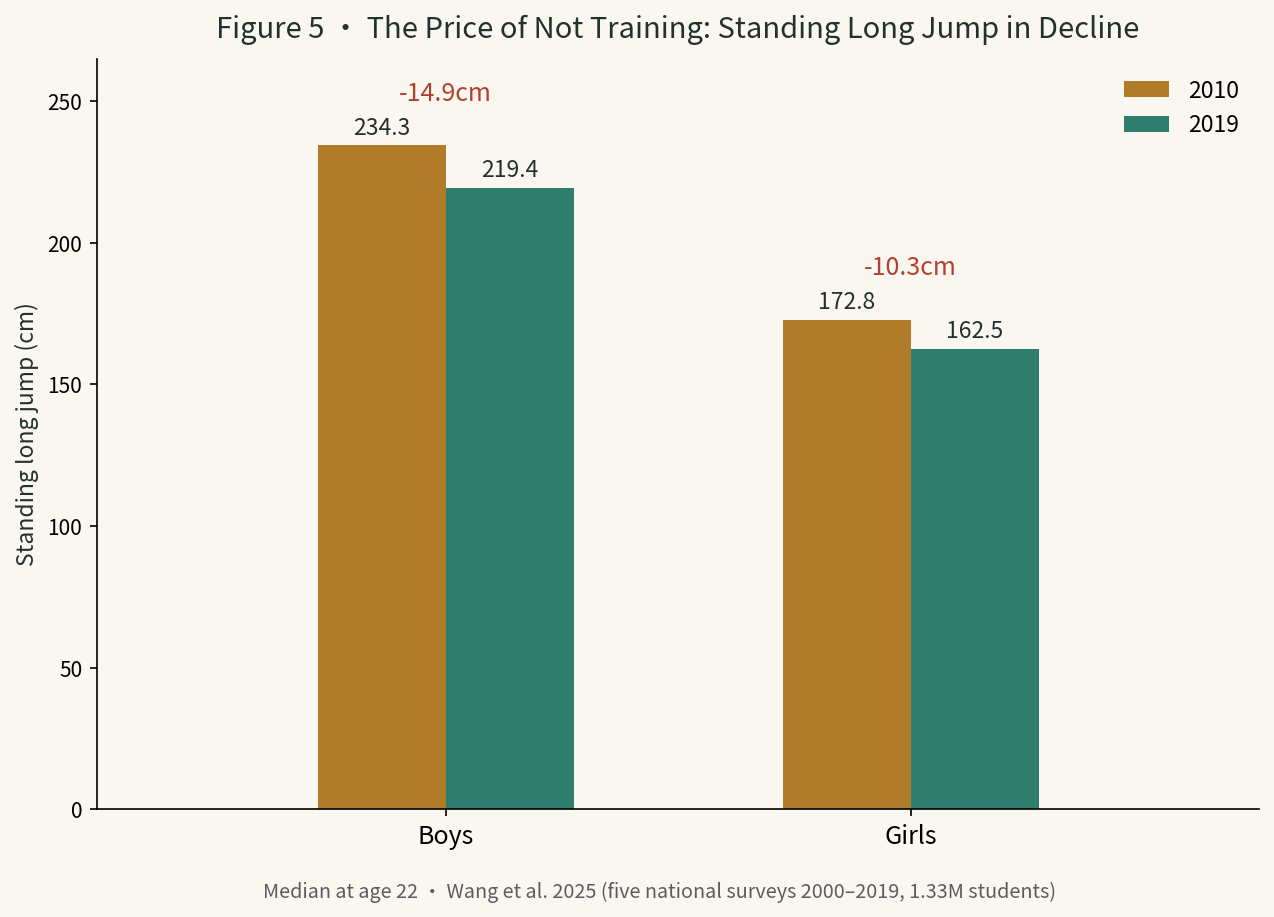
Note the age: 18 to 22, supposedly the peak years for muscular strength. If the peak is sliding, imagine the valley.
The cost of "not training" isn't just jumping shorter. It's written in bone: Nikander's 2010 review of 10 RCTs found strength training increased bone strength at loaded sites by 1% to 8% — bone is a use-it-or-lose-it tissue; deny it mechanical loading in childhood and it grows to the minimum spec. The 2014 international consensus (Lloyd et al., *BJSM*) went further: the mechanical stress of resistance training may promote bone formation and growth. Not "doesn't harm bones" — it *nourishes* them. It's also written in emergency rooms: Rössler's 2014 meta-analysis found structured exercise-prevention programs cut youth sports injuries by 46%; Myer's 2013 work showed neuromuscular training prevents ACL injuries, with the strongest effect in mid-adolescents.
Then there's the 2026 hypertrophy meta-analysis, which proposed a new concept: strength reserve. Childhood-built muscle and strength are a buffer against the neuromuscular decline of old age. Every set of squats your child does today is money saved for their 80-year-old self. The concept is new — a framework, not a settled conclusion — but I'm writing it in anyway, because it finally puts the word "insurance" on solid ground.
The title says muscle strength is a child's best insurance. What does the insurance cover? Everything in this chapter: bones, ligaments, and your 80-year-old self.
Remember the kid who finished dead last in the 800 meters from the opening? His bill isn't just his own — the cost of not training is global. But in China, that bill runs higher.
Chapter 6: The Chinese School Paradox — The State Wants It, Parents Fear It
This chapter is China-only. Because China's absurdity is beyond what imported evidence can explain.
Start with demand. In 2017, China's Physical Activity Guidelines for Children and Adolescents put it in black and white: ages 6 to 17, at least three days of resistance activity per week, 30 minutes each time. PE class, hobby classes, resistance games — all count.
Then look at the exam. In 2026, the PE section of the zhongkao (China's high-school entrance exam) in Guangzhou drew 151,000 candidates. The second-category events, choose one of six: one-minute rope skipping, medicine ball throw, shot put, triple frog jump, standing long jump, pull-ups (boys) / hanging traverse on a parallel ladder (girls). Count them: not one is pure aerobic; every single one is an expression of strength and power. Making kids test pull-ups without letting them train for strength is like testing them on math and forbidding practice problems.
Then look at supply. Do schools dare teach it? Most don't. Three mountains: teacher supply, facilities, and safety liability. Do parents dare allow it? As established: viral posts in parent groups still insist "no loaded training." So you get a landscape with Chinese characteristics: the state wants it, parents fear it.
But "the state wants it, parents fear it" is only the surface. Underneath lie the three genes of Chinese sports.
Gene one: the gold-medal gene. China's sports are sports for winning glory for the nation, not for children's health. Since the day the state-run sports system was born, the word "sports" has been welded to "winning medals" — sports are for the few: the kids in sports schools, the provincial-team prospects, not "my child." So when parents hear "strength training," their first reaction is "that's for athletes." Huxiu (Chinese business media) put it well: "For a long time, resistance exercise has always been seen as an athletes' need or a hobby for the few." That's not prejudice. It's genetic.
Gene two: the minor-subject gene. The running joke that "the PE teacher is always sick" is a shared childhood memory in China, where PE classes were routinely taken over by math and Chinese lessons. Math, Chinese, and English are major subjects; PE is a minor one; by ninth grade, PE class yields to academic subjects as a matter of course. When someone raised to believe "PE doesn't matter" grows up to be a parent, how can you expect them to believe "strength is insurance"? That line of code was never written into their genes.
Gene three: the liability-avoidance gene. Why don't schools dare teach it? Don't just blame "not caring" — look at the incentives: one safety incident and the principal is held accountable; skip all equipment-based programs and the risk is zero. Under an accountability regime of "the less you do, the less can go wrong," the optimal strategy is not to train. Parents run the same calculus: if my kid gets hurt training, it's my responsibility; if he stays weak by not training, well — "everyone's like that." The risk of not training is shared by all; the risk of training is borne alone. Anybody running that math would choose not to train.
Beneath the three genes lies a deeper stratum. From the "Sick Man of East Asia" to the state-run sports system, China's sports have always been a national narrative, never a personal one — "Develop sports, strengthen the people's health" (a 1952 slogan), whose subject is "the people," not "your child." Sports strong, nation strong; as for how fast your kid runs — that's your family's business. After sixty years of sports having nothing to do with "me," telling parents today that "strength is a child's best insurance" is arguing against their genes.
Chinese parents don't fear their children suffering. They fear suffering that "doesn't count." The suffering of grinding test-prep problems counts — it converts into scores; the suffering of sports doesn't count, and can even bring injury and blame. Their math is precise, and every line of it is love — except two missing lines: their child's knees at forty, and their muscles at eighty.
So this chapter's sharpness is aimed not at parents, but at the genes.
I call it "strength training as the zhongkao's invisible points." Parents enroll kids in academic tutoring without blinking at tens of thousands of yuan a year; yet when a child can't do a pull-up or throws a medicine ball short, nobody thinks of systematic training. It's not that they don't want to — they don't dare. The three words "strength training," in parent group chats, are roughly synonymous with forcing growth (like pulling seedlings to hurry them along).
Absurd? Deeply. On one side, national guidelines and zhongkao events both scream "we need strength"; on the other, conventional wisdom grinds strength training into the dirt. Children are caught in the middle: what they're tested on, they can't do; what would fix it, they don't dare do.
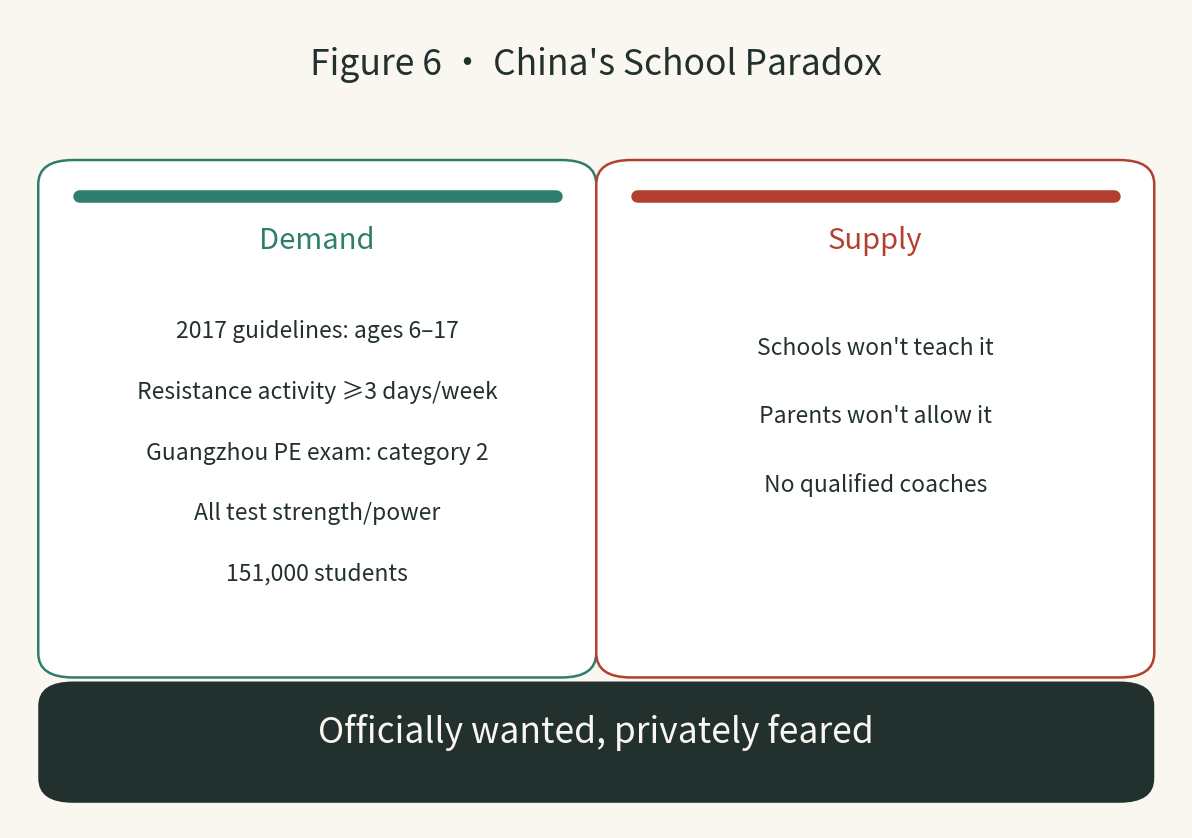
Boundary, stated plainly: there are no RCTs showing training raises zhongkao scores, so I won't write that. This chapter's conclusion can only be this — the events themselves test strength; that's an opportunity, not a promise. But letting an opportunity sit there because you don't dare grab it is a different thing from having no opportunity at all.
One last line, possibly offensive: ideas are much harder to train than muscles. Muscle shows results in eight weeks (Ozmun's data); ideas haven't budged in forty years (the AAP's lesson). The sharpness of Chapter 6 is deliberate — because the gentle words have all been said, for forty years, to no effect.
Once the mindset shifts, the next question is much more practical: what exactly should they train for?
Chapter 7: Squat, Push, Pull, Run, Jump — Training Strength Is the Same Thing
Back to your original draft. Its most valuable sentence: "The core of training for children is not how much strength, but variety and all-round development — squat, push, pull, rotate, walk, climb."
The evidence is on your side, and it lines up more neatly than you'd think.
In 2008, Stodden proposed a model: motor competence → self-efficacy → participation → fitness → back to motor competence — a loop. Run it in reverse, and children with low competence actively avoid anything that requires movement, sliding toward a sedentary life. In 2010, Lubans's systematic review confirmed the positive association between movement skills and physical activity (mostly cross-sectional studies; causality unproven — noted). In 2018, Barnett put the bodyweight squat directly on the "fundamental movement skills" list.
See it? Squat, push, pull, run, jump, land — these are both "fundamental movement skills" and the entire content of "technique-first strength training." Two things, one thing.
Behringer's 2011 meta-analysis gave the evidence for transfer: resistance training's transfer effect on running, jumping, and throwing was ES=0.52, reaching 0.99 for throwing alone. Strength training is not an "extra side dish" — it is the "main course" of movement skill. Faigenbaum once said something I love: "They're training for whatever sport they want to do later in life because the skills they develop are transferable to anything they might choose to do." What these children are training for is whatever sport they may play later in life, because the skills are transferable.
So "teach the child how to use the body first, then add load" is not a second-best compromise — it is the right answer. Load was never the goal; it is the means — and the means serve the end: a child who can squat, jump, and land. Your draft had this logic down in January 2026; the evidence just arrived a few years late.
The why is settled. The how, one item at a time.
Chapter 8: An Action List for Parents
Theory's done. Here's the practical stuff. Every item below is backed by consensus. No folk remedies.
What age to start? There is no statutory minimum age. The NSCA's line: if a child is ready to take part in organized sport (generally around 7 or 8), then they are ready to begin some form of resistance training. The AAP is even looser: Stricker says that for a 5-year-old, single-leg hops and frog jumps are strength training. In the end, the age limit is about cognition and communication — able to follow instructions and behave, with 7 or 8 as the norm.
Who supervises? Non-negotiable. The NSCA puts it plainly: young people should not do resistance training without qualified supervision, age-appropriate equipment, and a safe environment. Remember: every "safe" number in this article carries the qualifier "supervised." Remove the qualifier, and the conclusion is void. Faigenbaum cited a comparison in 2010: middle-schoolers training on their own (only 36% were supervised) had an injury rate of 0.176, versus 0.012 with supervision — nearly a 15-fold difference. Supervision isn't a suggestion; it's the qualifier.
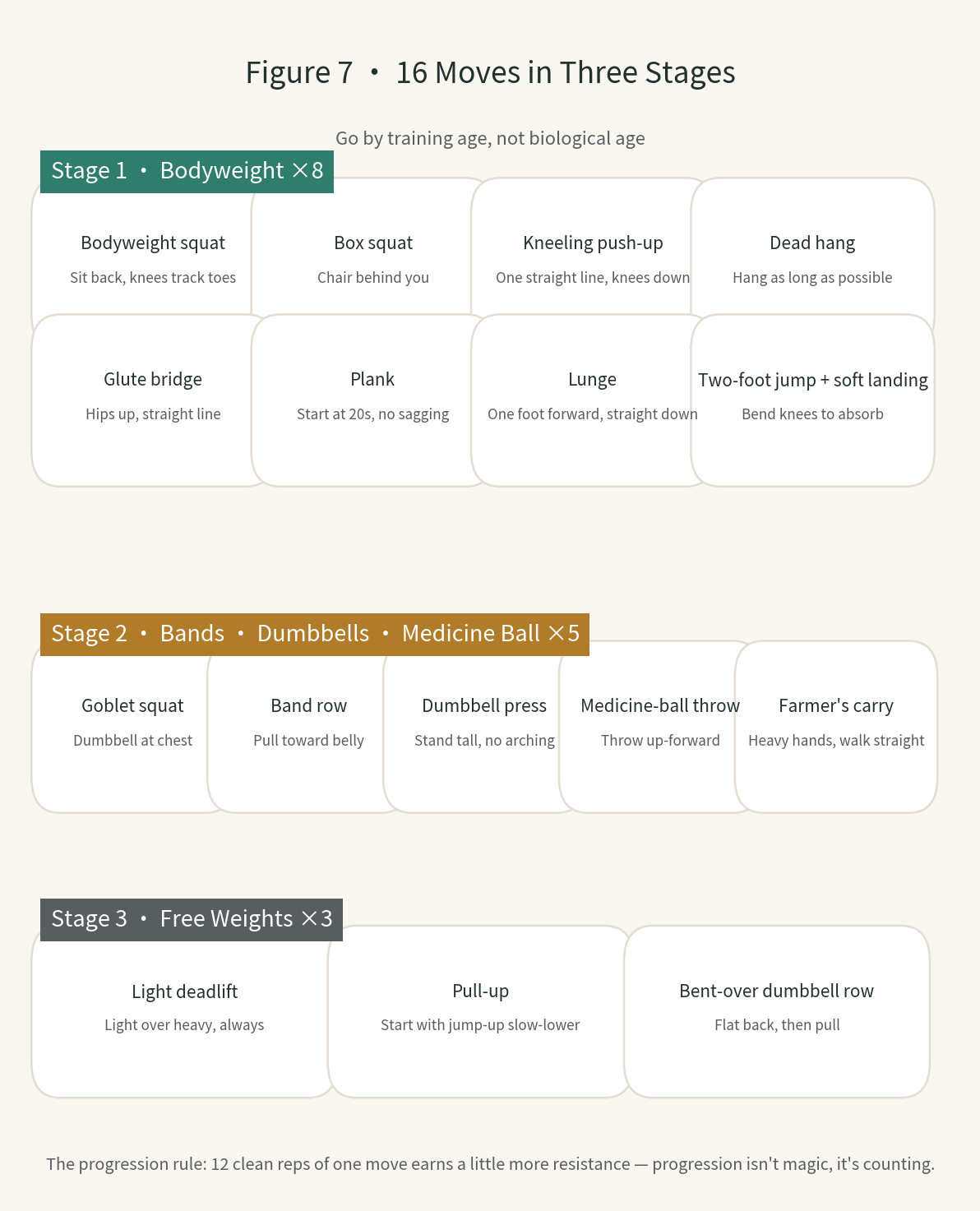
What to train, and in what order? Go by training age, not chronological age. Stage one, bodyweight, from around 7 or 8: get the movements right first — bodyweight squat (sit down like onto a chair, knees tracking the toes), box squat (a chair behind you to catch the forward lean), kneeling push-up (body held in one straight line), dead hang (hang for as long as you can), glute bridge, plank (start at 20 seconds, no sagging hips), lunge, two-foot jump with soft landing (learning to land softly matters more than jumping high).
Once the movements are sound, move to stage two: resistance bands, small dumbbells, medicine balls. Goblet squat (hold a dumbbell or water bottle at the chest), resistance-band row (a fix for rounded shoulders), dumbbell press, medicine-ball throw (a direct match for the medicine-ball event in the zhongkao), farmer's carry (carry heavy things in both hands and walk a straight line).
After a year of training, with a coach present, touch stage three: light deadlift (lighter is better), pull-up (start from a jump-up and slow negative, assisted if needed), dumbbell bent-over row.
How much? One sentence: 2 to 3 sessions a week, on alternate days; pick 4 to 6 exercises per session, 1 to 2 sets each, 8 to 15 reps per set; an adult or coach watches form throughout; if the child complains of joint pain, stop.
Don't skip the warm-up. Five minutes at the start — running and jumping games will do; cool down at the end. The warm-up isn't ritual; it's the second line of defense after supervision.
Don't hold your breath. Keep breathing as you exert force. Breath-holding through a heavy lift is a technique for adults moving big weights; children don't need to learn it.
Tell soreness from pain. Muscle soreness is normal; it will ease by the next day. Joint pain, sharp pain — stop immediately. They are two different things; don't mix them up.
How do you know a movement is "sound"? One ruler: if the child can do the same movement 12 times in a row without form breaking down, it's time to add a little resistance. Progression isn't magic; it's counting.
Whose protocol is the Lesinski one? That 2016 meta-analysis of 43 studies computed an "optimal dose": 5 sets, 6–8 reps, 80–89% 1RM. Don't get excited — that was for well-trained youth athletes chasing maximal strength, not your child. Having a beginner copy it is asking a primary-schooler to sit the gaokao (China's college entrance exam). Bolded once; bolded again.
Three things genuinely worth fearing. At this point I have to be honest: this whole article says "don't be afraid," but some things truly deserve fear. First, early specialization — focusing on a single sport at 8, playing one ball year-round; the IOC's 2015 consensus flags that early specialization raises injury and burnout risk, and the evidence favors "play more sports." Second, adding weight without technique — every safety number in this article carries the qualifier "technique first"; loading plates before the movement is learned is driving on the highway without a license. Third, a bad coach — worse than not training at all is training wrong. If you meet a gym that is treating kids like miniature adults, walk away.
See it now? What deserves fear was never "strength training" — it's "training wrong." Fear the wrong thing, and your fear was wasted.
The last item, and the most important one: make it fun. The NSCA's line: "children are not miniature adults." Faigenbaum said in an interview: "It is quite easy to increase the strength of a child. But the real question is, will it stick? It has to be enjoyable and fun." (Getting a child stronger is easy; getting them to stay with it is hard. It has to be fun.) Getting strong is physiology; sticking with it is psychology. The latter is harder. The IOC's 2015 consensus wording can serve as the acceptance standard: "varied strength and conditioning programmes that are suitably age based, quality technique driven, safe and enjoyable" — varied, age-appropriate, technique-first, safe, fun — five things, not one to skip.
A first-semester roadmap. You have the checklist; here's the timeline: September — bodyweight plus games, twice a week, so the child first feels "this is fun"; October — lock in the movements, bring out the "12 reps without form breakdown" ruler; November — add bands and small dumbbells, balance upper and lower body; December — retest once — not strength, but "which movement is smoother than in September"; January winter break — keep 1 to 2 sessions a week, don't stop. One semester later, what you've gained isn't muscle — it's a child who says "yes, I know how to train."
Chapter 9: How You Talk Is Part of the Training
The last chapter is for you — the parent.
First, let me try to understand you. On Xiaohongshu — China's lifestyle-sharing app — height-boosting fads are a vast traffic pool: "15-minute bedtime massages that add 5 cm to your child's height," "day 39 of exercise-based height boosting." Your fear of your child "not growing tall enough" grows in the soil of height anxiety. That anxiety is real. It's nothing to be ashamed of.
What you're really afraid of may not be strength training at all, but your own childhood — the running joke that "the PE teacher is always sick." It's hard to believe in something you never got. That's not your fault. But don't pass it down to the next generation.
Understand first, then persuade — that was the original intent of the last chapter of your draft, and I've kept it for the very end, because it is the foundation of this entire piece.
Then comes action. In 2026, Zhang & Han published a study in the *British Journal of Educational Psychology* on 614 Chinese secondary-school students: parents' and teachers' autonomy support → the child's enjoyment → exercise volume and adherence. This chain comes from domestic data — no more "Western studies show."
Put plainly: you don't need to understand training. You need to change how you talk.
"Ten more reps, no stopping" and "that last set of squats — your knees tracked steadier than last time" train the same child, but leave behind two different childhoods. The first trains obedience; the second builds self-efficacy. O'Rourke followed a whole season of young swimmers in 2013: in a task-oriented climate — one focused on progress — the children's intrinsic motivation rose all the way through; in an ego-oriented climate — one focused on winning and rankings — motivation slid the other way.
There's an observation of Faigenbaum's that I love: overweight, slow kids — the ones publicly humiliated at the back of the pack in every running test — become "the strongest kid in the class" for the very first time in the weight room. In front of the plates, they taste "I can" for the first time. Sadres' two-year follow-up in 2001 recorded it too: the kids who trained for strength showed improved self-concept.
In the context of Chinese schools, this point cuts even sharper. The 800-meter and 1,000-meter runs in PE class are a nightmare for many kids — you can't outrun them, you can't dodge them, and the whole class is watching. Strength training offers another track: the kid who finished dead last in the 800 meters can be the one with the cleanest squat form. That's not feel-good fluff — it's the mechanism spelled out in self-determination theory (SDT): competence is the fuel of intrinsic motivation.
One more word about girls. In China, girls face a deeper layer of difficulty in sport: the stigma of "girls shouldn't get too bulky," the shame of a changing body in puberty, the quiet retreat to the corner of the gym, the invisible opting-out. The irony is that girls are exactly the ones who need strength training most — before puberty, they barely gain bulk at all (d = 0.16; even if you wanted bulk, you couldn't get it — the Chapter 3 data), while the "I can" that strength delivers is the hardest evidence against "girls aren't built for sports." Don't let gender steal the competence she could have had.
So this piece doesn't end with "don't stop your kid from training," but with "here's how you can help": don't be the overseer — be the audience; don't count the reps — praise the specifics; don't ask "did you win?" — ask "which movement felt smoother today than last time?" How you talk is itself part of the training — your draft's closing line, and the evidence has stamped it approved.
Finally, if you've read this far and you're still afraid — that's normal. Fear isn't ignorance; it's love that took the wrong turn. What you've really been afraid of was never the dumbbells — it was "what if I choose wrong, and my child pays for it." That fear itself tells me you're a responsible parent. But responsibility doesn't mean standing still: you can start with the smallest step — this weekend, take your child to hang from a pull-up bar. A few seconds, whatever they've got. No classes to sign up for, no equipment to buy. Start first; debate right and wrong later.
Epilogue
Forty years ago, the AAP said don't train; forty years later, the AAP says train. What reversed wasn't the stance. It was the evidence. And your child can't wait for the next forty years.
You don't need him to be strong right now. What you need is, at 40, for him to still dare to run, to know how to land, to have hard bones; at 80, for him to have muscle in reserve to carry him through aging; every time he wants to move, for his body to say "I can," not "I can't."
Back to the kid from the opening. He's still running that last lap. But if someone had taken him to train two years earlier — not to turn him into an athlete, just twice a week, to learn to squat, to learn to land — he might still be running the last lap. But with his head held high.
Muscle strength is a child's best insurance. The beneficiary of the policy is the grown-up he will become. And the window to buy in is right now.
The kid still running that last lap is still running. But this time, in the stands, one fewer person is leaving early — and one more is staying to run it out with him.
◆
References
References
- Faigenbaum AD, et al. Youth resistance training: updated position statement paper from the National Strength and Conditioning Association. *J Strength Cond Res*. 2009;23(5 Suppl):S60–S79.
- Stricker PR, Faigenbaum AD, McCambridge TM. Resistance training for children and adolescents. *Pediatrics*. 2020;145(6):e20201011. (reaffirmed Nov 2024; current)
- Lloyd RS, et al. Position statement on youth resistance training: the 2014 international consensus. *Br J Sports Med*. 2014;48:498–505.
- Bergeron MF, et al. International Olympic Committee consensus statement on youth athletic development. *Br J Sports Med*. 2015;49:843–851.
- Lloyd RS, Oliver JL. The youth physical development model: a new approach to long-term athletic development. *Strength Cond J*. 2012;34(3):61–72.
- Lloyd RS, et al. National Strength and Conditioning Association position statement on long-term athletic development. *J Strength Cond Res*. 2016;30(6):1491–1509.
- Behm DG, et al. Canadian Society for Exercise Physiology position paper: resistance training in children and adolescents. *Appl Physiol Nutr Metab*. 2008;33:547–561.
- UKSCA. Position statement: youth resistance training. *UKSCA Journal*, Issue 26 (Summer), 2012.
- Hamill B. Relative safety of weightlifting and weight training. *J Strength Cond Res*. 1994;8(1):53–57.
- Falk B, Tenenbaum G. The effectiveness of resistance training in children: a meta-analysis. *Sports Med*. 1996;22:176–186.
- Behringer M, et al. Effects of resistance training in children and adolescents: a meta-analysis. *Pediatrics*. 2010;126(5):e1199–e1210.
- Behringer M, et al. Effects of resistance training on motor performance skills in children and adolescents: a meta-analysis. *Pediatr Exerc Sci*. 2011;23:186–206.
- Lesinski M, Prieske O, Granacher U. Effects and dose-response relationships of resistance training on physical performance in youth athletes: a systematic review and meta-analysis. *Br J Sports Med*. 2016;50:781–795.
- Effects of resistance training on muscle hypertrophy in children and adolescents: a systematic review and meta-analysis. *Sports Med*. 2026. DOI: 10.1007/s40279-026-02499-0.
- Ramsay JA, et al. Strength training effects in prepubescent males. *Med Sci Sports Exerc*. 1990;22:605–614.
- Ozmun JC, Mikesky AE, Surburg PR. Neuromuscular adaptations following prepubescent strength training. *Med Sci Sports Exerc*. 1994;26(4):510–514.
- Weltman A, et al. The effects of hydraulic resistance strength training in pre-pubertal males. *Med Sci Sports Exerc*. 1986;18:629–638.
- Sadres E, et al. Muscle power and the Wingate test in prepubertal children. *Pediatr Exerc Sci*. 2001;13:357–372.
- Alves AR, et al. Effects of resistance training on linear growth in children and adolescents: a systematic review. 2019.
- Pierce K, et al. Youth weightlifting injury surveillance.(one-year surveillance of 70 lifters aged 7–16; 1,224 attempts)
- Faigenbaum AD, Myer GD. Resistance training among young athletes: safety, efficacy and injury prevention effects. *Br J Sports Med*. 2010;44:56–63.
- Dahab KS, McCambridge TM. Strength training in children and adolescents: raising the bar for young athletes? *Sports Health*. 2009;1:253–257.
- Rössler R, et al. Exercise-based injury prevention in child and adolescent sport: a systematic review and meta-analysis. *Br J Sports Med*. 2014;48:1733–1739.
- Myer GD, et al. The effects of age on neuromuscular training effects on anterior cruciate ligament injury prevention. *Am J Sports Med*. 2013;41:203–215.
- Nikander R, et al. Targeted exercise against osteoporosis: a systematic review and meta-analysis for optimising bone strength throughout life. *BMC Med*. 2010;8:47.
- Steib S, et al. Dose-response relationship of neuromuscular training for injury prevention in youth athletes. *Front Physiol*. 2017;8:920.
- Ford P, et al. The long-term athlete development model: physiological evidence and application. *J Sports Sci*. 2011;29:389–402.
- Stodden DF, et al. A developmental perspective on the role of motor skill competence in physical activity. *Quest*. 2008;60:290–306.
- Lubans DR, et al. Fundamental movement skills in children and adolescents: review of associated health benefits. *Sports Med*. 2010;40:1019–1035.
- Barnett LM, et al. Updating the motor competence–physical activity model. 2018.(fundamental movement skills incl. bodyweight squat)
- Faigenbaum AD. Citius, Altius, Fortius: beneficial effects of resistance training for young athletes. *Br J Sports Med*. 2016;50:3–4.
- Faigenbaum AD, MacDonald JP. Dynapenia: it's not just for grown-ups anymore. *Acta Paediatrica*. 2017;106(5):696–697.
- Zhang Y, Han L. Teacher and parental autonomy support, enjoyment and exercise adherence in Chinese secondary students. *Br J Educ Psychol*. 2026.
- O'Rourke DJ, Smith RE, Smoll FL, Cumming SP. Parent-initiated motivational climate and young athletes' intrinsic motivation. 2013.
- Wang Y, et al. Imbalance between muscle strength development and weight gain in children and young adults in China. *Lancet Reg Health West Pac*. 2025;61:101640.
- Working Group for China's Physical Activity Guidelines for Children and Adolescents. Physical Activity Guidelines for Children and Adolescents (China). *Chinese Journal of Evidence-Based Pediatrics*. 2017;12(6):401-409. (in Chinese)
- Mayo Clinic. Strength training: OK for kids? (Chinese edition). https://www.mayoclinic.org/zh-hans/healthy-lifestyle/tween-and-teen-health/in-depth/strength-training/art-20047758