 拾光
Gleanings Series · 009 | By Heisenberg
Debunking Nutrition in the Family Group Chat
When love hurts because it doesn't know better — is love to blame? Four stories about native eggs, sweeteners, hot water, and artisanal-pressed oil
Prologue: "Drink More Hot Water," and Its Variants
At the end of this piece, there is a sixty-second voice message — a daughter holding down the voice button, stumbling through her words, explaining a viral "sweeteners cause cancer" post to her mother. No plot twist, no golden line. But from then on, before forwarding anything, her mother asks her first. Don't skip to the end just yet: how those sixty seconds came to be is hidden in the four stories ahead.
"Drink more hot water" — probably the most said, and most mocked, sentence on the Chinese internet.
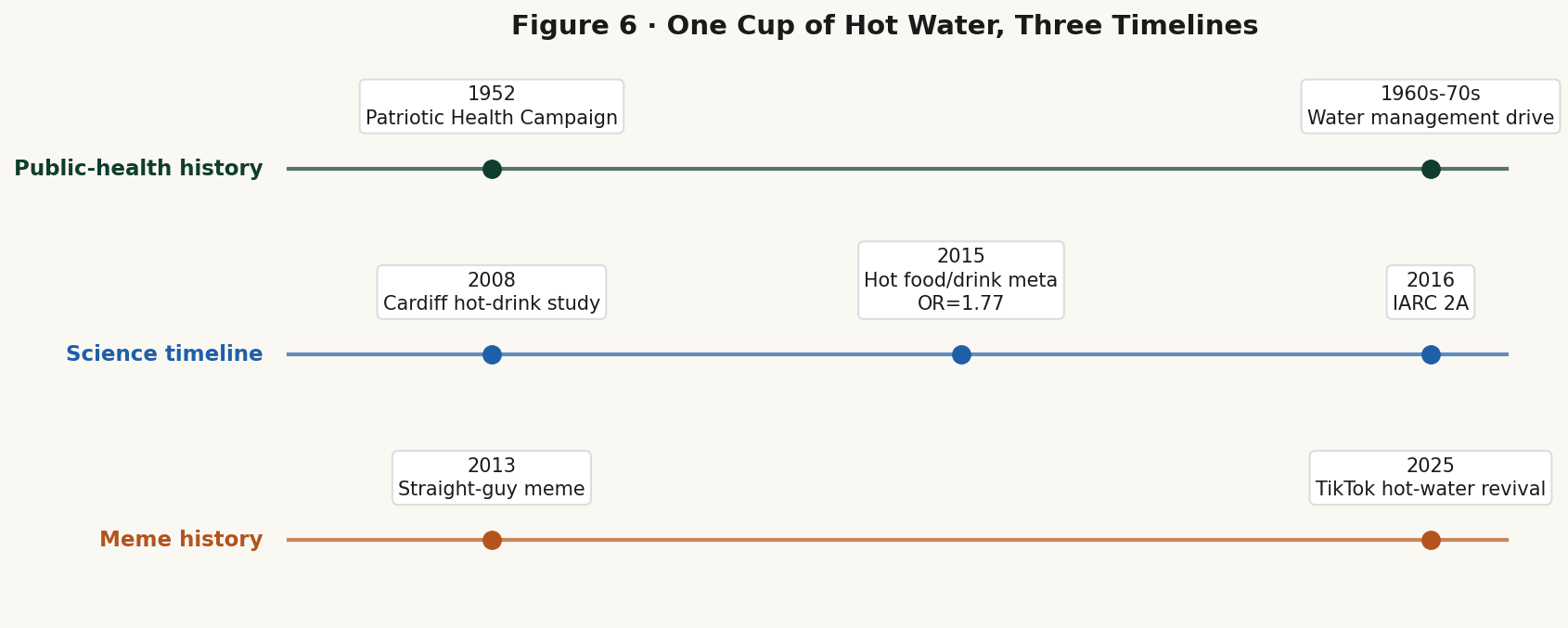
Got a cold? Drink more hot water. Stomachache? Drink more hot water. Feeling down? Drink more hot water. Around 2013, in the meme culture of Weibo, it slid from "caring" to "perfunctory" and became the label of the "straight guy" — China's internet shorthand for the well-meaning but clueless boyfriend. But who are the people saying it? A boyfriend in a long-distance relationship. A nurse-mom working the night shift. What they're really saying is the same sentence: "I'm not there with you."
Honestly, I've been the person who could only answer with those four words. Not that I didn't care — I genuinely didn't know what else to say. Every time this piece defends "the people who say it," it's defending who I used to be.
This piece tells four stories: native eggs, sweeteners, hot water, artisanal-pressed oil. They look nothing alike, but they're all variants of "drink more hot water" — the same sentence pattern: an assertion that needs no evidence, wrapped in "it's for your own good." "Native eggs are more nutritious," "sweeteners cause cancer," "artisanal oil has no additives" — like "hot water cures everything," they share one emotion: distrust of the modern food industry, and worry for family.
Hot water is the archetype of the four. It's the most universal, has the deepest cultural roots, and best illustrates what this piece is trying to say. So this chapter takes it apart completely — history, science, industry, gender, the world — layer by layer. Peel it open and you'll find the logic of the other three stories was hiding inside those four words all along.
Let me state my position up front. What this piece wants to debunk isn't a mother's caring — it's caring being exploited. The viral-article playbook — "experts say," "shocking," "forward to your family" — every line says the same thing: stop judging, just forward. What they hijack isn't your intelligence. It's your love.
So this piece has a thesis, in three words: love · knowledge · judgment. Love is the engine — it gets you moving. Knowledge is the map — it shows you the road. Judgment is the steering wheel — it turns at the fork. A car with no steering wheel only gets more dangerous the harder you press the gas.
Chapter 1: Native Eggs — Are You Paying for the Egg, or for the Word "Native"?
At the wet market, I've watched a grandmother insist on buying "native eggs" at 10 yuan a jin (a jin is 500 grams, roughly a pound) to steam egg custard for her grandson. The ordinary loose eggs next to them were 6.3. "I can't bring myself to economize on the good stuff," she said. "If I economize, it's on myself."
There's no arguing with that sentence. But we can help her spend that love where it counts.
(Note: the grandmother is an illustrative figure — there are many grandmothers like her at the wet market; I have written them as one person. The data, papers, and standards cited are all real; see the references at the end.)
The words "native eggs" have no national standard
First, a fact most people don't know: "native eggs," "firewood eggs," "clumsy eggs" — none of these has any definitional standard at the national level. They're folk names, not legal terms.
In a 2019 undercover report on CCTV's March 15 consumer-rights gala, the head of an egg company said on camera: "'Native eggs' have no national standard, no fixed authoritative definition... it's just something ordinary people say, like dialect — in the Northeast they call them 'clumsy eggs,' in the South 'grass eggs,' in Guangdong 'free-range eggs.' There's really no fixed meaning."
No standard, no loophole left unexploited. "Hao Tu" ("Good Native") is actually a registered trademark — so "Hao Tu native eggs" just means "Hao Tu-brand eggs." Stick the trademark "Xian Tu" ("Fresh Native") in front of the product name "eggs" and you've got farm-style "'fresh native' eggs." In May 2026, China's National Intellectual Property Administration launched a crackdown on "scheming trademarks": 1,174 deceptive trademarks were invalidated, including egg labels like "Mountain Native" and "Farmstead Native."
"Native" is a rhetorical device, not a standard. Every yuan you pay for the word "native" buys narrative.
The darker the yolk, the more nutritious?
"Native eggs have dark yolks — must be nutritious." That's the second myth.
Yolk color only reflects how many carotenoids were deposited from the feed. Chickens can't synthesize carotenoids themselves; they can only get them from feed — add more to the feed, and the yolk turns darker. Zhu Yi, an associate professor at China Agricultural University, said publicly during a 2026 controversy: an egg's nutritional value comes down to protein, amino acids, minerals and the like — it has nothing to do with yolk color.
And "adding pigment" is an open practice in the industry. In that 2019 March 15 report, a farm showed off its "canthaxanthin" feed-additive packaging and did a live comparison: no pigment, palest yolk; a little pigment, redder; more pigment, redder still. Canthaxanthin is a legal feed additive in China, capped at 8 mg/kg in layer feed — but China currently sets no requirement for canthaxanthin content in the finished fresh egg. That regulatory gap is exactly why the March 2026 "Wang Hai takes on Huang Tian'e" scandal — Wang Hai being China's most famous professional counterfeit-hunter, Huang Tian'e a premium egg brand — could never be technically settled.
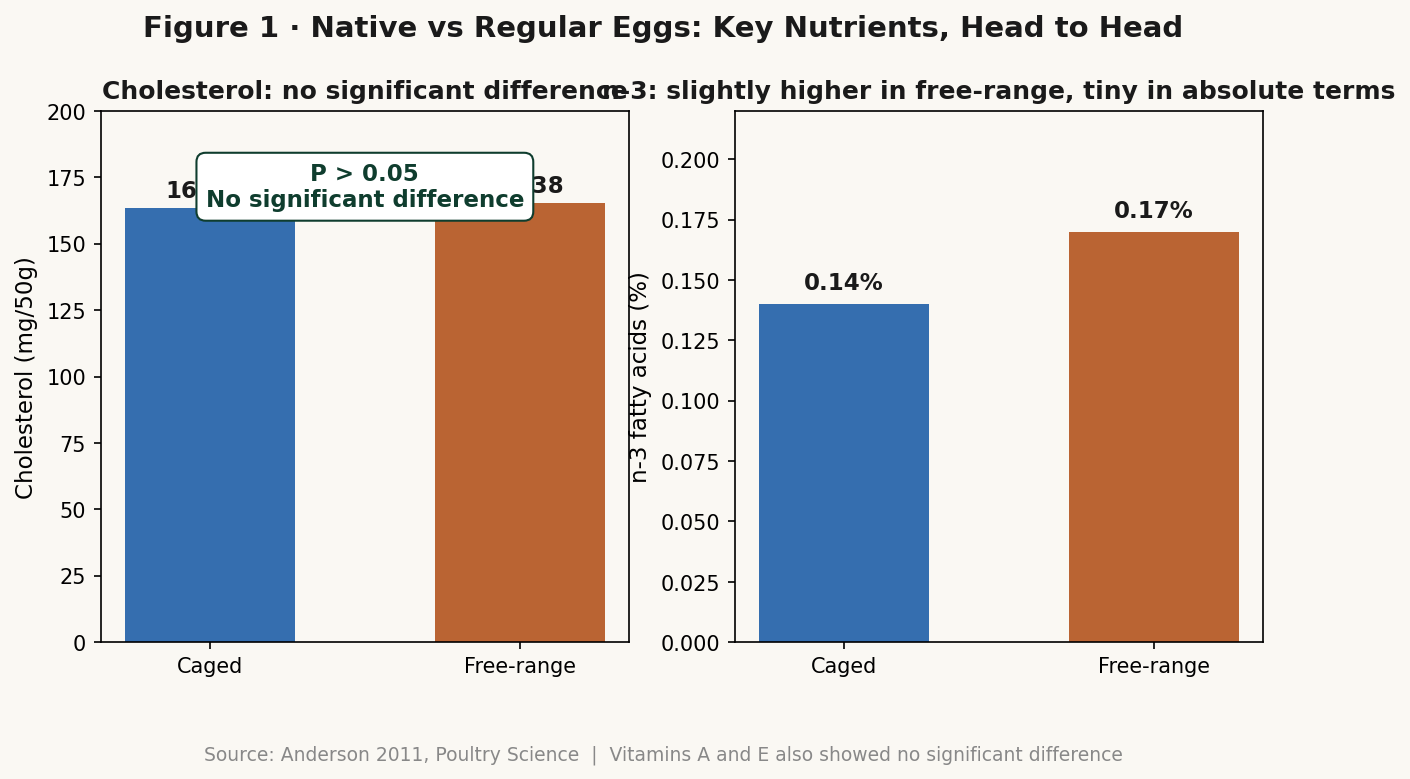
The one genuine head-to-head study is a 2011 paper in *Poultry Science* from Kenneth Anderson's team at North Carolina State University: 500 hens hatched in the same batch, identical conditions except free-range versus caged, cross-analyzed by four labs. The results:
- Cholesterol: caged 163.42 mg/50g, free-range 165.38 mg/50g — no significant difference;
- Vitamins A and E — no difference;
- The only things slightly higher in free-range eggs: total fat, n-3 fatty acids (0.17% vs 0.14%), and beta-carotene (which explains the darker yolk).
The paper's own conclusion: "a significant nutritional advantage ... could not be established" for free-range eggs. The study also prompted the USDA to lower its reference cholesterol value for eggs from 213 mg to 185 mg per egg.
A boundary that must be marked honestly
"Native eggs are dirtier" — that claim can't be generalized either. What multiple studies do agree on: on the shell surface, microbial contamination is indeed higher in free-range/litter environments than in cages. But inside the egg, Salmonella contamination rates were 3.97% for caged versus 3.58% for enriched cages — no significant difference. What determines risk is hygiene management, not the free-range-versus-caged binary.
The ledger: a 1.6x markup
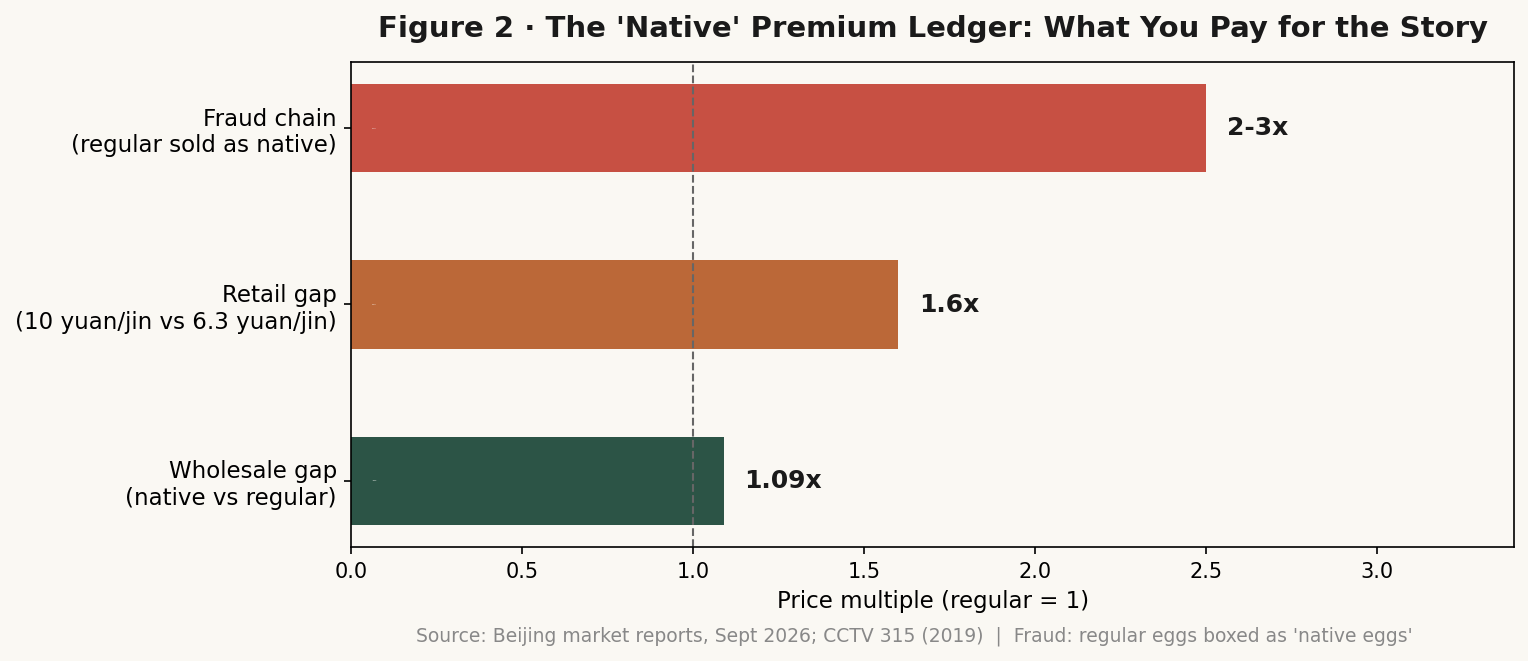
Beijing market, September 2026: ordinary loose eggs 6.3 yuan a jin, "native" eggs 10 — a markup of about 1.6 times. And in the counterfeit chain exposed on March 15, ordinary eggs repackaged into "native egg" gift boxes sold for 1 to 3 times the price.
I've been back to that wet market a few times since. The grandmother is still there, but she shops differently now: still buys native eggs, no longer by the jin — one a day. "My grandson eats one egg a day. More than that won't be fresh." With the money saved, she weighed out some pork. Nobody persuaded her; she did the math herself: the love wasn't discounted — just spent differently.
At bottom, "native eggs are more nutritious" and "hot water cures everything" are the same sentence pattern: an assertion that needs no evidence, wrapped in "it's for your own good." Remember the pattern — you'll meet it three more times, and in the hot-water chapter we'll take it apart down to the finest detail.
Chapter 2: Sweeteners — A Half-Century "Carcinogen" Rashomon
In an office building, there's a young guy who drinks two cans of zero-sugar cola a day. "At least I'm trying," he says.
Another scene: a daughter secretly buys sugar-free drinks for her diabetic father, who drinks them carefully, like he's doing something shameful. Sweeteners are the last indulgence of our time — "too timid to quit, too fond of sweet to stop" — a little sweetness adults leave themselves amid health anxiety. Writing that line, I felt a flicker of guilt — "too timid to quit, too fond of sweet" describes more than just them.
So when "SWEETENERS CAUSE CANCER! Forward to your family" floods the group chat, we owe it one serious look: what, exactly, has this argument been about?
Timeline: from a lab accident to July 14, 2023
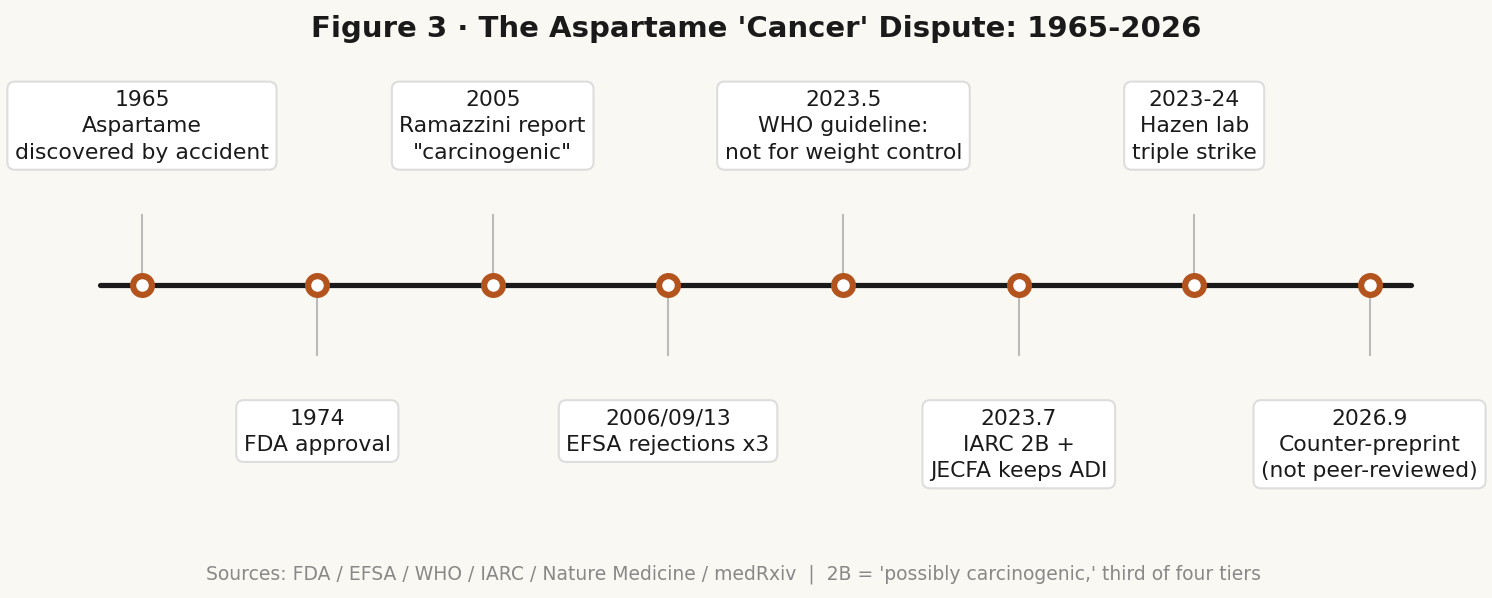
In 1965, a chemist developing an ulcer drug stumbled on aspartame — 200 times sweeter than sugar. The FDA approved it in 1974, then expanded the approval in 1981, 1983, and 1996 until it became a general-purpose sweetener.
The real turning point came in 2005. Soffritti's team at Italy's Ramazzini Institute reported that rats fed aspartame developed more lymphomas and leukemias; in 2007 they added that lifetime exposure starting from the 12th day of gestation amplified the carcinogenic effect even at low doses. The "aspartame causes cancer" narrative traces its scientific roots mainly to this series of studies.
But the regulators' rebuttals were equally specific. EFSA rejected the claims three times — in 2006, 2009, and 2013: the lymphoma increase had nothing to do with aspartame but reflected the high background rate of chronic lung inflammation in those rats, with no dose-response relationship; the kidney tumors were rat-specific and irrelevant to humans. The FDA's 2007 statement agreed.
On July 14, 2023, two agencies released their assessments on the same day, and Chinese social media exploded — "ASPARTAME CLASSIFIED AS CARCINOGENIC!" But the truth needs a key:
IARC does hazard identification; JECFA does risk assessment. IARC answers "can this thing cause cancer"; JECFA answers "how much of it is safe per day." IARC put aspartame in Group 2B ("possibly carcinogenic," based on "limited but unconvincing" human evidence for hepatocellular carcinoma); the same day, JECFA kept the acceptable daily intake (ADI) unchanged at 0–40 mg/kg of body weight — a 70-kg adult would have to drink 9 to 14 cans (200–300 mg per can) of zero-sugar soda a day to exceed it. The two don't contradict each other.
What does 2B mean? It's the third of four tiers, for cases where "human evidence is limited but unconvincing, or animal evidence is sufficient — but not both." The classification only answers "can it," never "how much will give it to you." Group 2B also includes: radiofrequency electromagnetic fields from phones, gasoline, pickled vegetables (traditional Asian pickles), and whole-leaf aloe vera extract. Coffee sat in 2B for 25 years before being removed in 2016. Saccharin sits in Group 3 (unclassifiable) — same sweetener family, but the classification tracks the state of the evidence, not some original sin of sweeteners.
| IARC (hazard identification) | JECFA (risk assessment) | |
|---|---|---|
| Question answered | *Can* it cause cancer? | How much is safe per day? |
| Aspartame conclusion | Group 2B (possibly carcinogenic) | ADI 0–40 mg/kg body weight, unchanged |
| What the evidence means | "Limited but unconvincing" human liver-cancer evidence | Safe within the limit |
| Common misreading | "Aspartame causes cancer!" | —— |
What did the WHO actually say?
On May 15, 2023, the WHO released its guideline on non-sugar sweeteners (NSS), with one core conclusion: it advises against using non-sugar sweeteners for weight control or to reduce chronic-disease risk. Francesco Branca, Director of the Department of Nutrition and Food Safety, said: "People should start reducing the overall sweetness of their diets from early in life."
But three qualifiers have to be seen together, or it's a misreading:
- This is a conditional recommendation, not a ban — the WHO stated plainly that the evidence is confounded, which is all a conditional recommendation can rest on;
- It explicitly excludes people who already have diabetes;
- It explicitly excludes sugar alcohols — erythritol and xylitol are sugar alcohols, outside this guideline's scope. Applying "the WHO says sweeteners are bad" straight to erythritol and xylitol is the most common scope error in Chinese media.
Erythritol: the most honest academic tug-of-war right now
In February 2023, Hazen's team at the Cleveland Clinic published in *Nature Medicine*: people with the highest blood erythritol levels had an 80% (HR 1.80) to 121% (HR 2.21) higher risk of cardiovascular events over three years than those with the lowest; eight healthy volunteers who drank an erythritol-sweetened beverage saw plasma levels rise more than 1,000-fold and stay elevated for over two days. In 2024, the team published twice more: a 30-gram erythritol intervention significantly enhanced platelet reactivity; a xylitol study reached a similar conclusion (HR 1.57).
The evidence chain — observational association plus thrombotic mechanism plus acute human intervention — looks formidable. But the challenges are equally specific:
- Endogenous confounding — the human body makes erythritol itself, and production rises with obesity and insulin resistance — precisely the traits of people already at high cardiovascular risk. High blood levels may reflect "already sicker to begin with," not "ate more sweetener";
- All three observational cohorts were patients "undergoing cardiac evaluation" — already high baseline risk, so generalizing to the public needs care;
- Tiny intervention samples (8, 10, 20 people), and single acute doses;
- In September 2026, a randomized crossover trial preprint reached the opposite conclusion (no increase in platelet reactivity) — note: not peer-reviewed.
Regulators' GRAS (generally recognized as safe) designations all stand unchanged. This is the most honest academic tug-of-war happening right now: association ≠ causation, and the argument is still open. Either side presenting it as settled is spending your trust.
Can sweeteners actually make you thin?
Short-term randomized controlled trials mostly show: in the "replace sugary drinks with sweetened ones" scenario, weight drops slightly or stays neutral (Miller & Perez's 2014 meta-analysis: an average 0.8 kg lost; the 2024 SWEET trial: the sweetener group kept off 1.6 kg more than controls). Long-term observational studies mostly show no effect or slight harm.
The split can be explained in one sentence: reverse causation — heavier people are more likely to choose sweeteners; sweeteners don't make people heavier. As for the "drink zero-sugar, then eat more elsewhere" compensation effect, the human evidence is mixed and inconsistent — not to be stated as fact.
A footnote worth savoring
In 1969, the U.S. sugar industry buried a study on the negative health effects of sucrose (Project 259); scholars didn't dig it up and publish it in *PLOS Biology* until 2017. Half a century of leniency toward "natural" sucrose, and a magnifying glass held over "artificial" sweeteners. Our leniency toward "natural" and our harshness toward "artificial" were never symmetrical. Which circles back to this piece's thesis: judgment should keep the scales level.
Sweeteners are neither poison nor savior
- Aspartame is safe within the ADI; the "carcinogenic" narrative confuses hazard identification with risk assessment;
- The WHO guideline is a conditional recommendation, and it doesn't cover sugar alcohols;
- The erythritol/xylitol cardiovascular debate is real but far from settled — don't throw out the sugar-free gum at home over one paper, but don't drink "zero sugar, zero calories" like water either;
- The biggest truth about sweeteners may be this: they won't make you thin. They're just modernity's compromise — wanting sweetness while fearing fat.
Don't laugh at the young guy with his two daily cans of zero-sugar cola. On the matter of "trying," at least, he's serious.
Like hot water, the sweetener debate's loudest voices were never the scientists'. Remember that pattern — in the next chapter, we'll lay it on top of the four words "drink more hot water" and take it apart completely.
Chapter 3: Drink More Hot Water — Taking Four Words Apart, Layer by Layer
As the prologue said, "drink more hot water" is this piece's central motif. This chapter takes it apart completely: history, science, industry, gender, the world — layer by layer.
First, a contrast: around 2025, a "hot-water wellness" craze swept Western TikTok, with young Westerners adopting it as "wisdom from the East," captioned "treat yourself." What young Chinese are mocking, young people across the ocean are studying in earnest. One sentence of caring completed a world tour.
Where did the worship of hot water come from?
History first. In 1952, the Patriotic Health Campaign was launched, against the immediate backdrop of the "germ warfare" allegations, with Mao Zedong's inscription: "Mobilize! Pay attention to hygiene." But honesty requires saying this: we found no primary source for the claim that "urging people to drink boiled water against cholera was a specific 1952 campaign slogan." The safer formulation: 1952 turned "hygiene" into a patriotic duty, and the "don't drink raw water, drink boiled water" message was reinforced again and again through the rural water-improvement drives of the following decades (the "water management" part of the 1960s–70s "two controls, five reforms" campaign). The worship of hot water is a decades-long public-health conditioning process — not a single slogan.
Then culture. The *Huangdi Neijing* (Yellow Emperor's Inner Canon) speaks of "cold qi lodging in the intestines and stomach"; the *Treatise on Cold Damage* forbids "raw and cold" foods after taking Guizhi decoction. But here's the key distinction: "cold" in Chinese medicine is the language of pathogenesis — stagnation, contraction, yang injury — aimed at constitution differentiation and prescribing, not a direct prescription about drinking-water temperature. Translating "cold injures yang" straight into "everyone must drink hot water" is a folk misreading of medical language. As for antique-sounding claims like "hot food injures the bones," we found no reliable classical source — best discarded outright.
Finally, the mirror image. Americans default to ice water not because of "cold-resistant constitutions," but because of a commercial conditioning: in 1806, Boston merchant Frederic Tudor started shipping New England lake ice to the Caribbean — the ice melted at the docks at first, and he landed in debtors' prison; twenty years later he'd built a global ice trade. Americans' "half a glass of ice" habit is half a century of commercial conditioning. Ice water is a product of business history; hot water is a product of public-health history — both are cultural habits, neither is a scientific conclusion. A rare symmetry.
What does the science say?
The conclusion first: the evidence does not support "you must drink hot water" — but "warm water is clearly healthier" is equally unsupported.
- A 2018 *European Journal of Nutrition* study: 2°C cold water vs 37°C warm water — cold water slowed gastric contractions and people ate less afterward — but the subjects were healthy young men, a tiny n;
- The Gatorade Sports Science Institute: a 12°C cold drink returns to over 30°C inside the stomach within five minutes of ingestion — cold drinks' effect on gastric emptying is "small and transient";
- Energy expenditure: 90 minutes after drinking, +2.9% for the cold-water group, +2.3% for the room-temperature group — "not enough to serve as a weight-loss method."
The only human evidence where "drink more hot water" stands its ground comes from a 30-person controlled trial at Cardiff University's Common Cold Centre in 2008 (*Rhinology*): hot drinks relieved runny nose, cough, sneezing, sore throat, chills, and fatigue "immediately and over time." But the conclusion is only symptom relief — that's the line it cannot be stretched across into "curing illness."
The real warning is on the other side
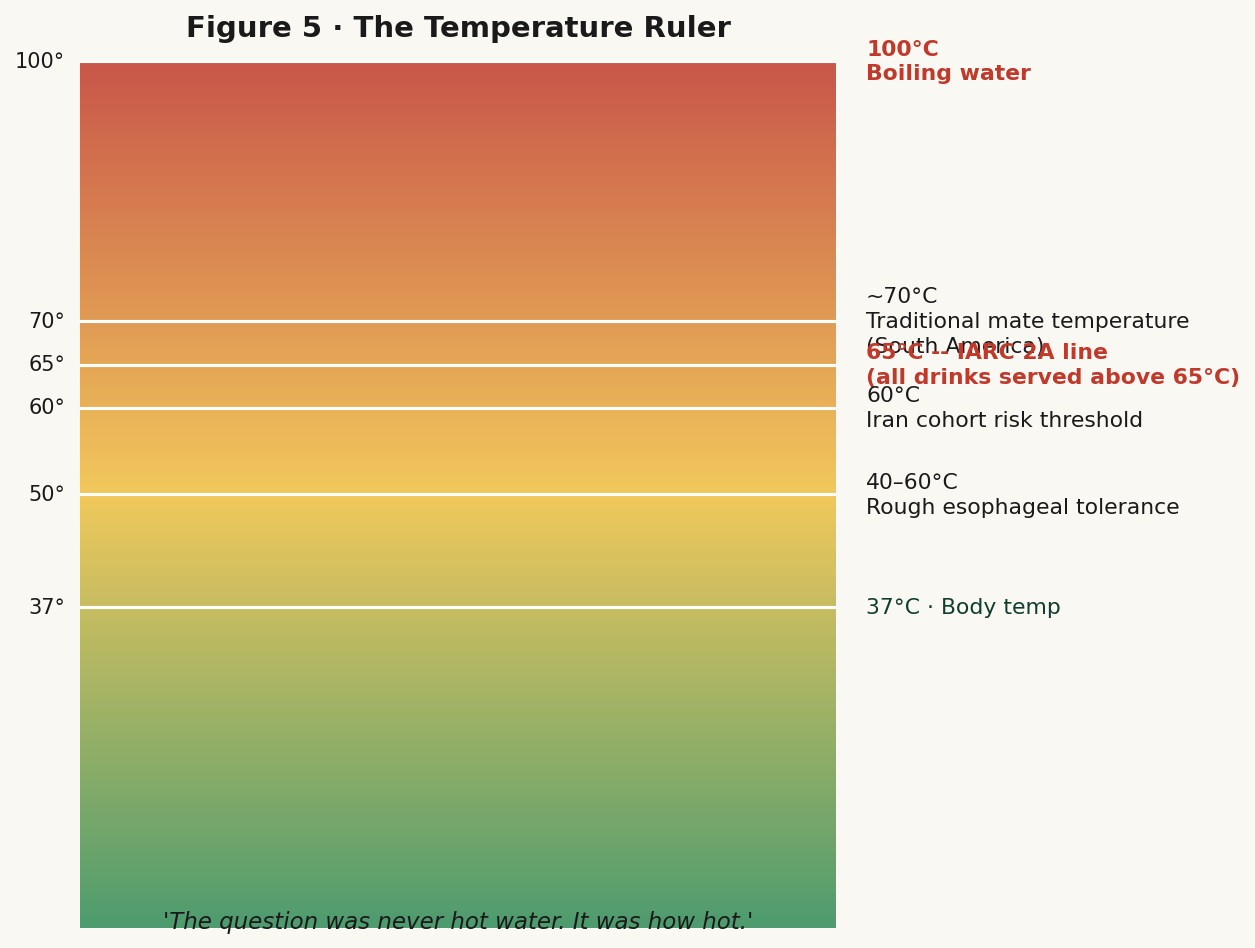
Here's the reversal. On June 15, 2016, the IARC confirmed: drinking any beverage hotter than 65°C is classified Group 2A (probably carcinogenic to humans) — the full assessment is IARC Monographs Volume 116. It's based on studies from regions where very hot drinks are habitual — South America (maté traditionally drunk above 70°C), China, Iran, Turkey: the hotter the drink, the higher the esophageal cancer risk.
Mind the wording: it's the drinking temperature above 65°C that's classified 2A, not "hot water is a carcinogen." 2A grades strength of evidence, not degree of danger; the IARC itself says "the proportion of esophageal cancer attributable to hot drinks is currently unknown."
The numbers: a 2015 *BMC Cancer* meta-analysis (39 case-control studies, 42,000 people) found a pooled OR of 1.77 for esophageal cancer among habitual very-hot drink/food consumers; OR 2.06 in Asian populations, 0.95 in European ones (not statistically significant) — the authors' own explanation: Europeans add cold milk to their tea, so it doesn't go down that hot. The footnote is itself cultural.
A 2019 prospective cohort in Golestan, Iran: habitual tea drinking at ≥60°C raised the risk of esophageal squamous cell carcinoma. But the researchers and Cancer Research UK both stress: a few accidental scalds to the mouth are nothing to worry about; the risk comes from a "long-term, repeated, scalding" habit. And relative risk is not absolute risk.
The cases are real: a Mr. Wang in Wuhan, a longtime lover of piping-hot food, went to the hospital with difficulty swallowing and was found to have severe esophagitis with atypical hyperplasia — a precancerous lesion. An elderly couple in Wenzhou ate every meal scalding hot; both were diagnosed with esophageal cancer. Their doctor's advice was plain: "Stop eating it steaming. Wait a bit, blow on it, eat it warm."
"Cold": a 19-billion-yuan business
Warning about "too hot" delivered — now the other side of the coin: when "drink more hot water" stops being a caring sentence and becomes a business.
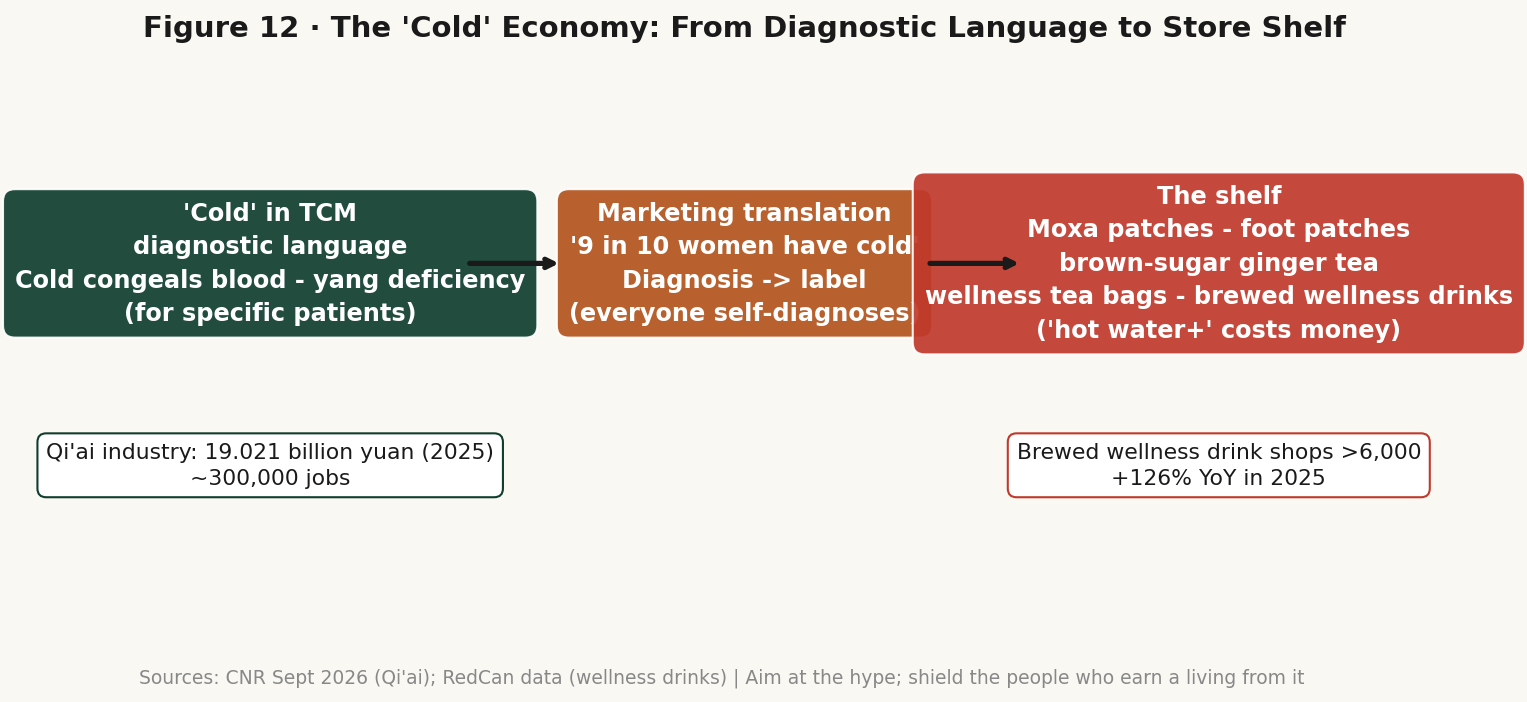
The four words "drink more hot water" are free, but "drink more hot water+" costs money. Open any livestream and behind the patter — "nine out of ten women have cold in them," "all illness comes from cold" — stands a row of shelves: moxibustion patches, foot patches, brown-sugar ginger tea, dampness-dispelling tea bags, freshly made wellness drinks. Hot water is this industry's cheapest entry point — first convince you that "everyone has cold," then sell you the cure.
A key distinction is mandatory here. "Cold" in Chinese medicine is genuine diagnostic language: cold congealing the blood, insufficient yang — it describes constitution differentiation, aimed at specific people. But the merchants' trick is elegant: swap "differentiation" (not everyone has cold) for "label" (everyone self-diagnoses cold). *Gong han* — "womb cold" — is a real term in TCM gynecology, describing a cluster of symptoms; in the livestream room it becomes an identity tag that "every girl has."
How big is this industry? Look at mugwort. Qichun in Hubei, "China's mugwort capital": per a September 2026 on-the-ground report by CNR (China National Radio), the Qichun mugwort industry was worth 19.021 billion yuan across the full chain in 2025, planted on over 200,000 mu (about 13,300 hectares), employing nearly 300,000 people. The *Compendium of Materia Medica* devotes all of 24 characters to Qichun mugwort. Those 24 characters have grown into a 19-billion-yuan industry.
And "wellness tea drinks" are the "cold economy's" fresh-made version: per RedCan food-service data, China had over 6,000 freshly made wellness-drink outlets in 2025, up 126% year on year. Bubble-tea shops sell "happy water"; wellness-drink shops sell "reassuring water" — and here the line from the core chapter comes true: what people buy is often not knowledge, but reassurance.
The blade must point at the patter that "generalizes differentiation into everyone-being-ill and turns anxiety into shelf space." But the guard must protect another group: Li Guoqing, the Qichun mugwort farmer (per the CNR report) — disabled, supporting two generations of his family on mugwort, farming over 800 mu. The "cold economy" holds more than anxiety-harvesters; it holds 300,000 people making a living. Condemning a business is easy; the hard part is not wounding the people who live off it.
To be explicit about this section's target: it is the rhetoric that turns "cold" into everyone-being-ill and anxiety into shelf space — not mugwort itself, and certainly not the 300,000 people making a living from it. The blade points at the rhetoric; the guard protects the people. That is this piece's rule, not this section's exception.
Hot water itself is free, but "hot water+" costs money — from a 9.9-yuan foot patch to a 19-billion-yuan mugwort industry, "cold" is good business. As for how much of that business is efficacy and how much is placebo, the drinker holds the scales — theirs to set.
Why "drink more hot water" always makes people angry
Back to the classic scene. Late at night, a girl curled up in bed with period cramps, her boyfriend gaming in the living room, not looking up: "Drink more hot water." A pillow flies — what's being hit isn't the four words, it's "you won't even look at me."
What enrages people about "drink more hot water" was never the water — it's "using correct nonsense to dodge real listening."
Two sociology concepts help make sense of it — borrowed, note, not proven.
The first comes from Georgetown linguist Deborah Tannen. In *You Just Don't Understand* (1990), she proposed that men's talk tends toward report talk (transmitting information, solving problems) while women's talk tends toward rapport talk (building connection, confirming the relationship). "Drink more hot water" is textbook report talk — it genuinely is "solving the problem," but it completely misses the rapport she wanted: she didn't want a solution, she wanted "you care how I feel." Wrong channel — and the louder it gets, the more it's noise.
The second comes from sociologist Arlie Hochschild's "emotional labor." When a girl says "my stomach hurts," she's expecting emotional labor — the other person mobilizing empathy, comfort, company. "Drink more hot water" is emotional labor's absence: four words that end the emotional work that should have happened. The anger is essentially this: I offered vulnerability, and you refused delivery.
But the warmth has to face both ways. Tannen stresses that neither style is better — it's difference, not defect. Many men who say "drink more hot water" genuinely don't know what else to say — an upbringing of "boys don't cry" stripped them of emotional vocabulary; they clumsily hand over four words, which get confiscated as perfunctory. Mocking "straight guys" is easy; the hard part is seeing the good will behind the clumsiness.
Then there's the generational version. A father texts his overtime-working daughter on WeChat, always the same four words: "Drink more hot water." In her twenties she found it perfunctory; in her thirties, after her father fell ill, she scrolled back through their chat history and realized — over those four years, he'd sent those four words on every one of her late work nights, never missing a day. He couldn't say "I'm worried about you living alone, worried you'll work yourself to death." All he had was "drink more hot water." That was his entire vocabulary.
So next time he says "drink more hot water," maybe you can hear the sentence that went unsaid: "I'm worried about you."
The world hot-water map: the whole world drinks hot water
"Only Chinese people drink hot water" is an illusion. Zoom out, and the "hot-water gang" is global — it's just that no cup of hot water got hot because "science proved it."
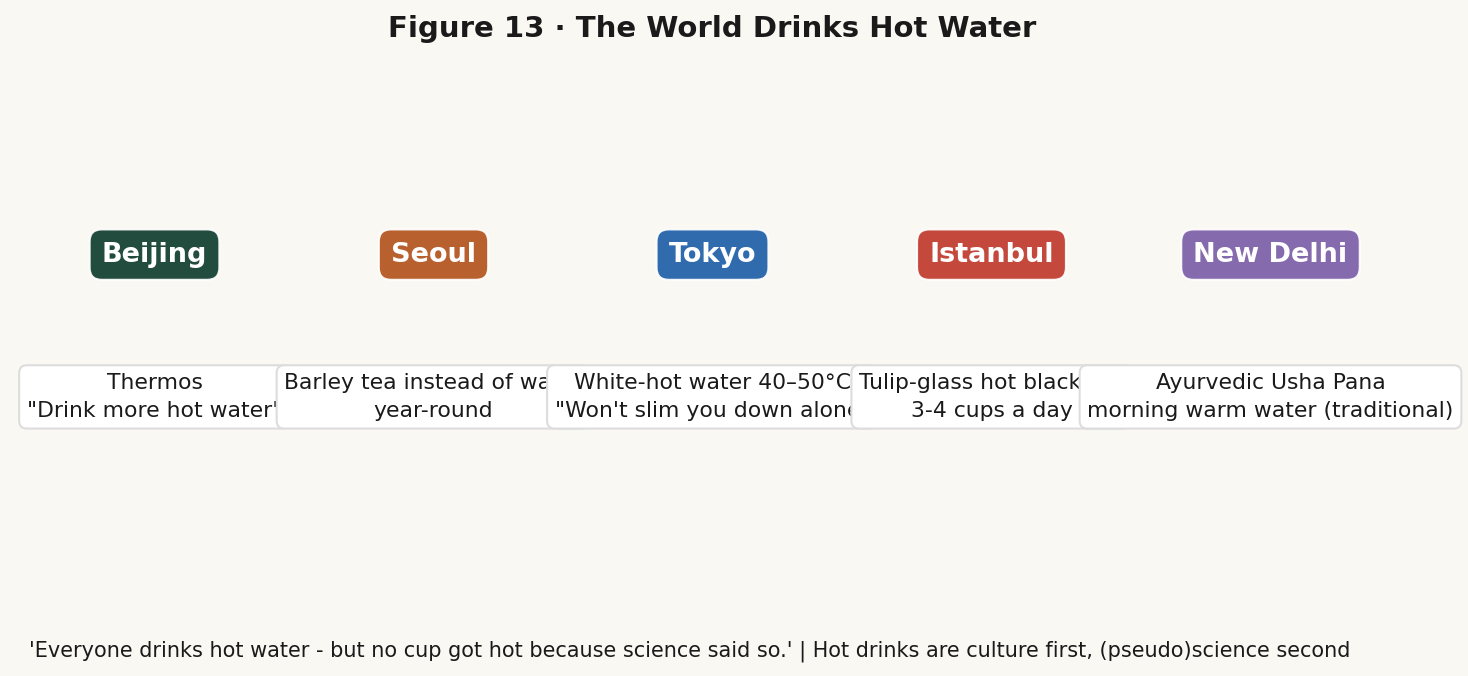
Japan drinks *sayu* — white-hot water: boil it, then let it cool to 40–50°C. A Japanese health-insurance union pamphlet says sayu has "been drunk for health since ancient times in Japan, India, China, and Europe." But doctors in the same country are honest too: losing weight on sayu alone is "basically hopeless"; for people with high blood pressure, gulping down scalding sayu first thing in the morning may burden the blood vessels instead. Even doctors in the "hot-water superpower" say it: the problem was never the hot water — it's the temperature and the way you drink it. Same logic as the IARC's 65°C red line.
Koreans drink barley tea instead of water all year round. Chinese drink "boiled water"; Koreans add a handful of barley to the boiled water — "hot-water worship" and "barley-tea freedom" are two banks of the same river.
India has Ayurveda's morning warm-water ritual, Usha Pana, which claims warm water "clears toxins." But that's traditional medicine's claim; modern evidence is thin — a distant cousin of China's "hot water cures everything."
Turkey is the world's number-one "hot-tea nation": the world's highest per-capita tea consumption, three or four cups a day, up to ten in winter. On the streets of Istanbul at forty degrees, people still drink scalding red tea. A tourist asks: "This hot out — why not something iced?" The tea vendor shrugs: "Grandpa drank it this way." Hot drinks are culture first, (pseudo)science second.
From Beijing's thermos to Seoul's barley-tea kettle to Istanbul's tulip glass — the whole world drinks hot water, but for different reasons: no running water, coffee too expensive, religious ritual, simply tastes good. Not one of those reasons is "modern medicine proved hot water is healthy." And Westerners' ice water, as covered earlier, is Tudor's ice-peddling conditioning. Both sides are culture; neither is a scientific conclusion — a rare symmetry.
The thermos: middle-aged armor
In 2017, a photo of Black Panther drummer Zhao Mingyi holding a thermos went viral. "Middle age gives you no choice: goji berries in the thermos" became the catchphrase of the year. That year, countless middle-aged people discovered for the first time that they and a rock star had picked up the same cup.
The thermos completed an identity shift. Halma — China's cup-and-flask leader, with 2024 revenue of 3.332 billion yuan, up 38.4% — wrote in its annual report that cups and flasks "are no longer mere traditional durables, but are gradually becoming fast-moving consumer goods, fashion items, symbols of a lifestyle." What you buy isn't a cup — it's the reassurance of "I'm still fine" and the label of "I'm still cool." A man in his early forties, three health-check markers in the red, swapped his five-year-old 2-liter water jug for a thermos, rotating goji berries, chrysanthemum, and cassia seeds. The cup cost just over a hundred yuan — the most expensive piece of "armor" middle age ever bought him.
But the debunking blade has to point at oneself in the end, too. The Beijing Consumers Association once spot-tested about 50 thermoses; 19 failed for excess heavy metals — mostly industrial-grade 201 stainless passed off as food-grade 304. In 2021, a woman in Sichuan had her goji-berry thermos suddenly explode, blasting a hole in her ceiling: dissolved sugars fermented, microbes produced gas, pressure built in the sealed cup. The middle-aged people who cherish their health most may be drinking "wellness water" from a "poison cup."
Keep the proportions straight: these are low-probability events, not a "thermoses are toxic" scare piece. The correct posture: look for the 304/SUS304 stamp, replace regularly, and don't use a thermos as a fermentation jar — don't leave goji water overnight.
What steeps in the thermos was never goji berries. It's "I'm still in time."
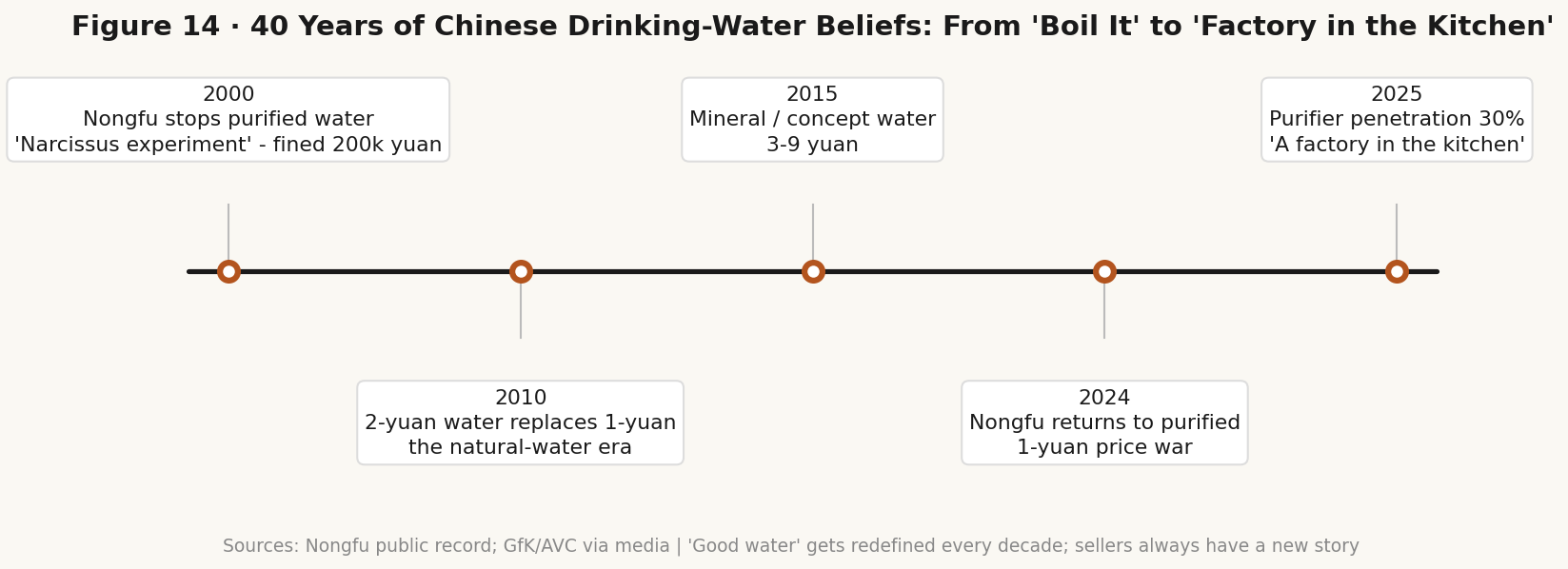
From "drink boiled water" to "drink purified water": forty years of changing Chinese water habits
The "hot-water worship" is a product of public-health history, as covered. But the story has a second half: after 2000, the Chinese definition of "good water" changed every decade.
On April 24, 2000, Nongfu Spring announced it would stop producing purified water and switch entirely to natural water — and staged its "daffodil experiment": daffodils watered with purified water grew slowly, supposedly proving "purified water does people no good." Wahaha, Robust, and 67 other companies issued a joint statement calling it pseudoscientific marketing; Nongfu Spring was ultimately fined 200,000 yuan. The loudest voice is never the most rigorous — that pattern played out once already, in 2000.
Twenty-four years later the boomerang came back: in 2024, Nongfu Spring relaunched purified water (the green bottle) and started a 1-yuan price war; meanwhile Zhong Shanshan said in public: "I still don't want people drinking the green-bottle purified water." The same man, selling it with one hand and advising against it with the other. That's not science. That's business. (Whether long-term purified-water drinking is harmful is itself contested in academia — no side taken here, just the contrast.)
A one-line history of change: from "drink boiled water" (kill germs) → "drink purified water" (clean) → "drink natural/mineral water" (has minerals) → "drink filter-purified water" (decide for yourself). Per GfK data, China's household water-purifier market was worth about 32 billion yuan in 2024, with cumulative sales over 120 million units and penetration rising from 20% to 30%. In forty years, China went from "boil the water" to "move the factory into the kitchen."
Three generations' "good water": grandpa boiled water in an aluminum kettle — "never keep boiled water overnight"; dad bought the first water dispenser after SARS in 2003 — "cleaner than boiled water"; son spent 6,000 yuan on an RO reverse-osmosis system in a 2024 renovation — "TDS 12, cleaner than Nongfu." Nobody convinced anybody. But every Spring Festival, the son still drinks the pot grandpa boiled — because grandpa boiled it.
Technology moved on; anxiety didn't. The father who spent 6,000 yuan on a purifier still boils the filtered water every morning. Machines filter the water; boiling settles the heart.
Coda: four words, four years
The father's story in the "why it makes people angry" section was only half told — after he fell ill, his daughter scrolled back through four years of chat history. The other half happened after that.
The day her father left the hospital, his daughter replied with more than four words for the first time: "Dad, I looked it up — hot water doesn't need to be scalding. Let it cool a bit, it's better for your esophagus. You and Mom, let your tea cool before drinking too."
Her father replied with two words: "OK."
Still not more than four words. But this time, his daughter understood — that wasn't perfunctory. It was the hardest-working sentence in his entire vocabulary: "I'm worried about you."
So let's translate "drink more hot water": "I looked it up — warm is fine, something hot does feel better when you're sick — but don't drink it scalding; above 65°C hurts the esophagus." Water is the substance; temperature is nostalgia. Once caring takes the shape of evidence, it stops being perfunctory.
Chapter 4: Artisanal-Pressed Oil — My Uncle's Two Barrels, and the Invisible Aflatoxin
Back home there's a second uncle who presses two barrels of peanut oil a year and drives hundreds of kilometers to deliver them to the city. "Pressed it myself — fragrant! No additives!" he says, face glowing with pride as he hauls the barrels into the elevator.
What he's fighting isn't science. It's fear. And fear has a history.
How trust collapsed
In 2010, a team led by Professor He Dongping at the Wuhan Institute of Technology published a survey: of the roughly 22.5 million tons of cooking oil China consumed each year, 2 to 3 million tons might be gutter oil. The headline "nearly one in ten cooking oils contains carcinogens" exploded across the country.
Then came the official hammer: in September 2011, police cracked a gutter-oil case spanning 14 provinces — 32 detained, about 100 tons seized; in March 2012, a Zhejiang case netted over 100 arrests, 3,200 tons seized, 13 black workshops busted; in January 2012, the Supreme Court, Supreme Procuratorate, and Ministry of Public Security jointly classified "producing cooking oil from gutter oil" under Article 144 of the Criminal Law — producing and selling toxic, harmful food; in 2013, a Lianyungang court sentenced 20 people, from seven years to life imprisonment.
One line sums it up: the authorities crushed real cases, and the public grew real panic. Ever since, "invisible industrial processes" have meant "untrustworthy" in many minds, while "a workshop you can see" means "safe." My uncle's two barrels grew out of those ruins of trust.
Writing this far, I have to admit my bias: of the whole piece, this is the chapter I least dared to write — afraid the blade would slip and wound not the workshop, but my uncle.
The invisible aflatoxin
But "visible" doesn't mean "safer." Aflatoxin is invisible too.
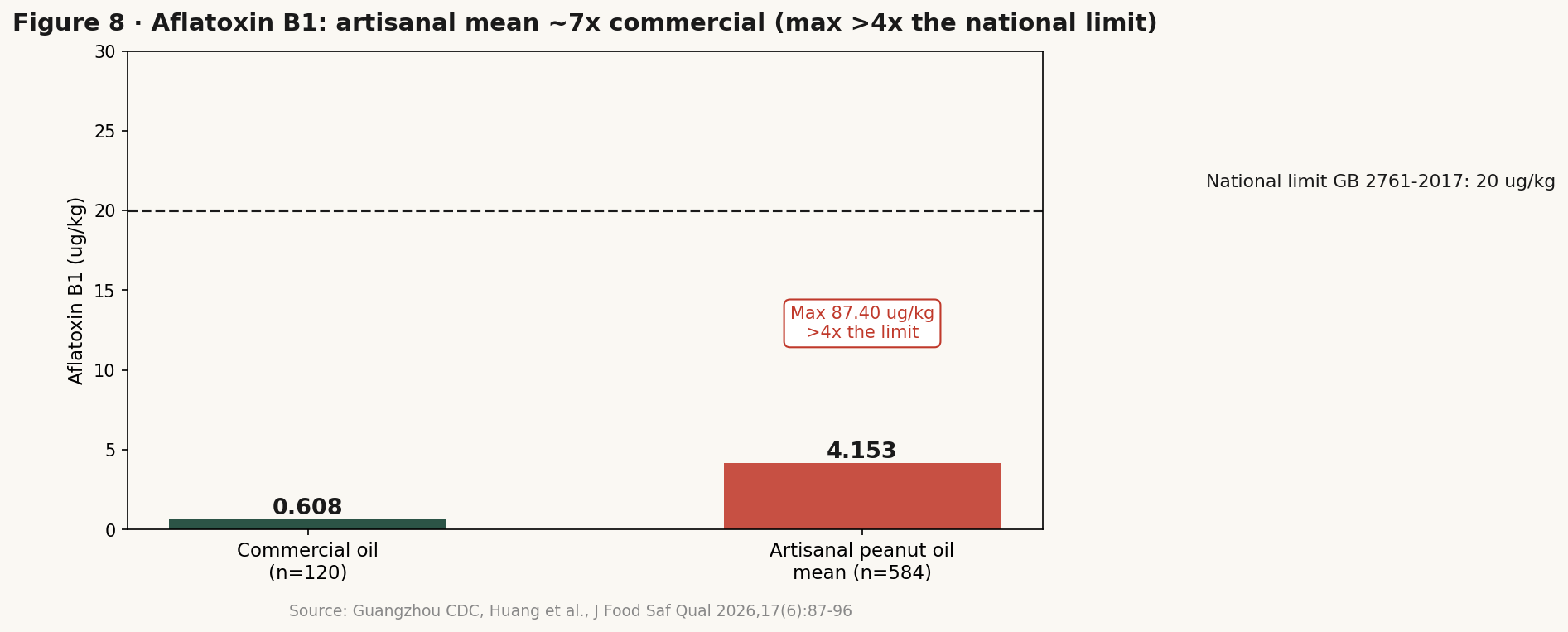
In March 2026, the Guangzhou CDC published a peer-reviewed study in the *Journal of Food Safety and Quality*: 584 samples of artisanal-pressed peanut oil tested averaged 4.153 μg/kg of aflatoxin B1, maxing out at 87.40 μg/kg; 120 samples of commercial vegetable oil averaged just 0.608 μg/kg. The artisanal oil ran about 7 times higher. Residents in high-consumption areas showed significantly higher serum AFB1-albumin adducts — adducts being biomarkers of toxin exposure, suggesting the risk may have moved beyond the oil and into people. But to be clear: elevated adducts mean higher exposure, not "already poisoned" — it's a signal to heed, not a diagnosis.
Aflatoxin B1 is an IARC Group 1 carcinogen (confirmed carcinogenic to humans), targeting mainly the liver. China's GB 2761-2017 caps it at 20 μg/kg in peanut oil; the EU caps it at 2 μg/kg for peanuts eaten directly. I'll stop here, without expanding — standard-setting also involves total dietary exposure and other factors, so "ten times looser" doesn't directly equal "unsafe." But it reminds us: this line is real.
The paper's own words are worth reading: "Artisanal peanut oil production relies mainly on manual labor or simple machinery, and lacking a refining step, it is more vulnerable to mycotoxin contamination." The problem isn't the "artisanal method" — it's two specific links: raw material (moldy peanuts) and quality control (no refining, no testing).
What does refining actually refine away?
Modern refining has four steps: degumming (removing phospholipids and other impurities), deacidification (removing free fatty acids), decolorization (removing pigments), deodorization (steam distillation at 220–250°C to strip odors). What you gain: better color, flavor, and stability — and significantly lower levels of nasties like aflatoxin; what you lose: some fat-soluble vitamins, carotenes, natural antioxidants.
And "solvent-extracted oil is toxic" is another common misunderstanding. The food-grade extraction solvent (mostly n-hexane) doesn't react chemically with the oil and is driven off in the subsequent evaporation, stripping, and refining. GB 2716-2018 caps solvent residue at ≤20 mg/kg for edible vegetable oils (the 1988 version allowed 50 mg/kg); pressed oils must test "not detected." Liu Shaowei, an expert with the Shanghai Food Safety Association, put it plainly: "Any finished edible vegetable oil produced to national standards and meeting them is safe. The idea that solvent-extracted vegetable oil is unsafe to eat simply doesn't hold."
But honestly: don't write "zero residue." A national cap of 20 mg/kg is itself proof that trace residue is the norm. Judgment always needs that kind of restraint.
| Artisanal-pressed oil | Refined oil | |
|---|---|---|
| Process | Sorting → roasting → pressing → settling/filtering → bottling | Degumming → deacidification → decolorization → deodorization |
| Removes | —— (no refining step) | Phospholipids, free fatty acids, pigments, odors, aflatoxins, etc. |
| Loses | —— | Some fat-soluble vitamins, carotenes, natural antioxidants |
| Risk points | Moldy raw material, aflatoxin, no testing | Trace solvent residue (national cap ≤20 mg/kg) |
| Smoke point | Low (more impurities, smokes earlier) | High |
Trust is no substitute for quality control
In 2025, the Binyang County market regulator in Guangxi issued a fine: the offender, "Huang Ji Old-Brand Oil Workshop," held a business license and a small-workshop food registration — not a black workshop, but a legally registered "old-brand oil press" the whole neighborhood trusted. Its physically pressed peanut oil tested at a peroxide value of 0.60 g/100g against a national cap of ≤0.25 — 2.4 times over. Of that 20-kg batch, 17 kg had already been sold; after the recall notice went up, not a single bottle came back.
That's the case's sharpest edge: "old-brand," "legal," "trusted by the neighbors" — all four labels, and it still failed. And when artisanal oil goes wrong, there's no brand recall system to catch it — what goes into the stomach stays in the stomach.
Three lines that must hold
Three boundaries, stated up front:
- "Artisanal-pressed oil = poison" is wrong, and so is "artisanal-pressed oil = safe." Good raw material (fresh, mold-free peanuts) plus a proper process can pass. The risk sits in raw material and quality control — not in the "artisanal method" itself.
- The cooking-fume/lung-cancer meta-analysis (RR=1.74) covers "Chinese cooking fumes" as a whole, not "artisanal-oil fumes." The writable chain stops at "lower smoke point → smokes earlier → possibly more fume exposure" — beyond that is speculation.
- The blade points at "unregulated workshop production"; the guard protects "my uncle's good intentions."
Making the good intentions safer
So this chapter shouldn't end with "don't eat your uncle's oil" — that would wound. It should end with: teach him to pick good raw material (fresh, mold-free peanuts; moldy ones go straight in the bin), remind him about storage (dark, sealed, eat it soon), and if possible, get it tested once.
It's not about negating the workshop — it's about making his good intentions safer. What my uncle delivers isn't oil. It's "this is what I can do for you." What we need is to make that "I can" truly able.
This autumn, my uncle delivered oil again. Taped to the barrel was a note in big characters: "Peanuts are this year's harvest, sun-dried three full days. Pour some out and sniff it often — if it smells rancid, don't eat it." He still doesn't trust those "invisible processes." But he's started trusting the note — the good intentions haven't changed; they've learned to protect themselves.
My uncle's two barrels and my mother's "drink more hot water" are the same love — one delivered to the door, one spoken aloud. Four stories told: native eggs, sweeteners, hot water, artisanal oil — each one "an assertion plus for-your-own-good packaging." And the hot-water chapter got the finest dissection — because those four words deserve it.
Chapter 5: The Core — An Inverted Pyramid of Certainty
In a community clinic, a woman asks the doctor: "Doctor, just tell me — can I eat eggs or not? The yolk — yes or no?" The doctor says: "It depends. Your lipids are high, so..." She stops listening, walks out disappointed. That afternoon, she orders a "detox beauty package" in her Moments feed, because the seller says: "Guaranteed to work. Money back if it doesn't."
"It depends" lost to "guaranteed." That's not her fault — what she wanted wasn't the truth. It was reassurance. And "swearing by it" is this era's best-selling reassurance.
Why nutrition science keeps "reversing itself"
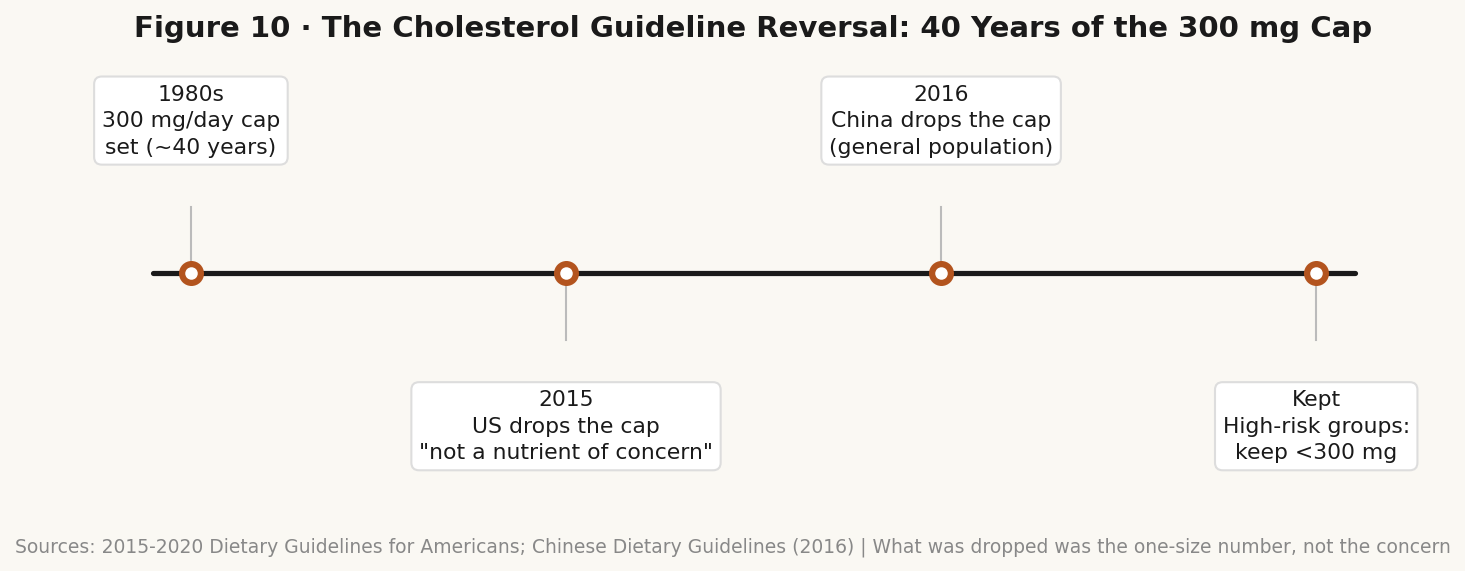
A word for the scientists first. In 2015, the U.S. released new dietary guidelines, dropping the roughly 40-year-old 300 mg/day cap on dietary cholesterol (about 1.5 eggs' worth). The advisory committee's original words: "Cholesterol is not a nutrient of concern for overconsumption." In 2016, China's *Dietary Guidelines* followed — no 300 mg cap for the general population — though the 300 mg advice stayed for high-cardiovascular-risk groups.
Note the qualifier that usually gets dropped: the 2015 U.S. guidelines also said scrapping the number "doesn't mean dietary cholesterol no longer matters" — still "as little as possible." What was scrapped was "a one-size-fits-all number," not "stop caring."
"Yesterday they said egg cholesterol was bad, today they say it's fine" — the public's confusion is real. But its root isn't scientists "flip-flopping." It's that nutrition science is brutally hard:
- You can't lock people up and feed them for 20 years. Cardiovascular disease and cancer incubate over decades; long-term randomized trials are nearly impossible, ethically and financially — so we lean on observational studies.
- What people ate can't be measured cleanly. Food-frequency questionnaires run on memory — "how many eggs did you eat last week" is astonishingly noisy data; and "people who eat eggs" versus "people who don't" already differ across dozens of dimensions — income, exercise, smoking — that confounders can't fully scrub out.
- Reverse causation is everywhere. Is it "people who drink zero-sugar cola are fatter," or "fatter people prefer zero-sugar cola"? (We met this one in the sweetener chapter.)
Stanford's John Ioannidis — author of "Why Most Published Research Findings Are False" — wrote in the *BMJ* in 2013: "Definitive solutions won't come from another million observational papers." One review found that observational claims validated in later randomized trials succeeded at a rate of 0 out of 52.
His prescription isn't "don't trust science" — it's "concentrate the money on fewer, better-designed trials." He's criticizing the method and demanding better research — which must never be read as anti-science.
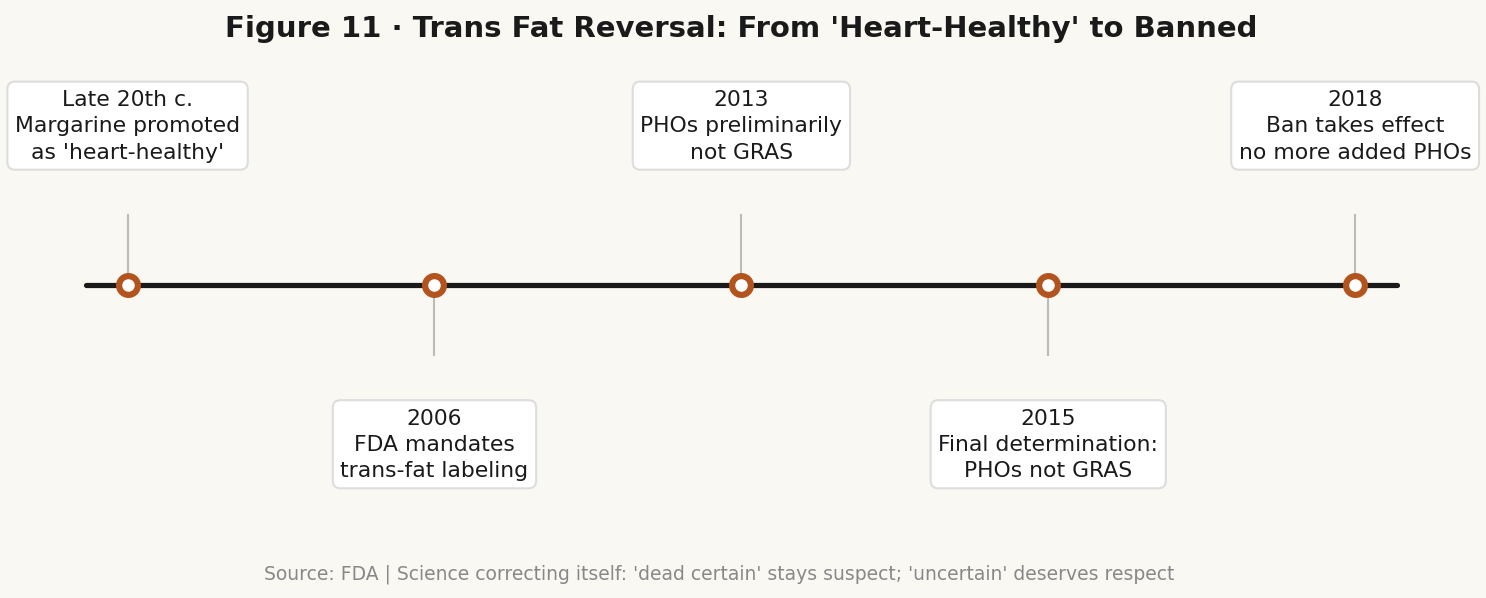
The margarine story is the perfect footnote for "science correcting itself": for much of the 20th century it was promoted as the "heart-healthy" butter substitute (no cholesterol, from vegetable oil); then the trans-fat danger became clear, and the FDA mandated labeling in 2006, preliminarily determined in 2013 that partially hydrogenated oils were no longer "generally recognized as safe," finalized it in 2015, and the ban took effect in 2018. What was recommended yesterday is banned today — not proof that "scientists are useless," but proof the correction mechanism works. It's exactly this mechanism that makes "swearing by it" forever suspect, and "uncertain" worth respecting.
The inverted pyramid: one more layer down, one more degree of certainty
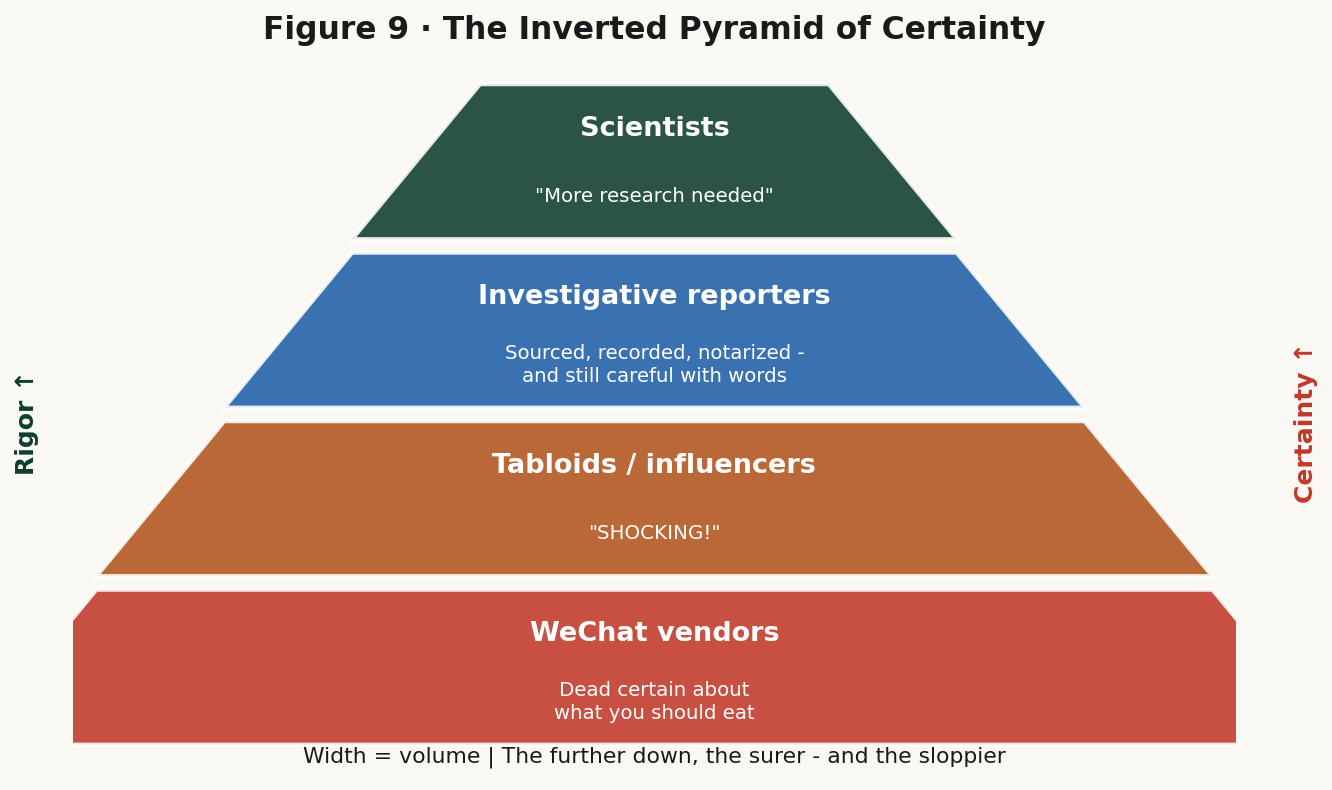
Now pull the camera back to the whole chain. We'll string it on "hot water" — the same cup of hot water looks different on every level:
The tip (narrowest): scientists — "More research is needed." The IARC wrote "drinking temperatures above 65°C," worded so precisely lest you misread it as "hot water causes cancer." Honest scientists know that concluding lightly is irresponsible.
Second layer: top investigative journalists — "Evidence, recordings, notarized — and the wording stays cautious anyway." On December 25, 2018, DXY (Dingxiang Doctor, China's best-known medical media outlet) published "The Hundred-Billion Health Empire Quanjian, and the Chinese Families in Its Shadow," opening with the case of 4-year-old Zhou Yang: malignant sacrococcygeal germ-cell tumor, her markers back to normal after 4 surgeries and 23 rounds of chemo; her father, trusting Quanjian's marketing, stopped the chemo — relapse and metastasis two months later; Quanjian then used Zhou Yang's photo to fabricate "cured" promotions. DXY's statement: "Every word of the article is true. Everything is backed by evidence, recordings, or written materials — we even had it notarized. This isn't one-sided sourcing." Quanjian demanded a retraction; DXY's reply: "We won't delete. We stand behind every word. Sue us." On January 8, 2020, Shu Yuhui was sentenced to 9 years, fined 50 million yuan.
Caution isn't guilt — it's professional duty. One false accusation can destroy an ordinary person or a business, so journalists have to tread carefully.
Third layer: self-media, evening papers — "SHOCKING! Hot water causes cancer?!" Qualifiers start falling off here; certainty starts inflating.
The base (widest): the Moments-feed seller — "Drink more hot water, cures everything." Here hot water turns from a caring sentence into a business. Certainty peaks here; rigor hits the floor.
One layer down, certainty up a notch, rigor down a notch. The same cup of hot water: at the tip it's "65°C," at the base it's "cures everything" — that is the inverted pyramid of certainty.
The people on the chain are people too
On the subject of sellers, we need to pause and look at one person.
A former agent's account: she joined a micro-brand in 2016, spent 2,500 yuan on inventory to become an agent, pulled her downline into her own WeChat group — 200-plus people at peak. She asked her upline: "How do those people actually make hundreds of thousands a month?" Her upline asked how many people were in her group, and stopped talking about money. She'd once thought "the big brothers and sisters leading everyone to riches — how wonderful."
She is this inverted pyramid's living specimen: first absorbed by the upstream's "certainty" patter, then passing that patter downstream. She's one link in the chain — and an ordinary person trying to earn a living, a mother. Writing about her, the ones who should be nailed down are the people who designed the patter — the ones who knew "cures everything" was a lie and printed it on posters anyway.
And Zhou Yang's father. A father who, when the legitimate treatment faltered, grasped at straws in desperation. He's not "stupid" — he's a father with nowhere left to turn. The blade points at Quanjian; the guard must protect ordinary people like him.
The warm core: what people buy isn't knowledge — it's reassurance
The warmest line of this section can be said now:
What people forward, buy, and believe in is often not knowledge — it's reassurance. In a world full of uncertainty, "tell me what to eat" is itself a placebo. Understanding that, you stop laughing at the forwarders — a mother forwarding "sweeteners cause cancer" and a patient demanding a straight answer in the clinic are the same longing: don't leave me hanging; tell me how to be safe.
So an honest "I don't know" is the gentlest protection science can offer. It holds your "don't get scammed" baseline — what's uncertain is honest; what's sworn by is usually business.
And judgment's combat form is now complete: the more sworn-by a nutrition claim, the more it deserves a raised eyebrow; the more it says "uncertain, it depends," the more it deserves a hearing. Treat "swearing by it" itself as a signal — the single most important judgment tool this piece can teach.
Back to the woman in the clinic. If the doctor could add one more sentence: "Sister, one yolk a day is fine for you; what you really want to cut back on is the deep-fried stuff. That 'guaranteed' package — let me look at the ingredients with you before you decide?" — see, a doctor can become her new "source of certainty" too. Only this certainty is an honest one.
She never mentioned the package again. At her follow-up, she asked the doctor: "So one yolk a day — that's fine, right?" The doctor said: "Right." — She never wanted a standard answer. She wanted someone to take her seriously.
That's what we're trying to do: not laugh at people who need reassurance, but give them more honest reassurance.
Epilogue: The Forwarding, Reversed
A few days ago, Mom forwarded another one: "SWEETENERS CAUSE CANCER — forward to your family."
Her daughter didn't reply "Mom, you're wrong," and didn't fire back a science link. She held down the voice-message button and talked for sixty seconds — a little rambling, stumbling once midway: "Mom, that's the weakest-evidence tier of 'possibly carcinogenic.' The few cans of zero-sugar cola at home are fine to drink normally. Don't worry."
Mom replied with a "got it" sticker.
No "thanks for the science lesson, sweetie." No "Mom won't forward anymore." But after that, before forwarding a link, Mom started adding one line: "Sweetie, can you check whether this is true?"
And just like that, the forwarding reversed — it used to be Mom forwarding anxiety to her; now it's her handing verified reassurance back to Mom, one sentence at a time. Imperfect, stumbling, rambling — but that's what real people sound like.
My uncle's oil, the grandmother's eggs, the father's four words — every one of them has an afterword now.
Back to the thesis, in three words: love · knowledge · judgment. Love is the engine — it gets you moving; without it, nothing starts. Knowledge is the map — it shows you the road; without it, devotion takes wrong turns. Judgment is the steering wheel — it turns at the fork.
Ignorant love isn't not-love. It's love that hasn't yet learned to protect the people it wants to protect. And we wrote this piece not to prove "Mom was wrong," but so that "Mom's love" arrives safely — and the way it arrives may not be a standard answer. It may just be a conversation where you're willing to say a few more sentences, stumbles and all.
◆
References
References
- Anderson KE. Comparison of Fatty Acid, Cholesterol, and Vitamin A and E Composition in Eggs from Hens Housed in Conventional Cage and Range Production Facilities. *Poultry Science*, 2011;90:1600–1608. DOI:10.3382/ps.2010-01289
- WHO. Aspartame hazard and risk assessment results released. 2023-07-14. (IARC Group 2B + JECFA ADI 0–40 mg/kg bw unchanged)
- WHO. WHO advises not to use non-sugar sweeteners for weight control in newly released guideline. 2023-05-15.
- Witkowski M, et al. The artificial sweetener erythritol and cardiovascular event risk. *Nature Medicine*, 2023;29:710–718. DOI:10.1038/s41591-023-02223-9
- Witkowski M, et al. Xylitol is prothrombotic and associated with cardiovascular risk. *European Heart Journal*, 2024. DOI:10.1093/eurheartj/ehae244
- IARC Monographs Vol.116: Drinking Coffee, Maté, and Very Hot Beverages. Press Release No.244, 2016-06-15. (Beverages above 65°C classified Group 2A)
- Chen Y, et al. Consumption of hot beverages and foods and the risk of esophageal cancer: a meta-analysis of observational studies. *BMC Cancer*, 2015.
- Sanu A, Eccles R. The effects of a hot drink on nasal airflow and symptoms of common cold and flu. *Rhinology*, 2008;46:271–275.
- Huang Lili, et al. Risk assessment of aflatoxin B1 exposure among residents in different consumption areas of artisanal-pressed peanut oil in Guangzhou, 2022–2024. *Journal of Food Safety and Quality*, 2026;17(6):87–96. DOI:10.19812/j.cnki.jfsq11-5956/ts.20251103004 (in Chinese)
- GB 2716-2018, National Food Safety Standard: Vegetable Oils (solvent residue ≤20 mg/kg; peroxide value ≤0.25 g/100g) (in Chinese)
- GB 2761-2017, National Food Safety Standard: Maximum Levels of Mycotoxins in Foods (aflatoxin B1 in peanut oil ≤20 μg/kg) (in Chinese)
- Binyang County Market Regulation Bureau, *Administrative Penalty Decision* Gui-Nan-Bin-Shi-Jian-Chu-Fa [2025] No. 371 (Huang Ji Old-Brand Oil Workshop peroxide-value case) (in Chinese)
- Kroll BJ, et al. Project 259: Sugars and the Heart. *PLOS Biology*, 2017. (the sugar industry's buried study)
- Dietary Guidelines Advisory Committee. Scientific Report of the 2015 Dietary Guidelines Advisory Committee. ("Cholesterol is not a nutrient of concern for overconsumption"; 2015–2020 U.S. Dietary Guidelines dropped the 300 mg/day cap)
- Chinese Nutrition Society. *Chinese Dietary Guidelines (2016)*. (no 300 mg cap for the general population; retained for high-cardiovascular-risk groups) (in Chinese)
- FDA. Final Determination Regarding Partially Hydrogenated Oils. 2015-06-16. (compliance date 2018-06-18; PHOs no longer GRAS)
- Ioannidis JPA. Implausible results in human nutrition research. *BMJ*, 2013;347:f6698.
- DXY (Dingxiang Doctor). "The Hundred-Billion Health Empire Quanjian, and the Chinese Families in Its Shadow." 2018-12-25. (in Chinese)
- Tannen D. *You Just Don't Understand: Women and Men in Conversation*. William Morrow, 1990. (report talk vs rapport talk; concepts borrowed and interpreted in the text)
- Hochschild AR. *The Managed Heart: Commercialization of Human Feeling*. University of California Press, 1983. (emotional labor; concept borrowed and interpreted in the text)
- CNR (China National Radio). "Vital China" field report from Qichun: Qichun mugwort industry worth 19.021 billion yuan across the full chain. 2026-09-17. (in Chinese)
- Halma 2024 annual report (via China Fund News): revenue 3.332 billion yuan; "cups and flasks shifting toward fast-moving consumer goods, fashion items, lifestyle symbols." (in Chinese)
- "Nongfu Spring" (Chinese Wikipedia entry): purified-water production halted 2000-04-24; 69-company joint statement; 200,000-yuan fine; purified water relaunched April 2024. (in Chinese)
- GfK (via media reports): China's 2024 household water-purifier market worth about 32 billion yuan, cumulative sales over 120 million units. (in Chinese)