 拾光
拾光 Gleanings · 002
The Price of Gold
State-run vs. market-driven sports: when topping the medal table meets the reality on the pitch
Prelude: 201 Gold Medals, and a 77–97
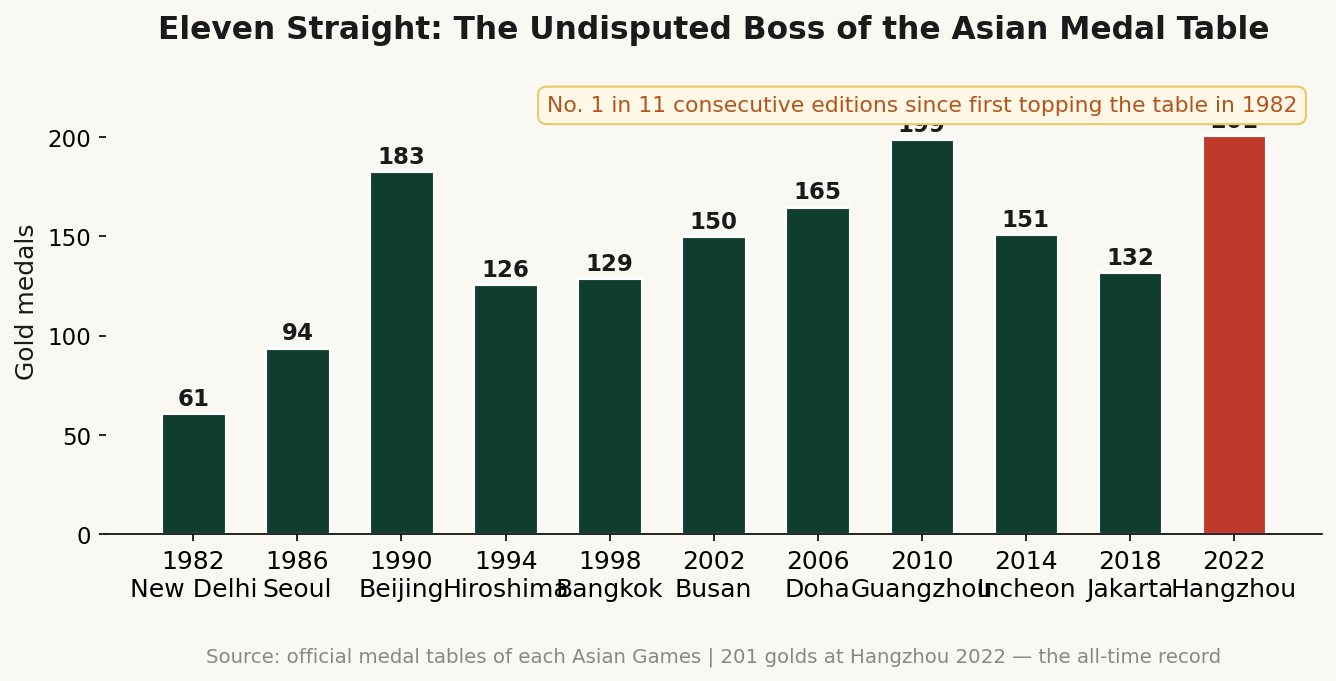
In 2023, at Hangzhou, China won 201 Asian Games gold medals — its 11th straight time atop the medal table. The undisputed boss of Asia. The best result in history.
Three years later, in Nagoya, China's men's basketball team lost 77–97 to Japan — and Japan didn't even field its starters: reserves plus college kids. A 20-point margin — the worst Asian Games defeat in team history, and the worst ever against Japan.
At the same Games, the men's football team reached the semifinals for the first time in 28 years, and the whole country partied. The reason for the party was heartbreaking: 28 years just to touch the semifinal door — and only after the tournament switched to U23.
Topping the medal table and being a sporting nation are two different things. The former is a number in a ledger; the latter is whether your kid has a court to play on after school, and whether they feel like going for a run on the weekend.
This essay answers one question: why can a country that wins 201 Asian Games golds not get football and basketball right?
I. Symptom, Not Mentor
The hotter Zhang Xuefeng gets — China's celebrity gaokao counselor, whose entire brand is telling students which majors won't ruin their lives — the clearer it becomes: ordinary people have no choice but the gaokao.
The more glorious the whole-nation system's golds, the clearer it becomes: athletes have no choice but the podium.
The medal table is not the answer. It is the symptom. A healthy sporting ecosystem doesn't need a "gold-medal strategy." Just as a healthy education system doesn't need a Zhang Xuefeng.
Wherever you need a "pit-avoidance master," that's exactly where the pits are deepest — and dug by the system itself. — Apply that sentence to sports, and you don't need to change a word.
Xu Guoqi of the Chinese University of Hong Kong tore the veil off: "The 51 golds are a product of the whole-nation system; the medal count tells you nothing about the overall level of Chinese sport. A great sporting nation is first of all a nation of physically strong citizens."
Of course, the system has its defenders. Yuan Weimin, former head of the General Administration of Sport, said the essence of the whole-nation system is "the superiority of socialism in concentrating resources to accomplish great things"; Mao Zhenming of Beijing Sport University was blunter: compared with India, whose conditions resemble ours, "without the strong leadership of the state, Chinese competitive sport could never have achieved such enormous success."
The defense has a point — but it only answers half the question. It explains where the golds come from. It never answers what they cost. This essay is here to do the accounting.
II. Money First, Sentiment Later
Talk sports systems, talk money first, sentiment later. Sentiment is free. Gold medals aren't.
China: in 2024, the General Administration of Sport spent ¥4.137 billion of lottery public-welfare funds — at the central level. Note the words "central level": local finance, the sports-school system, payroll on the establishment — all counted separately, and the total has never been disclosed. A system that won't even publish what it spends — you want to discuss return on investment with it?
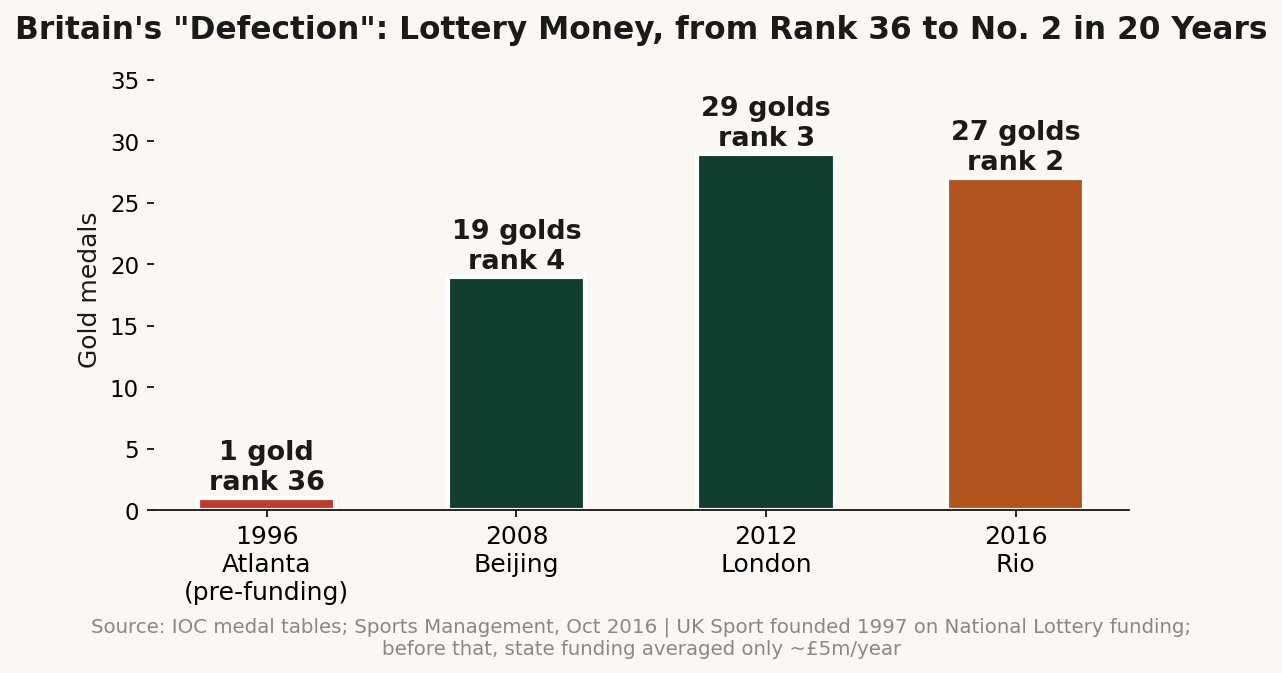
Britain: before the 1996 humiliation, the government spent about £5 million a year. After the humiliation, it switched to the lottery — UK Sport distributes money by "medal probability"; sports that can't win get nothing.
America: what the federal government spends on the Olympics is approximately zero. Seventy to eighty percent of the US Olympic Committee's revenue comes from sponsorships and media rights; another ten to twenty percent comes from donations.
Three ledgers, three worldviews: China is "the state covers everything," Britain is "the lottery players cover everything," America is "the market covers it, and the universities pick up the tab."
public-welfare funds for sport
(central level only;
total undisclosed)
for the US Olympic effort
(AP)
of 352 NCAA Division I
schools (AP)
III. Britain's "Defection"
Atlanta, 1996. Britain finished 36th with a single gold. The nation was stunned; the press called it a national humiliation.
Then the British did something "treasonous": they created UK Sport and funneled National Lottery money to sports by "medal probability" — no passengers. What is that? A whole-nation system in a suit. The goal is identical to China's; only the money comes from lottery players' pockets instead of the treasury.
Twenty years: from 36th to 2nd (Rio 2016, 27 golds). "The lottery-funded whole-nation system" — the Chinese internet's nickname. Ugly, but precise.
Britain proved one thing: the key to the whole-nation system was never "the whole nation." It was the accounting. Who gets the money, why they get it, what happens when they don't deliver — China's version of the system has never done those sums. Where our money comes from, where it goes, whether it's worth it: no published total, no exit mechanism, only more and more of the word "new" piled in front.
IV. America's Absentee Landlord
The US federal government: not one cent from me.
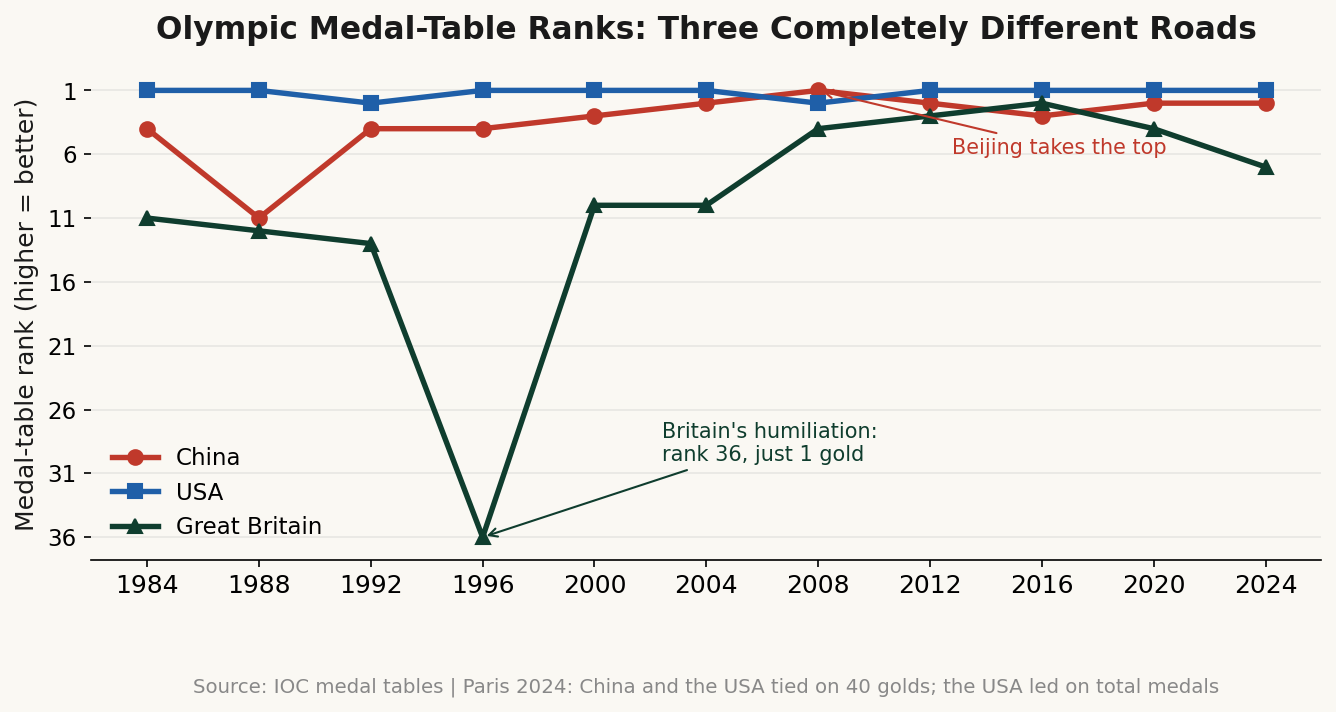
And the result? Since 1984, top of the Olympic medal table almost every time — China only beat it once, at Beijing 2008. In Paris, China and the US tied on 40 golds; America still led on total medals.
Where does the money come from? The NCAA. 352 Division I schools pull in nearly $20.5 billion a year in sports revenue, and pour over $5 billion a year into Olympic sports that lose money — cross-subsidized by football and basketball.
At Paris, 444 of America's 592 athletes had college competition experience — 75%. About three-quarters of Team USA athletes, and nearly 85% of its medalists, are current or former college athletes. Even wilder: more than 800 NCAA-background athletes competed for other countries — over a tenth of all 10,500 Olympians. American universities are training Olympians for the entire world.
The American model in one line: it offloaded the cost of developing athletes onto the college-sports industry. The government walked away, the NCAA picked up the tab, and the athletes walked off with degrees and scholarships.
In America, college sport is a place where you're allowed to make mistakes; in China, the sports school is a place that locks you in early — with your file and your establishment post.
Through the NCAA, you earn a degree; through the sports school, your academic education is effectively dead on arrival. Two roads, two lives.
V. Face at the Asian Games, Substance on the Pitch
201 golds, 11 straight titles. Face: maxed out.
Substance?
Men's basketball: knocked out in the semifinals two Asian Games running. At Hangzhou, on home court, they blew an 18-point lead to the Philippines, lost 76–77, and took bronze. At Nagoya, they lost 77–97 to Japan's second string — the other side fielded reserves and college kids and beat us by 20, the worst in team history. As this essay was being written, China's men were preparing for the bronze-medal game against Iran.
Men's football: a 0–2 loss to South Korea in the Hangzhou quarterfinal; at Nagoya they finally reached the semifinals after 28 years — and drew South Korea again: five Asian Games meetings, five defeats, 2 goals scored, 12 conceded. The best result in history is still the silver from Hiroshima 1994.
Once you see this contrast, you see the boundary of the whole-nation system:
What it's good at is the "packageable" sports — niche, obscure, individual, technique-based. Lock the kids in a sports school, train them behind closed doors for four years, take the gold. At that SOP, China is the best in the world.
What it can't handle is the "unpackagable" — football, basketball. Deeply marketized, deeply globalized: they run on professional leagues, neighborhood courts, community youth training, global talent flows. The system's hand can't reach into the market.
Topping the medal table and flopping at the big-ball games are two sides of the same coin.
The most ironic comparison is South Korea. Their men's football team won a third straight Asian Games title — this time with 9 Europe-based players. What does Korea run on? Military-service exemption for Asian Games gold. Son Heung-min stayed at Tottenham because of that gold in 2018. Those players weren't fighting for one match; they were fighting for the next two years of their lives.
Same national honor: they drive it with personal incentives; we drive it with the system's wrapping. Market incentives beat packaged mobilization.
We're brilliant at locking kids in sports schools for four years to win a gold; we can't manage ten thousand kids kicking a ball freely on neighborhood courts.
The former is engineering. The latter is ecology. Engineering can be rushed. Ecology can only grow.
VI. The Observer Effect: The Biggest "Major-Picker" Is the System Itself
Zhang Xuefeng recommends computer science, and computer science depreciates — everyone piles in, supply gluts, self-negation. That's the observer effect.
The whole-nation system is the sports world's biggest "major-picker."
At Paris, China's six traditional powerhouses (diving, gymnastics, weightlifting, shooting, table tennis, badminton) won 27 golds — 67.5% of the delegation's total. Wherever the resources are bet, the grassroots flood in — obscure sports pile on in a herd, train up, and discover there are only a handful of establishment posts in the whole country. Then self-negation.
In September 2026, the authorities proposed the "633" strategy: 6 traditional strengths + track and field, swimming and water sports as the 3 foundational categories + the three big-ball games. Not enough — they added a qualifier: the "new whole-nation system."
What's new about it? Nobody can say. The name changed; the logic didn't: keep betting, keep herding.
The biggest major-picker was never a blogger. It's the system itself. At least Zhang Xuefeng gets yelled at for "recommending computer science into the ground." When the system bets a sport into the ground, who yells at the system?
VII. The Pit They Dug Themselves
Sports schools: 3,687 in 1990; 2,268 in 2017; 2,037 in 2020. More golds, fewer sports schools.
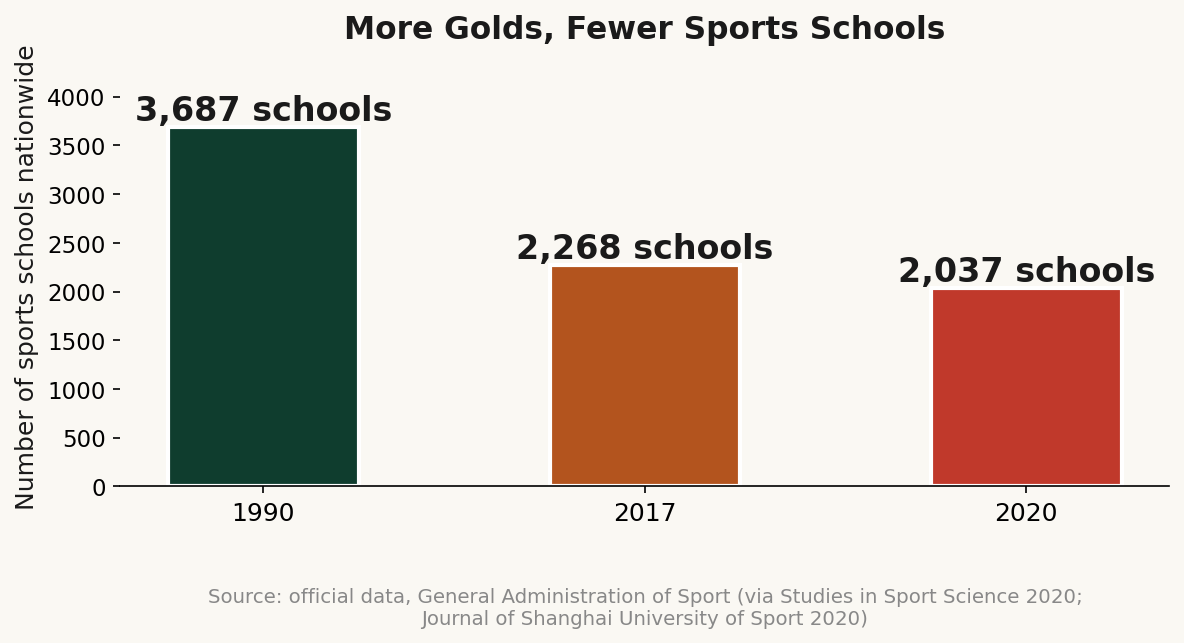
Why? The Chinese edition of The New York Times put it in one line: "Middle-class parents are no longer willing to hand their only child to the state sports system." Voting with your feet is the most honest opinion poll.
The retirement bill is even more gutting:
Zou Chunlan, former national women's weightlifting champion, ended up scrubbing customers in a bathhouse to make a living — the most famous "retirement bill" in Chinese sports history.
He Bingjiao, Olympic silver medalist: ¥746,300 in retirement compensation — ¥387,700 in basic resettlement, ¥198,700 in seniority compensation, ¥160,000 in performance bonuses. Priced out in the open. One lump sum, bought out.
Liu Xiang: a ¥494,000 buyout plus ¥980,000 in ten years of salary subsidies — and he donated all of it.
Academic surveys: 43.64% of retired athletes lacked skills-upgrading support after re-employment; 17.20% never received any support at all. In sports with weak mass bases — heavy athletics, track and field — choosing your own career path is hardest (Zhu Jun, Zou Dexin, Studies in Sport Science, 2021).
The golds belong to the system. The injuries are yours. The retirement is yours.
VIII. Sport's Greatest Power Is Education
We trained sport into utilitarianism and lost the education.
Sport's greatest power was never the gold medal. It's education. It teaches three things: empathy, respect for the rules, and how to lose.
Dr. He Li'an of Monster Training calls the arena "life, broadcast live." He proposes the "philosopher-coach" — the point of the game isn't humiliating the opponent or the medal, but striving under shared rules with mutual respect.
He also did something ruthless: he publicly confessed that he used to coach with beatings and verbal abuse. After studying in America, he watched American coaches build disciplined teams through reasoned communication — the whole team sitting down to talk through a single foul — and understood: humiliation and corporal punishment leave only trauma. They educate no one.
His most savage line, for everyone who believes in "education through suffering":
"You're going to die someday anyway — should I kill you now so you can prepare?"
—— He Li'an, Monster Training Podcast EP165, "Sport Is Education"
If beatings really made people better, you'd just open a "Monster Beating Center," charge money, and hit people — his sarcasm cuts to the bone.
Look back at our sports schools: the day a child enrolls, academics are effectively dead; the day they retire, the system "uses and discards." That's not education. That's use.
A system that trains children into medal machines has no business talking about education. Only a sport that teaches a child how to lose is education.
Empathy — for the opponent, the teammate, the defeat. That is sport's real power over ordinary people, and we've thrown all of it away. We remember only the golds, and forgot why sport set out in the first place.
IX. Two Sets of KPIs
Regular exercisers: China 38.5%, the UK 63.4%, the US up to about 52% on the aerobic standard.
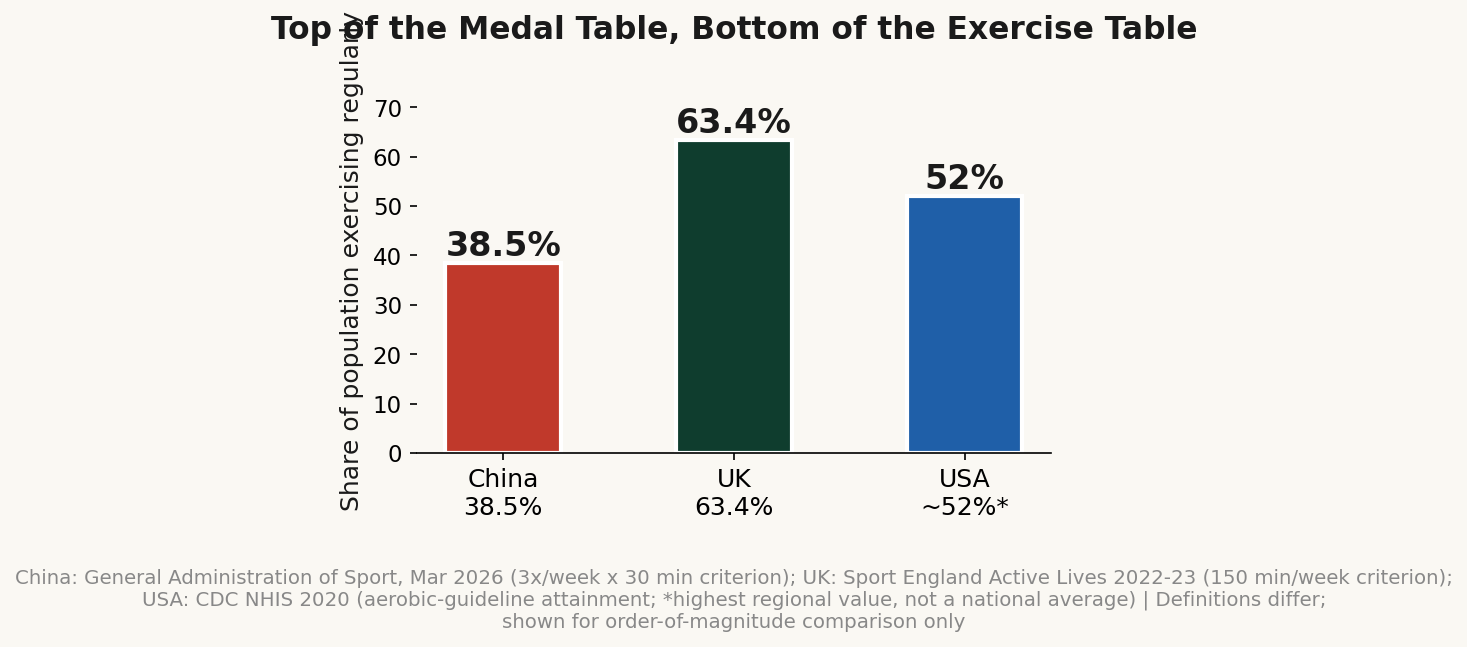
The medal table is for the system to look at; the playground is for the children. Those are two sets of KPIs. We only completed the first.
Even the system's own scholars can't stand it anymore. Yang Guoqing (Journal of Shanghai University of Sport, 2025): the whole-nation system has "weak resource-mobilization capacity, a single-track incentive-and-constraint mechanism, and low resource-use efficiency" — and argues for market mechanisms to fill the gap. When even its own people admit the packaged approach is no longer efficient.
Coda: Gold Medals, or a Sporting Life?
201 Asian Games golds. 11 straight titles. Boss of Asia. Every one of those numbers is real, and every one is worth pride.
But numbers can't answer one question: why is winning golds getting easier, while getting children to love sport is getting harder?
The whole-nation system answers "how to win golds." Market sport answers "how to get people moving." Those are two different exams, and we only passed one.
The British proved with the lottery: the goal can be national, the means can be market. The Americans proved with the NCAA: the government can walk away, the universities can pick up the tab, and the athlete can walk off with a degree. The Koreans proved with the military exemption: personal incentives beat packaged mobilization.
And we are still going in circles inside four words: "the new whole-nation system."
◆
References
- General Administration of Sport, "2024 Lottery Public-Welfare Funds Usage Announcement" (via Sina Finance, 2025-07-25): ¥4.137 billion in central-level lottery funds.
- Xinmin Evening News, 2024-03-08: during the 13th Five-Year Plan, lottery funds supported Olympic glory programs (>¥2.2B), reserve-talent development (>¥1.1B), and national-team preparation (>¥1.5B).
- Liu Mingyi et al., "The Evolution, Real Problems, and Governance Strategies of China's Sports Schools," Studies in Sport Science, 2020(3): sports schools 3,687 (1990) → 2,268 (2017); Journal of Shanghai University of Sport, 2020, 44(10): ~2,037 in 2020.
- IOC Olympic medal tables (compiled via Wikipedia): China 1984 4th (15 golds) → 1988 11th (5 golds) → 2008 1st (51 golds) → 2024 2nd (40 golds, tied with the US for most).
- Sports Management, Oct 2016: before 1996, UK government funding averaged ~£5m/year; the 1997–2000 Sydney cycle received £58.9m in lottery funding; Atlanta 1996: 36th (1 gold).
- AP (via SportsTravelMagazine 2025): 75–80% of USOPC revenue from sponsorships and media rights, 10–20% from donations; direct federal funding near zero.
- USA Today / Berkowitz, Feb 2025: NCAA association FY2024 revenue nearly $1.4B; AP (via Barchart 2025): 352 D-I schools' 2024 total sports revenue nearly $20.5B; AP, Jul 2024: NCAA schools spend over $5B/year on non-revenue Olympic sports.
- Boston Globe / USOPC via Sports Business Journal 2024: at Paris 2024, 444 of 592 US athletes (75%) had college competition experience; Knight Commission: ~3/4 of Team USA athletes and nearly 85% of medalists are current/former college athletes; AP, Jul 2024: 800+ NCAA-background athletes competed for other countries.
- Xinmin Evening News, 2023-10-09: Hangzhou Asian Games — China 201 golds, 111 silvers, 71 bronzes; 11th straight time atop the medal table.
- Sina Sports, Sep 2026: Nagoya Asian Games men's basketball semifinal, 77–97 loss to Japan (20 points — worst Asian Games defeat in team history), knocked out in the semifinals two editions running; Hangzhou semifinal 76–77 loss to the Philippines, bronze.
- Sina Sports, Sep 2026: Hangzhou men's football quarterfinal 0–2 loss to South Korea; Nagoya 3–0 win over Thailand — semifinals for the first time in 28 years (first since the U23 switch); China–Korea Asian Games head-to-head: 5 meetings, 5 defeats (2 scored, 12 conceded); Korea's third straight men's football title with 9 Europe-based players; Asian Games gold exempts from military service.
- Weifang Daily, 2024-08-13: at Paris 2024, the six traditional powerhouse sports won 27 golds — 67.5% of the delegation's total.
- Jimu News via Guangming Daily, 2026-09-03: Gao Zhidan proposes the "633" program strategy and the "new whole-nation system."
- Fengyu Finance, 2026-09-12: Liu Xiang's buyout ¥494,000, ten years of salary subsidies totaling ¥982,935 — all donated; Sina Sports, 2026-08-30: He Bingjiao's retirement compensation ¥746,300; Zou Chunlan scrubbing in a bathhouse after retirement.
- Zhu Jun, Zou Dexin, "Double Disembedding: The Practical Dilemmas of Retired-Athlete Resettlement Policy," Studies in Sport Science, 2021: 43.64% of retired athletes lacked skills-upgrading support after re-employment; 17.20% never received any support.
- Minister Gao Zhidan, March 2026 "minister's corridor" (Beijing Business Today): 38.5% regular exercisers in 2025; Sport England, Active Lives 2022.11–2023.11: 63.4% of UK adults meet the 150-min/week standard; CDC NHIS 2020 (published Jan 2023): US regional aerobic-guideline attainment tops out at 52%.
- Yuan Weimin on the whole-nation system as "concentrating resources to accomplish great things"; Mao Zhenming et al., "From Separation to Integration of Sport and Education," Physical Education Teaching, 2021 (the India comparison); Yang Guoqing, Journal of Shanghai University of Sport, 2025, critiquing the system's efficiency; Xu Guoqi, Twenty-First Century, on the 51 golds and the sporting nation; NYT Chinese edition, Aug 2024, on middle-class parents and sports schools.
- Monster Training Podcast EP165, "Sport Is Education" (Dr. He Li'an / Dr. Josh, 2025-12-17): the arena as "life, broadcast live," the "philosopher-coach," the critique of corporal punishment, the "Monster Beating Center" satire, and Dr. He's confession after studying in America.
- The author's research notes on "The Zhang Xuefeng Phenomenon": "symptom, not mentor," "information arbitrageur," the observer effect, and "in America, the university is a place where you're allowed to make mistakes; in China, the university locks you in early with your file, your hukou, and your establishment post."