 拾光
拾光 Gleanings · 003
Twenty Thousand Unremarkable Wednesdays
Love is an integral, not a spark
Opening: The Funnel of Life
Ninety minus your age. If you live to ninety, the difference is the number of years you'll spend with "the other half" — the current one, or the future one. That is the funnel of your life, and there is still plenty of time left in it.
Choosing this person may be the most important decision of your life. You are simultaneously choosing: the father or mother of your children, the companion for 20,000 meals, the hiking buddy for 100 weekends, the card partner after retirement, the "physical therapist" for your career and your life — and the person who will say "so today, blah blah blah…" to you 18,000 more times.
What jars is society's attitude toward it. Starting a company, society says: study business, write the business plan, analyze the data — the more rational, the better. Finding a partner, society says: let it happen, follow your feelings — the more rational, the more unhinged you look. If someone drafted a detailed "mate-hunting" action plan and tracked every step on a Gantt chart, public opinion would say: this person is taking dating way too seriously. Run a business with dating's laissez-faire and you'll lose everything; run dating with business's rationality and you'll be laughed off the stage. That is society's first prank on love: the most important decision gets the most casual methodology.
So first, three questions. Why do you fall in love with this person and not another? Is enough time together sufficient for love? Why are you willing to be with him, and not with someone else?
These three look like questions about feelings; they are really questions about mathematics. Answering them doesn't take more life experience — it takes a different coordinate system. Our language for describing love is impoverished: the crush, the feeling, fate, the spark — every one of these words describes a single moment. But love was never a single-moment thing. Love is a thing of time. And where time is involved, calculus is more honest than adjectives.
A Crush Is the Derivative; Love Is the Integral
Calculus has two basic moves. Differentiation asks: "how fast is it changing, right now?" Integration asks: "from start to finish, how much has accumulated?" One governs the instant; the other governs a lifetime.
A crush is the derivative. The racing heart at first meeting, the sweaty palms of a confession, the tight throat at reunion — all steep, all enormous rates of change, but they describe only change itself. However large the derivative, it is still the property of a single point.
Love is the integral. The Riemann integral works like this: slice the time axis into countless tiny intervals Δt, compute each slice's small rectangle — "presence-quality f(x)" times Δt — and add them all up. Love is that total area.
You can take a point on a curve, shrink it toward zero, and call it "the slope" — but you know it's only an approximation, never the whole.
Two people who burn for three months and break up: enormous derivative, tiny integral — the curve shoots high, but there's little area underneath. Two people who grow old together: the derivative may be so gentle it's almost boring, but decades of addition make an area with no visible bottom. The peak decides the heartbeat; the area decides a lifetime.
The integral has one more cold corollary: on days of absence, Δt = 0. However large that day's f(x) — however expensive the gift, however grand the ceremony — multiplied by zero, it's still zero. Intensity cannot compensate for absence. Business trips, cold wars, "too busy lately" — every missing day is a permanent hole in the integral, and no f(x), however large, can fill it afterward. The integral doesn't do reason; it only does addition.
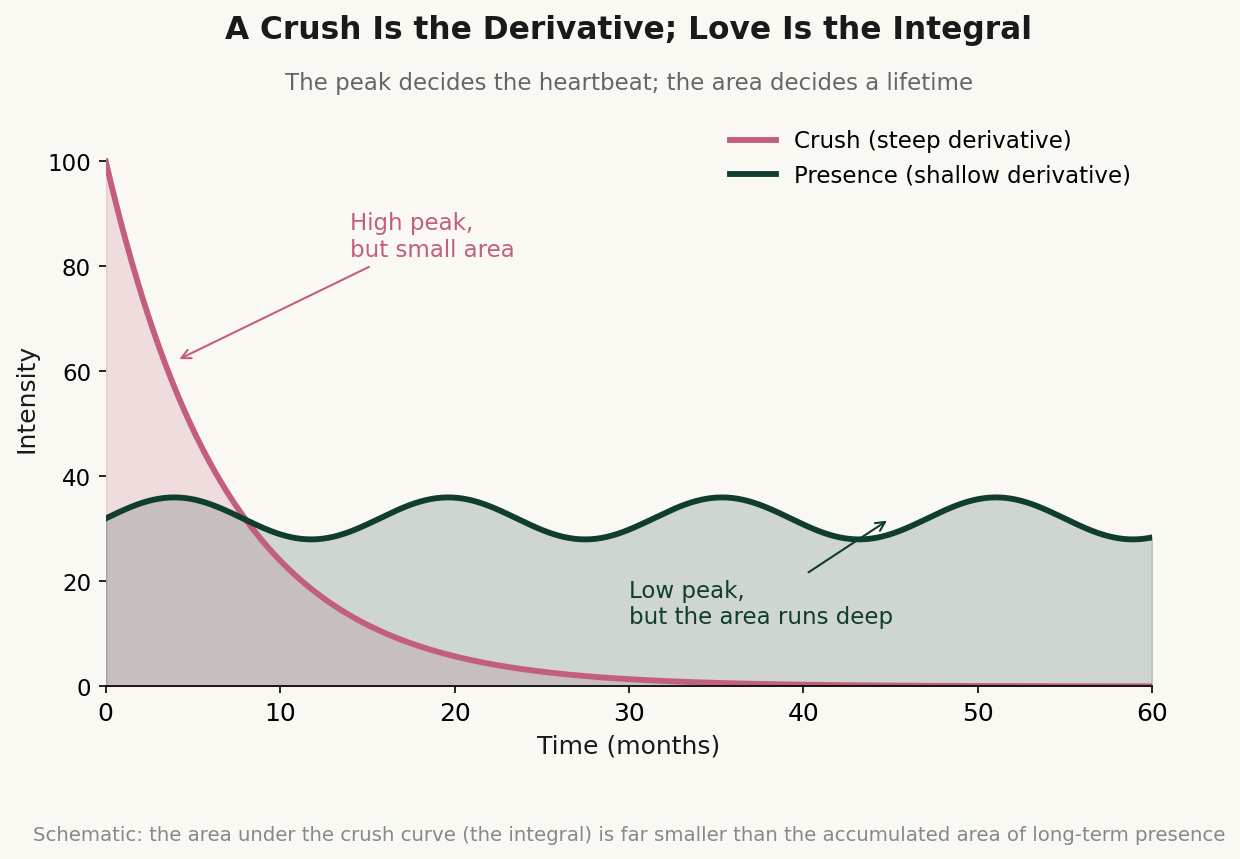
Tim Urban sketches a type: "Old Luo," the romantic drunk. He believes that as long as the love is strong enough, love is everything a marriage needs — numbing himself with "how hard-won our meeting was" and "I still love her just as much," deaf to the constant quarrels and the vanished warmth. Translated into calculus: Old Luo is the man who mistakes the derivative for the integral. He guards the peak memory of the derivative and refuses to admit the integral stalled long ago. Those who mistake the derivative for love will walk out on every morning the derivative hits zero — or stay drunk inside a marriage whose derivative hit zero years ago — spending a lifetime "proving" that love disappears. What disappeared was only ever the derivative.
Sex Can Be Functional; Love Is the Integral
Sex and love are inseparable — but how we divide them decides what we understand love to be.
Sex can be functional. Physical release, social exchange, emotional regulation — sex can serve these functions; it can be bought, it can be replaced. That is a fact, no need to be coy about it. But love cannot be merely functional. The moment love starts operating on functional logic, it deforms. Biologically, sex and love can of course be separated; at the level of human nature, they are often mismatched; but from the standpoint of psychological wholeness and the structure of intimacy, they should not be divided.
Neuroscience footnotes that sentence. The human brain runs two motivational systems on entirely different chemical tracks.
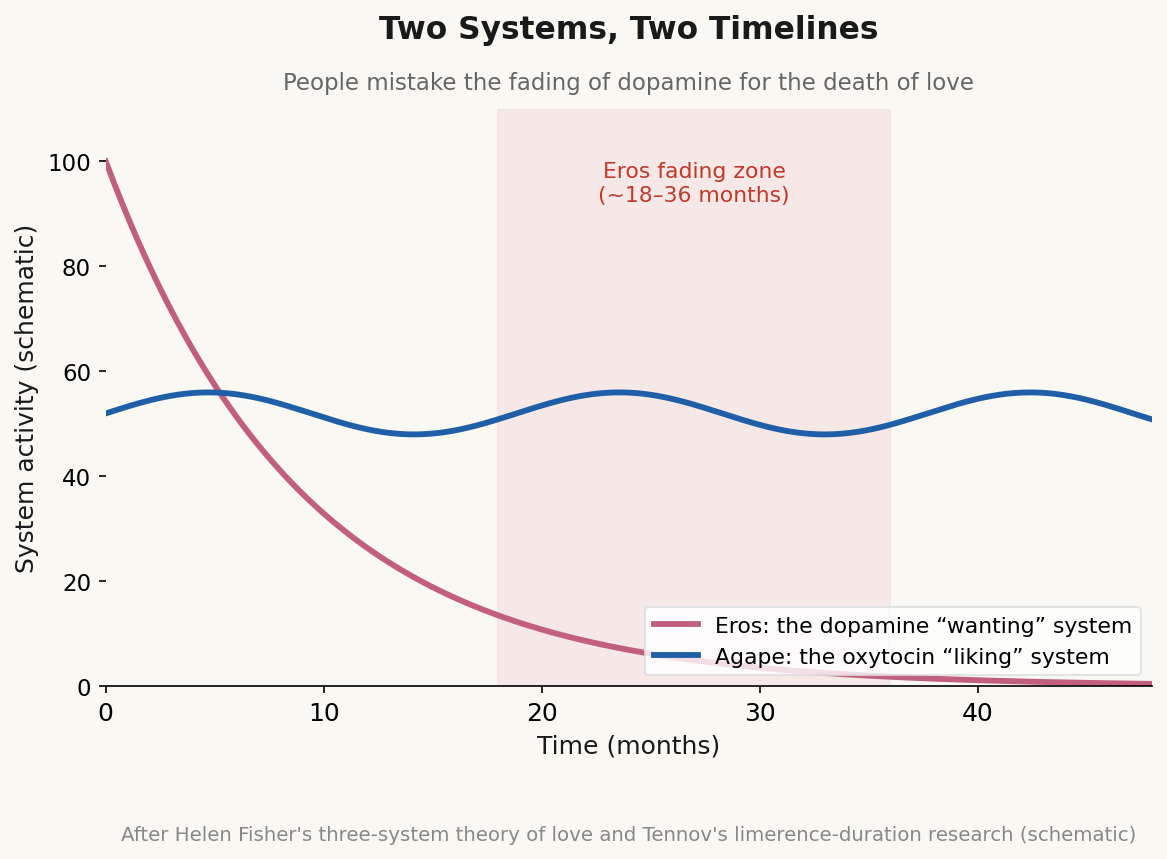
The first is called Eros: the dopamine-driven "wanting" system. High dopamine, low serotonin, marked by an obsessive frenzy of "it has to be you." It is instrumental — it treats the other person as a means, chasing the "gap" itself. It obeys the hedonic treadmill: stimulation must keep escalating to sustain the same pleasure. And its expiry date is written in: as novelty fades, in roughly 18 to 36 months, the dopamine tide will recede. (Note: the wanting/liking separation comes from reward and addiction research; borrowing it for love is this essay's interpretation, not the original papers' conclusion.)
The second is called Agape: the "liking" system driven by opioids, oxytocin, vasopressin. It doesn't run on chasing gaps; it runs on present-tense contact, safety, and being-together. It is autotelic — the process itself is the reward; it produces nothing external that can be stored, withdrawn, or coasted on. Its only output: more love, and the flourishing of the other. (Note: the classic evidence for oxytocin/vasopressin and pair-bonding comes from animal experiments; the direct human evidence stays mostly at the level of trust and social cognition — allow room when extrapolating to "love.")
Evolution wrote this script long ago. Human infants are extremely altricial, needing years of pair-bonded care — dopamine's brief pleasure cannot sustain years of tending. So the brain prepared a second system. The pity is that people so often mistake dopamine's fading for "love is dead," and walk out. They replay the same drama all their lives, each time "proving" that slow-and-steady is a lie — when really they just bought a ticket for the first system every single time.
So what is real intimacy? Not technique, not duration, not positions. It is this: when you come close to my body, I trust you with no defenses up — not afraid to be naked, not afraid to sink, not afraid that being low as dust before you will get me trampled. Not because there is no shame, but because I am certain you will cherish me.
A person's loneliest moment is not the absence of sex, nor the absence of love — it is this: you have stripped yourself bare, and not a single inch of you has truly been seen.
"Technically perfect sex" is not what I want. When we come close, silence is fine, clumsiness is fine, slowness is fine — but it has to be ours, not time lent out, rented, consumed. When sex and love truly overlap, we quietly surrender into a universe only we understand. It can be soft or fierce; brief or long-lasting; but it cannot be meaningless, cannot be hollow.
Twenty Thousand Unremarkable Wednesdays
Tim Urban wrote a passage I consider the most precise description of marriage ever written: "Marriage is not so much a poetic, romantic symphony — it may just be '20,000 unremarkable Wednesdays.' Marriage is not the honeymoon you spent on a Thai island — it may just be 'day four of your 56th trip together.' Nor is it the big dinner after you signed your first mortgage together — it may just be 'the 4,386th dinner in this home' (and it isn't even Valentine's Day)."
Translated into calculus: every "unremarkable Wednesday" is one Δt. The integral of a marriage is 20,000-plus Δt's, each multiplied by that day's presence-quality f(x), summed into a total area. The honeymoon, the island, the feast — those are peaks of the derivative: beautiful, but small in area. What really decides the area is Wednesday. Wednesday has no filter, no soundtrack — just one question: today, did you turn back?
You can't stretch a lifetime's happiness out to look at it all at once. Life's canvas will always have its wrinkles; our happiness is the sum of each present moment.
Gottman slices Wednesday finer still, proposing "sliding-door moments": countless tiny moments each day — a partner's offhand "look out the window," a weary "I'm beat" coming home — where you can turn toward, turn away, or turn against. Each choice is trivial alone; accumulated, they push two relationships onto entirely different tracks. That Wednesdays are made of sliding-door moments and integrals are made of Δt's is the same thing said twice.
So for "how to spend 20,000 Wednesdays happily with one person," the answer isn't in honeymoon guides — it's in Wednesday itself. Tim Urban gives three directions: find a best friend who passes the "traffic test" — the kind of friend you'd deliberately take the long way home for, just to steal a little more time together; build a feeling of "home" — trust, being on the same wavelength, accepting flaws, a positive atmosphere; run the relationship like a business — communication, equality, effective conflict. Not one of them is about the crush; all of them are construction blueprints for the integral.
Hidden inside "effective conflict" is Gottman's most counterintuitive number: 69% of a couple's typical conflicts are perpetual — rooted in core differences, destined never to be "solved." Sensible couples don't keep re-solving the unsolvable; they train a different skill: repair attempts — anything in a conflict that lowers tension and stops negativity from escalating: an apology, a joke, a pause. What matters is not whether a repair was attempted, but whether it succeeded. The integral doesn't fear negative area; it fears negative area that never gets offset.
Every Turn-Back Is a Point in the Integral
The integral is the sum of countless points. So in an intimate relationship, what exactly is a "point"?
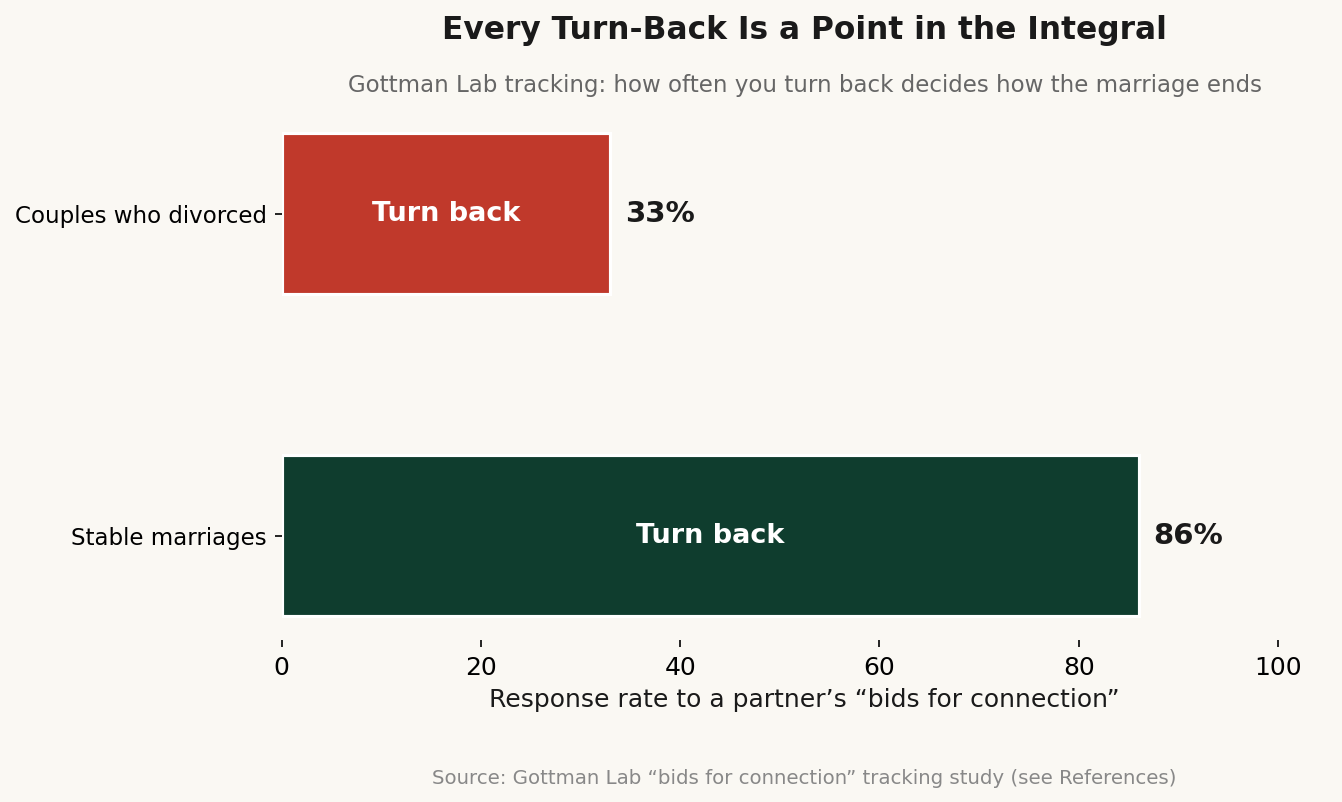
The Gottman Lab gave the answer. Tracking couples' daily interactions, they proposed "bids for connection": a partner's offhand "look at that bird outside," a weary "today wiped me out" coming home — all bids, inviting you to turn back, to respond, to step into their world. The lab's tracking result: couples in stable marriages respond to bids 86% of the time; couples who eventually divorced, only 33%. (A correlational finding from a single lab — not causal proof. But the direction is glaring enough.)
Note what that number means. What decides a marriage's ending is not infidelity, not screaming fights, not buying the house or the car — not the "big events" — but, in the dozens of tiny bids each day, how many times you turned back. Gottman said: "Trust is built in very small moments." That sentence is almost a plain-language Riemann integral — every turn-back, every wait, every softening is one f(x)·Δt in the integral.
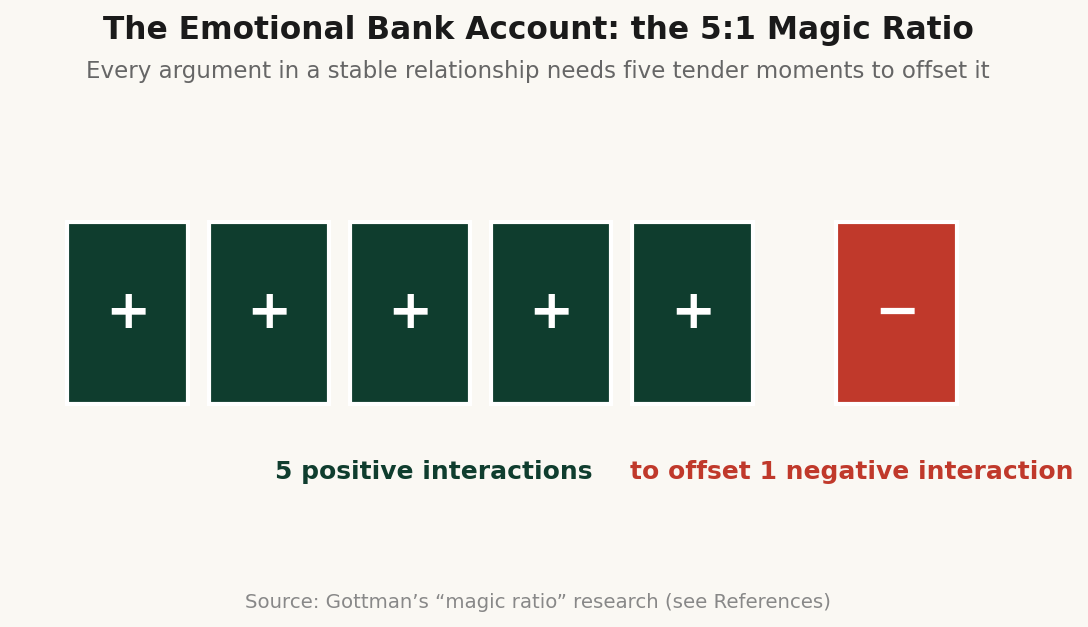
There's a second number, called the "magic ratio": in conflict conversations, stable couples' positive-to-negative interaction ratio is at least 5:1 (in everyday life it can run as high as ~20:1; drop to 1:1 and the red light is on). One argument, one cold shoulder, one hurt takes five tender moments, five turn-backs, five "I'm here"s to offset. Negative interactions weigh five times what positive ones do — another property of the integral: area can be negative, and negative area is "heavier."
So "is enough time together sufficient for love" — the opening question can be answered now: time is only the horizontal axis, Δt. What really decides the integral is the vertical axis, f(x): in all that time, how many times did you turn back. Someone who lived together ten years and never turned back may have a smaller integral than someone who spent three years turning back every time. Time doesn't produce love; turning back does.
One cold fact about being single, by the way. When researchers split married people by marriage quality, the happiness ranking runs: good marriage (happy beyond words) > single > bad marriage (miserable — worse than single). A single person is one step from happiness — finding a good relationship. Someone trapped in a bad marriage is three steps away — a soul-tearing breakup, a long convalescence, and starting over. Choosing wrong costs more than staying single. That's why "don't marry the wrong person" matters far more than "don't marry too late," no matter how loudly society drums about the latter.
Bookkeeping vs. Keeping Records
Short video has turned intimacy into a school of accounting: whoever gives more, loses; split the bill or cover it all, materialistic or not. The comments section holds court every day, and the charge is always "was it worth it."
But "I want nothing from you" is often the most exquisite moral pose. Its subtext: everything I give can go uncounted; if you count, you're materialistic. Yet the truth is usually the reverse — what deserves vigilance is not calculation but the double standard: enjoying the costs the other bears while refusing to bear any yourself, then packaging the taking as the value of "not being materialistic."
You may choose not to spend. But you may not refuse to bear any cost, enjoy the fruits of someone else bearing it, and then call their demand for fairness and responsibility "materialistic."
Two different acts need distinguishing here: bookkeeping, and keeping records. Bookkeeping is calculation — it wants to settle the books at some chosen point: "I did A for you; you owe me B." Record-keeping is memory: the photographed receipt, the movie ticket tucked away, the menu jotted down — not the commodification of feeling, but the preservation of a one-of-a-kind shared memory. Years from now, these records will tell you: look how far we've walked together.
In the language of the integral: the bookkeeper wants to differentiate and settle at a single point — but love is an integral, and the integral has no settlement day. The foundation of a healthy relationship was never a perfectly fair exchange of interests; it is both sides willingly bearing responsibility, honestly examining themselves. Not that nothing is counted — but that counting, in love, is beneath you.
Language Is a Knife
A true story. At a private, joking gathering, someone remarked on their partner's teeth — "yellow, look big" — and, riffing along, blurted out "why not get a boob job." The speaker thought it was flirtatious banter; what the listener felt was being objectified — in that moment, she felt no different from the women in the eyes of those ordinary men who judge women.
In the debrief afterward, the weightiest sentence was: "Intent doesn't cancel harm." The joking intent was real; the hurt was real too. The deeper problem is a defense mechanism psychology calls "intellectualization": using a powerful logical mind to explain everything away — "you should understand I meant no harm" — until logic, once a tool for seeing through the world, stages a coup and becomes the moat that keeps the other's pain out. Theory lives in the head; the relationship lives in the heart; something snapped in between.
Gottman puts this kind of interaction into a colder frame, called the "Four Horsemen of the Apocalypse": criticism, contempt, defensiveness, stonewalling. Of these, contempt is the single strongest predictor of divorce — the condescending sneer, the eye-roll, looking at your partner like an idiot. The contempt in a "joke" is this: it instantly flattens the partner into a body part that can be inspected and modified. Language can wound, but structure turns language into a knife — certain words carry an institutional, disciplinary toxicity that recognizes no context and asks no consent.
And when a woman voices discomfort and is told to "be logical, don't be emotional," objectification completes its second layer: even her right to feel pain must first pass through logic's security check.
De-instrumentalized love is what stays after every evaluation and every performance has been stripped away — and you still choose to remain.
There is no shortcut out. Stop proving yourself, admit the harm, delete body-evaluating jokes from your dictionary, rebuild trust with long-term action. Vows mean nothing in themselves; what means something is action — action is the only real f(x) in the integral.
What You Lose Is the Area
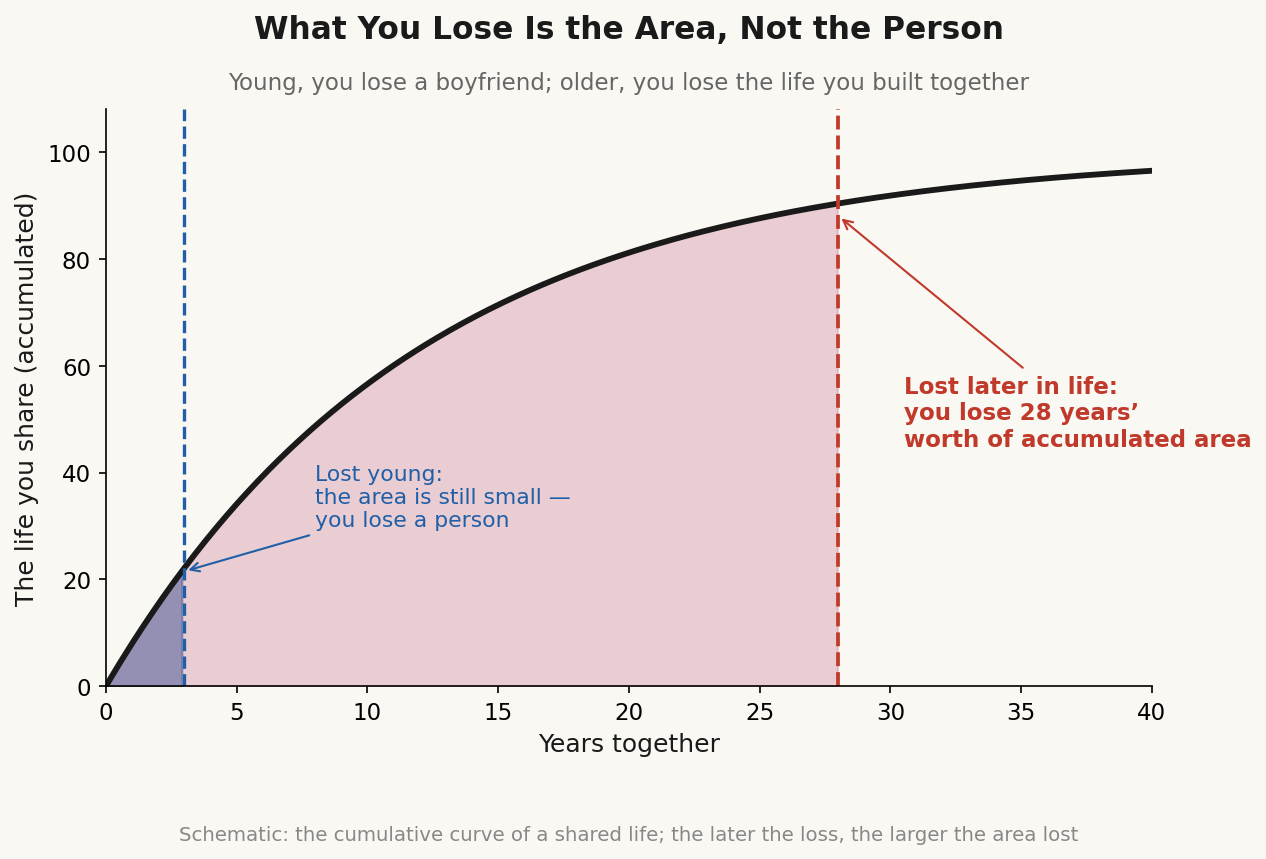
When you're young, you only lose a boyfriend. Break up, cry for a few days, find someone new, and the self grows back quickly — because the area is still small, and what you lost is only what's near a single point.
When you're older, you lose the life you built together. What you lose is not a person — it is decades' worth of accumulated area, whole.
Aron's self-expansion model explains why. Humans have a basic motive: to expand the self. And the core reward of an intimate relationship is "inclusion of other in the self." The IOS scale the Arons designed has just one question: seven pairs of circles with increasing overlap — which pair looks most like you two? The more they overlap, the more the other is part of you — their resources, perspectives, habits, memories, growing into your self bit by bit, becoming part of the function that is "you."
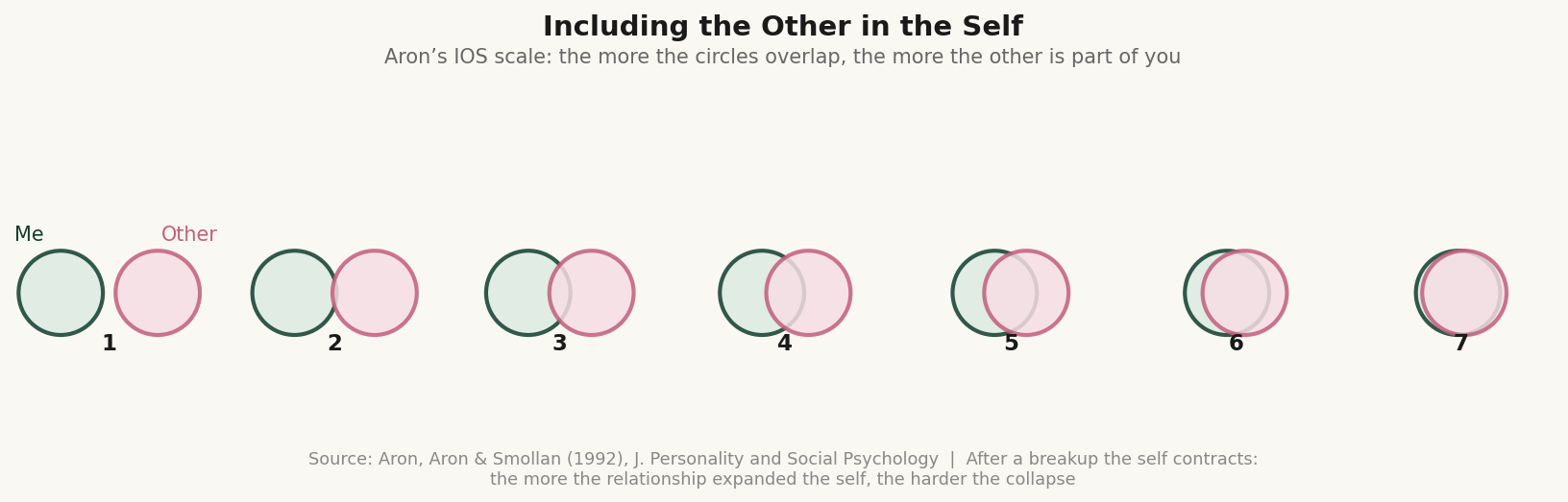
And so loss takes on a mathematical form. Lewandowski's research found: the more a relationship expanded the self before the breakup, the more violently the self contracts after it — self-concept clarity drops, emotional pain intensifies. Losing a person is losing part of the self. The older you are, the more the overlap, the more devastating the collapse when it's gone. This isn't sentimentality; it's structure: the other person is already part of your function — take them away, and the function itself is left incomplete.
When the integral runs deep enough, it pierces through psychology into physiology. Shor and colleagues' 2012 meta-analysis (ten-plus prospective studies): widowed people's overall mortality risk rises 12% (RR=1.12), rising 41% within six months of bereavement (RR=1.41) — the effect markedly stronger in men (1.22), near-zero in women (1.03). Another meta-analysis gives a mean hazard ratio of HR=1.23. Heterogeneity across studies is high (I²=88%), the effect concentrated in early bereavement and in men — but the direction is consistent: the integral of a shared life runs deep enough to touch the very business of staying alive.
Two Spheres, Tangent
Picture two spheres, one large, one small, touching lightly. They meet on one tiny plane — and the vast remainder of each sphere has nothing to do with the other.
That tiny plane of contact is trust. Not there on day one — accumulated by the integral: turn-back after turn-back, unguarded moment after unguarded moment, until they form a node. On that node, both people are willing to hand over their softest, most sensitive, most unguarded parts — and let the other take root there.
And those two vast, non-touching spheres are each person's independent growth. Work, friends, the book at midnight, the running track at dawn — the parts that are "mostly done alone." Many mistake loving for merging into one, for pressing two spheres into a single ball. But the price of pressing them into one is that both people lose their shape at once.
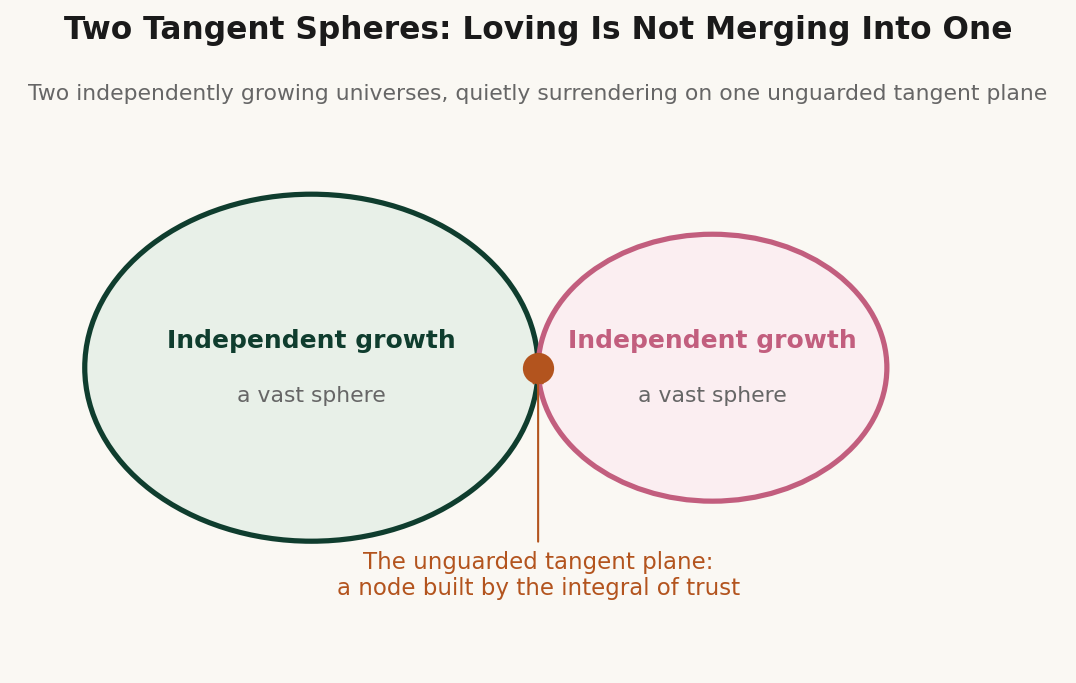
Loving is not merging into one; it is two independently growing universes, willing to quietly surrender to each other on one unguarded tangent plane.
There's a subtle tension here worth naming: the last chapter said intimacy is including the other in the self (overlap); this chapter says loving means staying independent (tangency). A contradiction? No. What gets included is being; what stays independent is becoming. You can hold a person in your heart — their habits, memories, laughter growing into your self — while not handing your life over: your choices, your dignity, your hands still on the wheel. What overlaps is memory and habit; what stays tangent is choice and self. The best intimate relationships hold overlap and tangency at once.
Attachment theory stamps this metaphor approved: securely attached people treat their partner as a "secure base" — precisely because the base is solid, they dare to walk farther. The best intimate relationships make you more independent, not more dependent. Needing the other to survive is not love; it's parasitism. Letting the other be free, being free yourself, and still choosing to turn back every day — that is love.
Love in the narrow sense has three hard conditions: uniqueness (unrepeatable), continuity (not easily broken), irreplaceability. You cannot replicate a love, just as you cannot replicate someone's care for you, the warmth of a body, the habits of a language, the embedding of a presence. All this uniqueness, continuity, irreplaceability comes from the tiny, ordinary moments of daily life — love was never decided by some great moment; it happens unnoticed, in turn-back after turn-back, wait after wait, softening after softening. They are like points on a function's graph — tiny to look at, but stretch the time axis and they have already drawn the entire curve.
❦
Coda
Back to the three opening questions. They can be answered now.
Why him, of all people? Because the integral is path-dependent — same start, same end, different road, completely different area. The road you walked together: send anyone else down it and the f(x) would be different. Those 20,000 Wednesdays belong to the two of you, and to no one else.
Is enough time together sufficient for love? Time is only Δt. Ten years without turning back may integrate to zero; three years of turning back every time can run very deep.
Why are you willing to be with him? Because on that curve there are countless points you never noticed at the time — a turn-back, a wait, a softening — and they joined into the one curve of your life you could never cut away.
Real love is generated from the accumulation of points. You may never know which moment it began — but look back, and those points have already joined into the one curve of your life you could never cut away.
References
- Gottman, J. M. (2011). The Science of Trust: Emotional Attunement for Couples. New York: Norton. Ch. 3 "Sliding-Door Moments". (Bids for connection: in a 6-year newlywed tracking study, couples still together responded to bids ~86% of the time, divorced couples only 33%; a correlational finding from a single lab, not causal proof. See also Gottman & DeClaire (2001) The Relationship Cure.)
- Gottman, J. M. (1994). What Predicts Divorce? The Relationship Between Marital Processes and Marital Outcomes. Hillsdale, NJ: Erlbaum. (The 5:1 magic ratio: positive-to-negative ≥ 5:1 in conflict conversations; contempt is the strongest of the Four Horsemen as a divorce predictor, with reported accuracy figures varying across retellings, around ninety percent.)
- Gottman, J. M., & Silver, N. (1999). The Seven Principles for Making Marriage Work. New York: Crown. (Repair attempts; ~69% of a couple's typical conflicts are perpetual — a standard Gottman formulation.)
- Fisher, H. E. (1998). Lust, attraction, and attachment in mammalian reproduction. Human Nature, 9(1), 23–52. (The three brain systems of love); Fisher, H. E., Aron, A., & Brown, L. L. (2006). Romantic love: a mammalian brain system for mate choice. Phil. Trans. R. Soc. B, 361, 2173–2186. (fMRI evidence.)
- Tennov, D. (1979). Love and Limerence: The Experience of Being in Love. New York: Stein and Day. (Limerence typically lasts 18 months to 3 years — the field's classic summary figure.)
- Berridge, K. C., & Robinson, T. E. (1998). What is the role of dopamine in reward: hedonic impact, reward learning, or incentive salience? Brain Research Reviews, 28(3), 309–369. (The wanting-vs-liking separation; the theory comes from reward/addiction research — its application to love here is an interpretive extension.)
- Aron, A., & Aron, E. N. (1986). Love and the Expansion of Self: Understanding Attraction and Satisfaction. New York: Hemisphere. (The self-expansion model.)
- Aron, A., Aron, E. N., & Smollan, D. (1992). Inclusion of other in the self scale and the structure of interpersonal closeness. Journal of Personality and Social Psychology, 63(4), 596–612. (The IOS scale.)
- Lewandowski, G. W., Jr., Aron, A., Bassis, S., & Kunak, J. (2006). Losing a self-expanding relationship: Implications for the self-concept. Personal Relationships, 13, 317–331. (Self-contraction after breakup; based on recall and priming experiments, not longitudinal tracking.)
- Shor, E., Roelfs, D. J., Bugyi, P., & Schwartz, J. E. (2012). Meta-analysis of marital dissolution and mortality. PLoS ONE, 7(2), e23465. (Widowed people's mortality risk: RR=1.12, 1.41 within six months; heterogeneity across studies extremely high, I²=88%, effects concentrated in early bereavement and in men); Roelfs, D. J., Shor, E., Kalish, R., & Yogev, T. (2012). Widowhood and mortality: A meta-analysis and meta-regression. Demography. (Mean HR=1.23.)
- Mikulincer, M., & Shaver, P. R. (2007). Attachment in Adulthood: Structure, Dynamics, and Change. New York: Guilford. (The secure base and attachment theory.)
- Tim Urban (2014). How to Pick Your Life Partner. Wait But Why. (The "20,000 unremarkable Wednesdays" phrasing comes from this piece; the author is a popular-science writer and the figures are rhetorical, not measured data. The Chinese adapted version cited here is from the author's research notes.)
- The author's original long-form essay "On Sex and Love Being Inseparable — But How We Divide Them Decides What We Understand Love to Be" (2026 draft).
- The author's research notes: "Intimate Relationships and Love from the Viewpoint of Calculus," "Beyond the Ledger of Love," "The Autotelic Nature of Love," "Speech Boundaries and the Trust Crisis in Intimate Relationships," and the adapted translation of Tim Urban's piece "When You're Young, You Only Lose a Boyfriend; When You're Older, You Lose the Life You Shared."