 拾光
拾光 Gleanings · 004
The Algorithm of Love: From Calculus to Sincerity
A quartet on intimate relationships
Prelude: An Offensive Question First
Short video has a sentence pattern that never fails to go viral: "A man who won't spend on you doesn't love you." Next: "A woman who checks your phone is controlling." Next: "Going Dutch is just calculation."
One punchy line, dressed up as universal truth, steamrolling every particular case.
I wrote in an old essay: the world is, first of all, a world of small things. Not measured by eyes or numbers, but felt by the heart. You see me grinning; I see you grinning. My habits got better because of you; your habits carry my shadow. It is the concrete things — how much that hotpot cost, what we ordered, what mood we were in — that make up memory. The abstract things — "materialistic," "cheap," "how much was given" — make up only a verdict.
The busiest trade of our age is not love. It is the trial of love.
And trials need standards, and standards need numbers. So our age has quietly completed a conversion: feelings have become a math problem. Short video writes the questions (who gave how much), dating apps supply the formulas (98% compatibility), relationship influencers grade the papers (materialistic / cheap / ick). Everyone is solving the problem. Nobody asks whether the problem itself is valid.
This essay's title is a provocation: The Algorithm of Love. Its subtitle is a debt repaid: from calculus to sincerity.
Last time, we dissected love with calculus — a crush is the derivative, love is the integral. That was mathematics at its most honest: where time is involved, calculus is more honest than adjectives. This time we walk the other half of the road: when "computation" stops being a method and becomes a faith — when we start believing love can be optimized, matched, solved for the optimum — where does that road lead?
A quartet, in four movements: the Algorithm, Attachment, Desire, Sincerity. Beginning in computation, ending in sincerity.
First Movement · The Algorithm: When Love Becomes an Optimization Problem
In 1962, two mathematicians, Gale and Shapley, published a paper titled College Admissions and the Stability of Marriage.
They proposed an algorithm, later called "deferred acceptance." The rules are simple: take a group of men and a group of women, each holding a ranked wish list. The men take turns "proposing" to their top choice; each woman provisionally keeps her best offer so far, trading up when a better one arrives, and the rejected go on to propose to the next name on their list. Rounds continue until nobody switches. The algorithm is guaranteed to converge on a "stable matching": there exists no man and woman who would both rather be with each other than stay put. In plain language — nobody wants to elope.
Mathematically, it is perfect. Roth turned the theory into real market design — assigning medical residents, admitting students to public schools — and shared the 2012 Nobel Prize in Economics with Shapley.
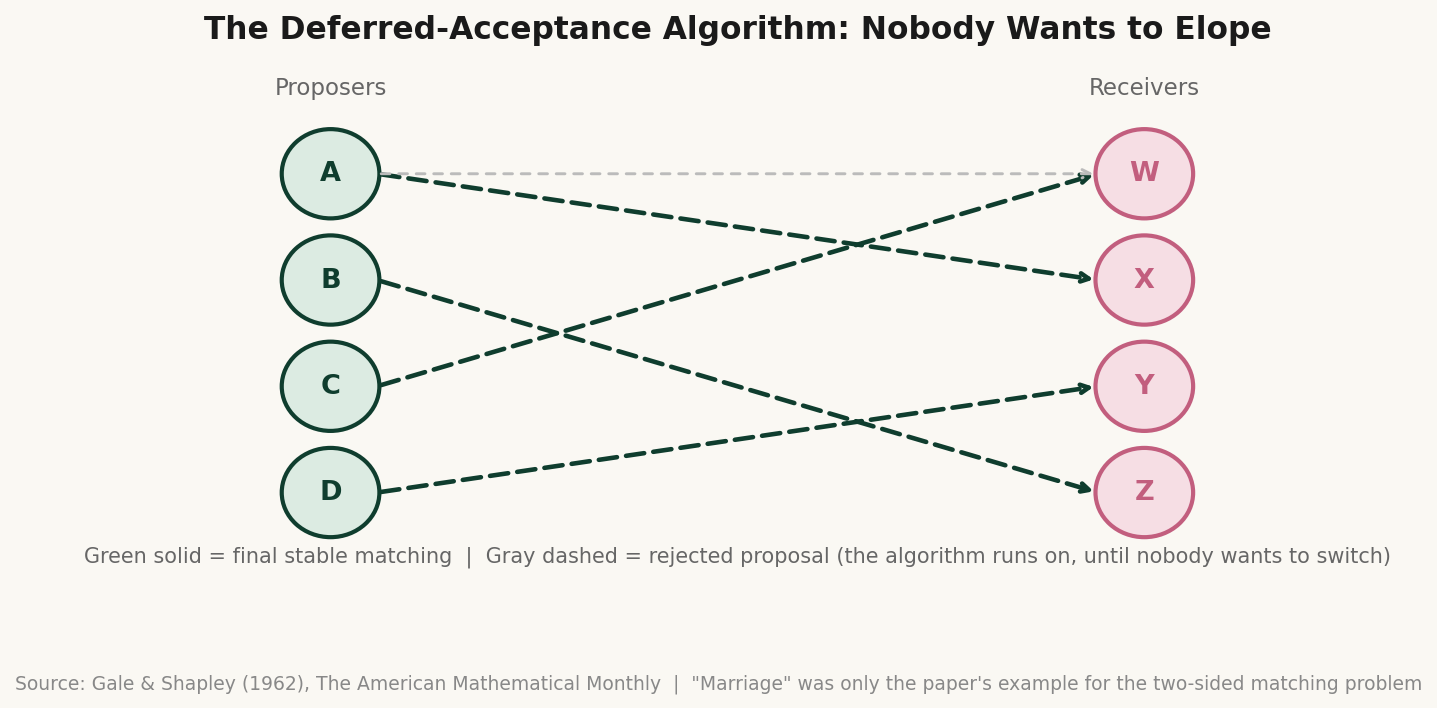
But one honest sentence up front: the "marriage" in the paper's title is merely an illustrative example of a two-sided matching problem — not empirical research on human courtship. Lifting stable matching straight onto the dating market is an interpretive stretch, not the paper's conclusion. Honesty first; then we can cut loose.
Good. Now, cut loose.
What the algorithm solves is "stability." But stability is not happiness. Stability is defined as "nobody wants to run"; happiness is defined as "somebody wants to stay." Those are two different problems. Couples-therapy waiting rooms are full of stable matchings — nobody elopes, and nobody wants to stay either.
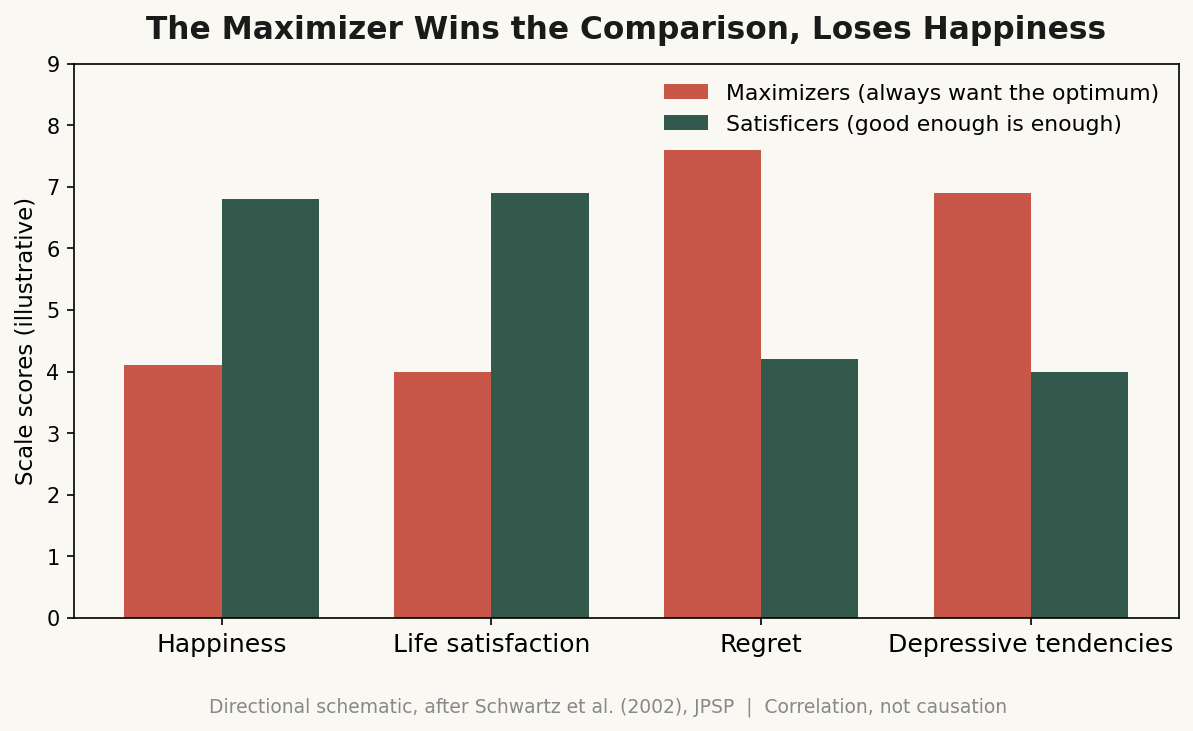
A sharper cut comes from Schwartz. In 2004, The Paradox of Choice: more options, less happiness. Two years earlier, he and his colleagues had published the classic study in the Journal of Personality and Social Psychology, sorting people into "maximizers" — forever hunting the optimal solution — and "satisficers" — good enough is good enough. The results were brutal: maximizers scored lower across the board on happiness, optimism, self-esteem, and life satisfaction, and higher across the board on regret, depression, and perfectionist tendencies. (Note: this is correlational, not causal; the scale has since attracted methodological criticism — but the broad direction, "maximizing makes people less happy," has survived replication.)
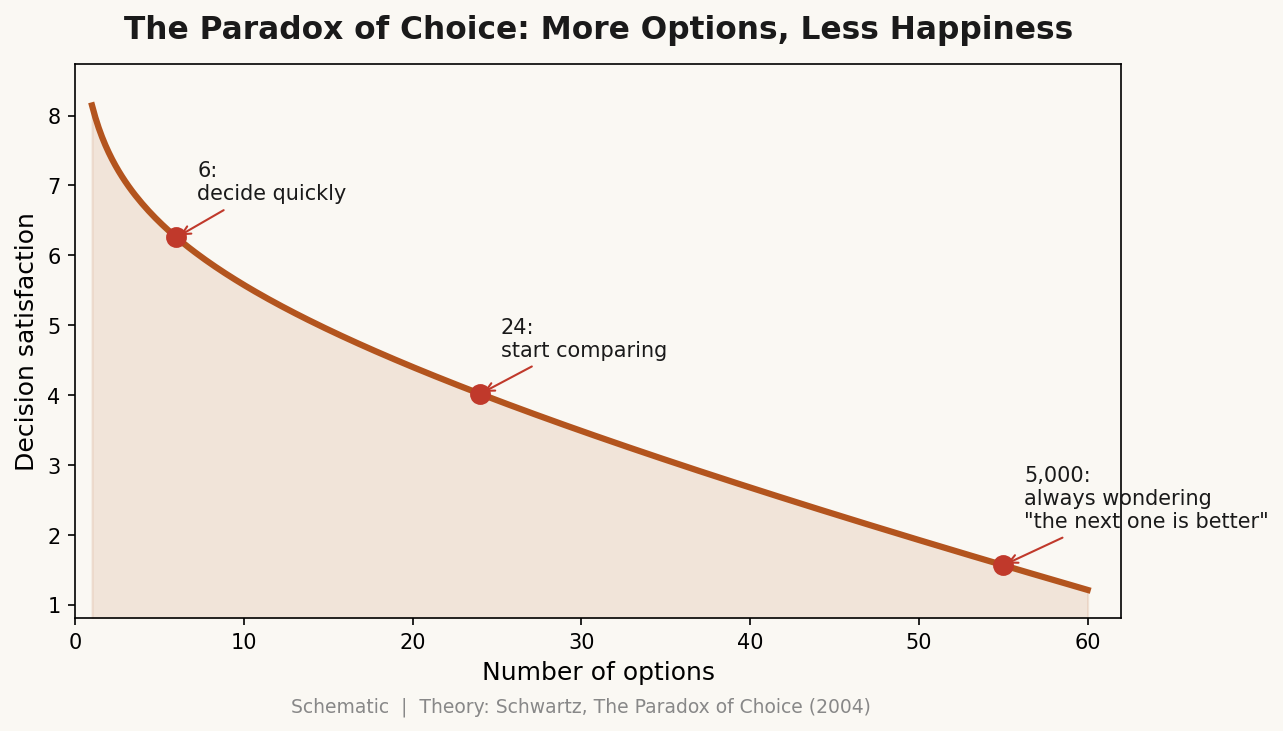
Translated to the dating scene: dating apps are a maximizer's paradise and happiness's hell. Five thousand people on the shelf, and every right swipe reinforces one belief — "the next one might be better." So nobody has the patience anymore to live "good enough" into "very good." The cruelest irony: those who optimize hardest against regret turn out to be the most accomplished regretters. Because the optimal solution is a mirage, and comparison is a perpetual-motion machine.
Then there is Zahavi. In 1975, in the Journal of Theoretical Biology, he proposed the "handicap principle": the peacock's tail is huge and heavy, an obvious burden for survival — and the peahen loves exactly that. Because only the truly fit can afford such a handicap. Cost is sincerity: that is costly signaling. The evolutionary psychologist Miller extended it to humans: diamonds, sports cars, lavish weddings — all human peacock tails. (Note: the handicap principle remains fiercely contested and has never been empirically confirmed; Miller's application is an extension from evolutionary psychology, not a conclusion of Zahavi's original paper.)
See how it works: in the algorithmic age, we have learned to compute love — compatibility scores, sunk costs, "I deserve better." But one question nobody computes: when love becomes an optimization problem, who wrote the objective function?
Short video wrote it. "He doesn't love you if he won't spend on you" — compressing a complex person into a binary verdict, a hundred thousand likes. It is the same disease as the dating app's "98% compatibility": one killer line, one number, steamrolling every particular case. The concrete person vanishes. What remains is the template and the trial.
Second Movement · Attachment: You Fell in Love with Your Factory Settings
In 1987, Hazan and Shaver published a landmark paper in the Journal of Personality and Social Psychology — "Romantic love conceptualized as an attachment process" — carrying Bowlby's theory of infant attachment straight into adult love.
They asked 620 newspaper readers to sort themselves into categories. The result: 56% secure, 25% avoidant, 19% anxious/ambivalent. (Note the exact 56/25/19 — not the oft-quoted 60/20/20. The sample was self-selected newspaper readers who mailed back a questionnaire, not a nationally representative sample. Honesty first.)
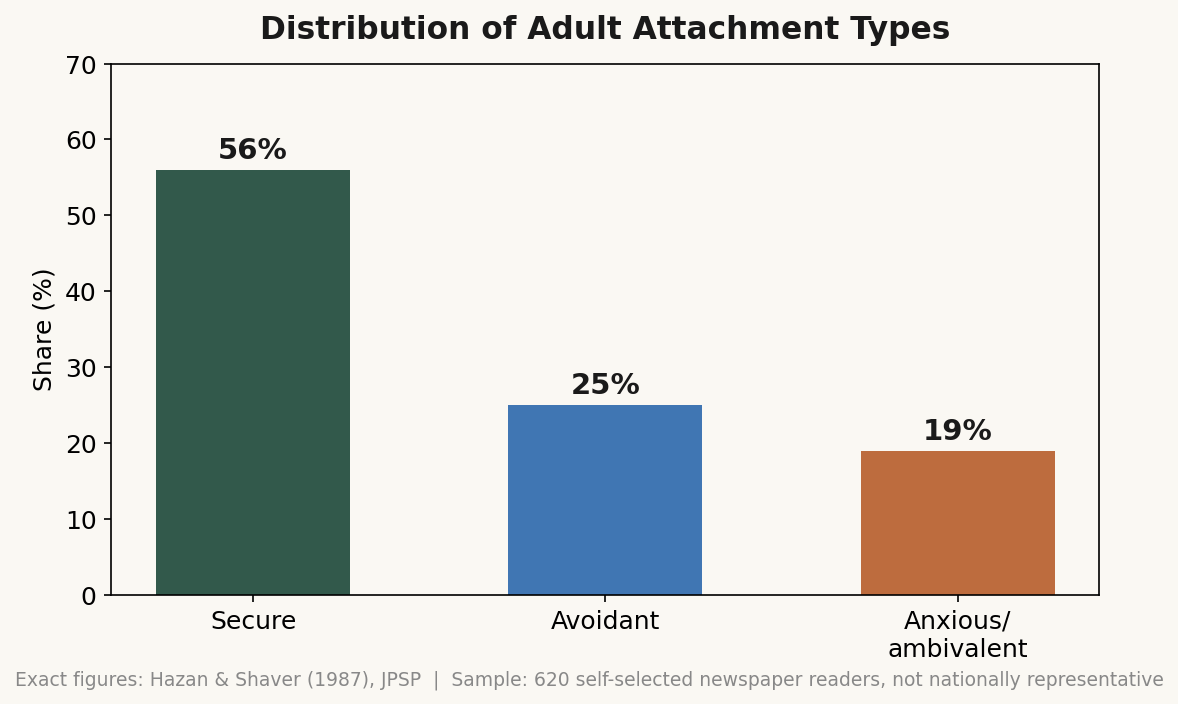
In plain terms, those three kinds of people:
Secure: closeness feels easy; depending on someone doesn't panic them. "I'm here, you're here — how good is that."
Avoidant: closeness suffocates; independence is oxygen. "Don't come too close. I need air."
Anxious: distance panics; reassurance is a basic need. "Do you still love me? Say it again."
In 1991, Bartholomew and Horowitz pushed the model into four quadrants: model of self (am I worthy of love) × model of other (are others reliable). Positive–positive gives security (+/+); negative–positive gives preoccupation (−/+: I'm not worthy, but you're reliable, so I'll cling to you for dear life); negative–negative gives fearfulness (−/−: I'm not worthy and you're not reliable, so let's not start); positive–negative gives dismissiveness (+/−: I'm fine; you, on the other hand… keep your distance). (The sample was 17-to-24-year-olds; extend to other ages with caution.)
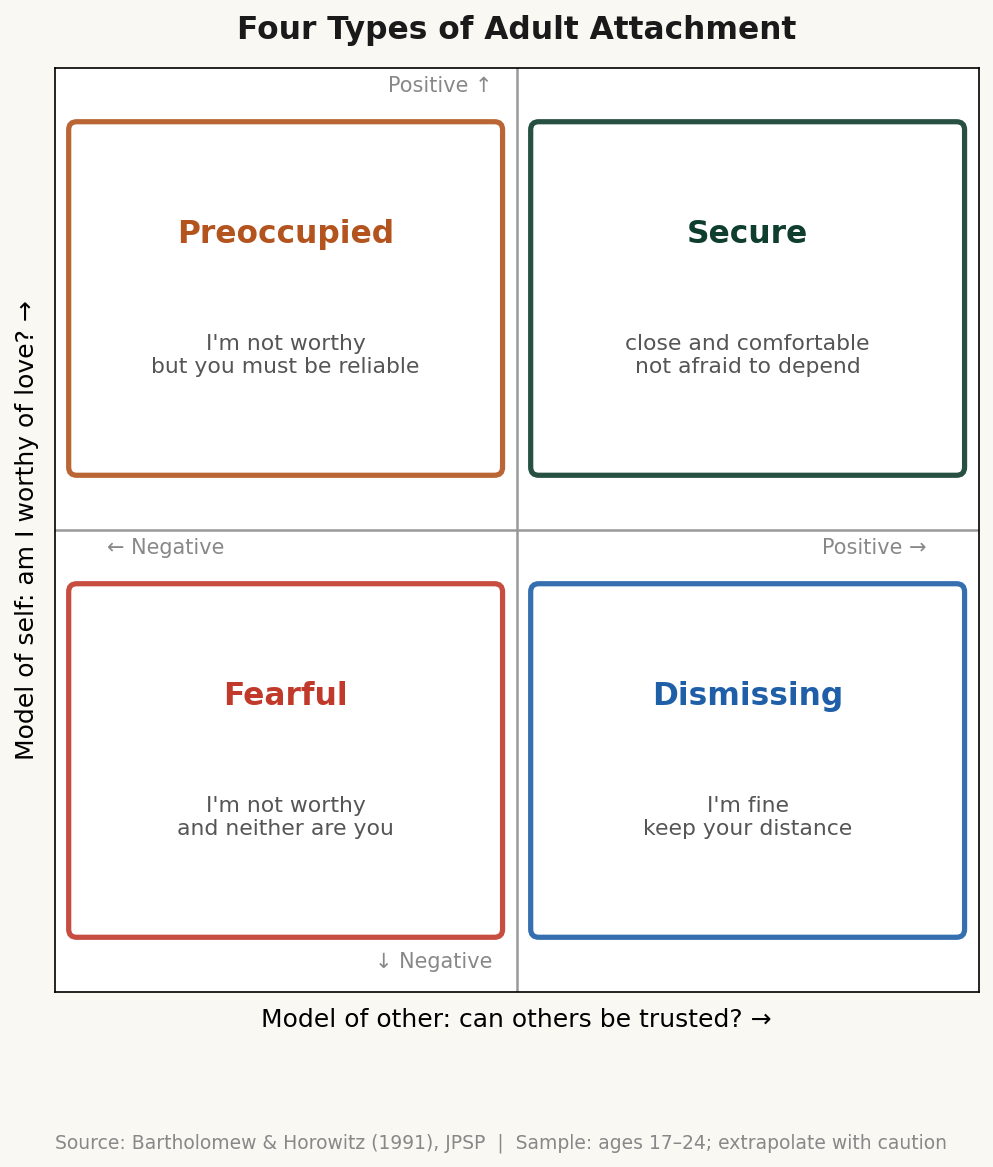
Now for something offensive: you think you're choosing a partner. In fact, your attachment system is voting on your behalf.
Avoidants are most easily drawn to anxious types — one needs space, the other needs confirmation. The chase begins: one steps back, the other steps forward. The one who retreats thinks, "See? Suffocating." The one who pursues thinks, "See? Unloved." Factory settings finding each other — a match made in heaven, at war every day. This isn't fate. It's two childhoods recognizing each other.
But attachment is not a verdict. The literature has a term: earned security. Inside a good relationship, a person can reflash the factory firmware. Factory settings explain your starting point; they don't decide your destination. The most romantic sentence in this chapter: it doesn't matter what model you were born as. What matters is whether you're willing to upgrade the system.
Third Movement · Desire: What Love Cannot Hold
Note: this chapter is not about chemistry. The last essay covered Eros and Agape, dopamine and oxytocin — we won't touch those here. That was circuitry. This chapter is politics — the spatial politics between two people.
In 2006, the therapist Esther Perel published Mating in Captivity. Its core argument in one sentence: love seeks closeness, safety, the elimination of distance; desire needs precisely distance, mystery, adventure — and otherness.
Here lies the fundamental paradox of long-term relationships: we work desperately to turn our partner into "one of us" — roommate, business partner, best friend, family — and then ask, baffled: why do I feel nothing for "one of us" anymore?
Perel's answer offends: because desire needs the other. You cannot desire someone you fully possess. Intimacy says, "I know everything about you." Desire says, "I still want to discover you." When only the former remains, love is still there — and the fire is out.
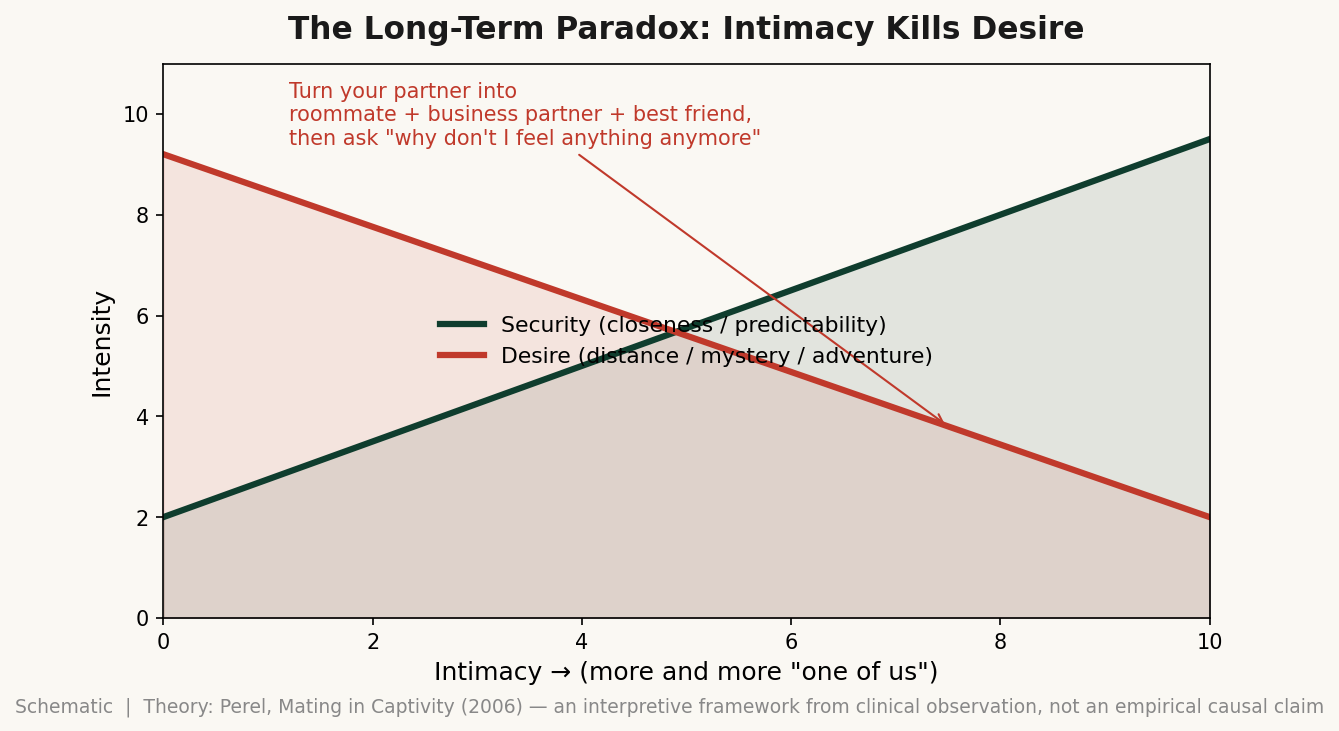
The biggest lie of modern intimacy is "we tell each other everything." Telling everything kills mystery, and mystery is desire's oxygen. Perel isn't teaching you to hold back; she's pointing at a structural contradiction: we use the word "intimacy" for two opposite needs at once — the need for safety and the need for adventure. The first wants uncertainty eliminated. The second wants uncertainty itself.
So stop asking, "We clearly love each other — why is the passion gone?" Love and passion don't insure the same risk. One insures "don't lose you." The other wants "I still want to win you."
Fourth Movement · Sincerity: The One Variable That Can't Be Computed
In 1997, Aron and colleagues published an experiment in the Personality and Social Psychology Bulletin: two strangers took turns answering 36 progressively deepening self-disclosure questions — from "Who would be your ideal dinner guest?" to "What is your most painful memory?" After 45 minutes, the experimental group reported a level of closeness equal to "the average of their closest real-life relationships." A control group that made small talk for the same 45 minutes came nowhere close.
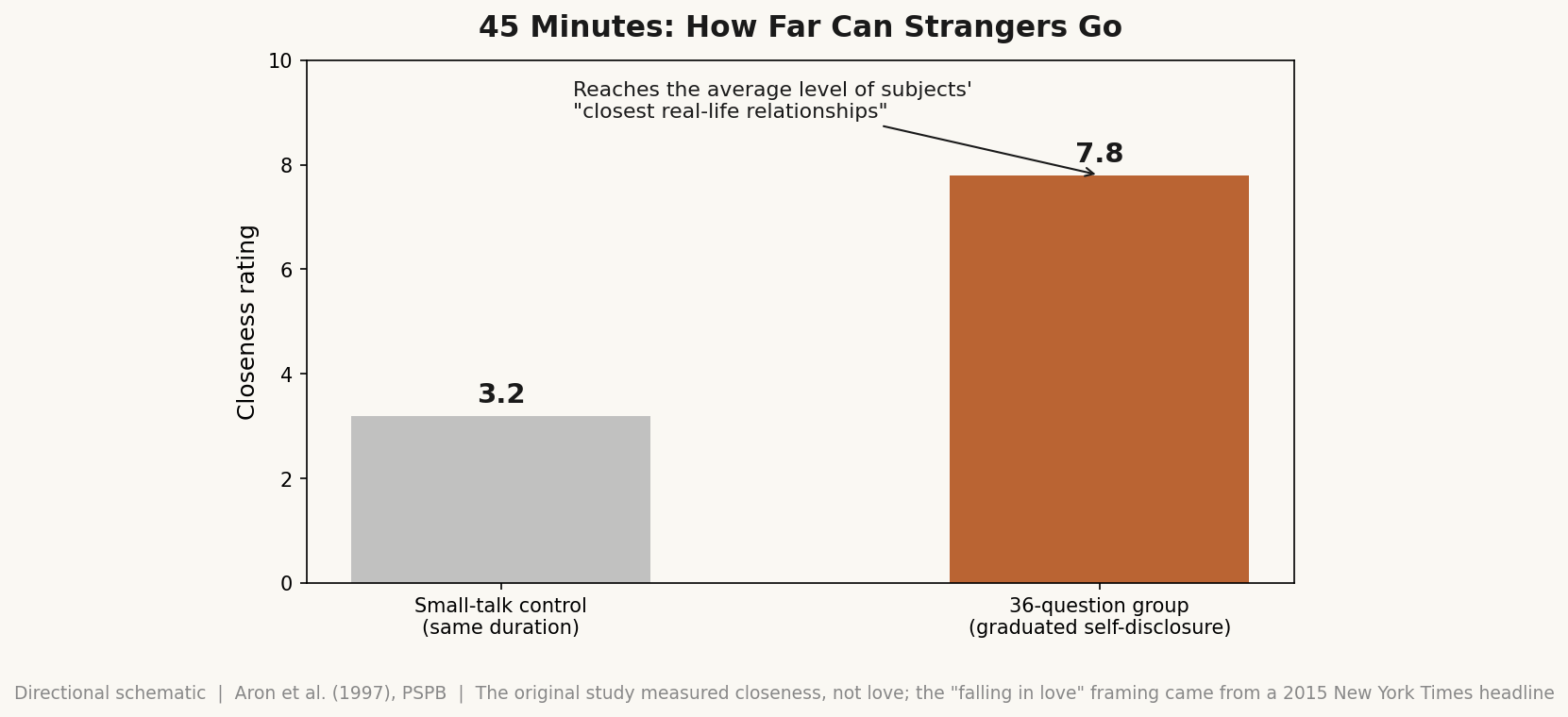
First, three corrections to the versions that got mangled in retelling — amusingly, the corrections are this chapter's best footnote:
One: the original paper measured closeness, not love.
Two: the "36 questions to make strangers fall in love" framing was a 2015 New York Times columnist's headline invention — not the paper's conclusion.
Three: "one couple married months later" was an anecdote from the early pilot phase, not an experimental result; the closing four-minute gaze was also added by the NYT version — it appears nowhere in the original paper.
See? Even the retelling of this experiment performs insincerity — embellishing, packaging closeness as love. While the paper itself proves the opposite: sincerity — gradual, genuine self-disclosure — is the most reliable recipe for closeness. That the rumor outruns the paper only shows how hungry we are for shortcuts, and how impatient with the honest road.
In 1973, Altman and Taylor gave the phenomenon a theoretical name in their monograph Social Penetration: social penetration. Intimate relationships develop as self-disclosure advances along two dimensions — breadth (how many topics) and depth (how deep) — like peeling an onion. Personality is layered; sincerity is letting the other person peel in, layer by layer — and daring to peel yourself open, layer by layer, in return. Those who won't peel are socializing. Those who dare are intimate.
Then Murray. In 1996, Murray, Holmes, and Griffin published a longitudinal study in the Journal of Personality and Social Psychology: people who idealized their partners (positive illusions) reported higher relationship satisfaction a year later, and their relationships were more likely to survive conflict and doubt; moreover, partners gradually internalized the idealization, becoming the better self seen through their lover's eyes. The paper's title says it verbatim: love is not blind, but prescient.
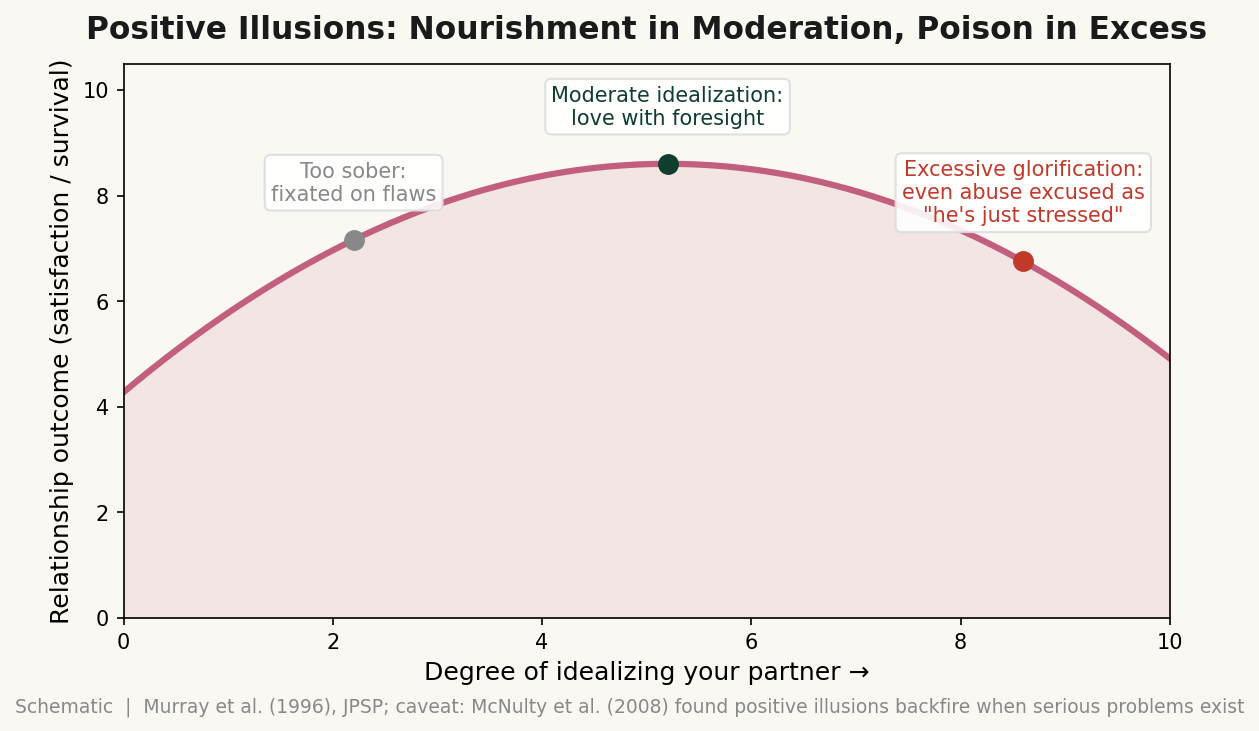
But one qualifier is mandatory — without it, this is chicken soup: McNulty and colleagues found in 2008 that when a relationship has serious problems, positive illusions backfire. The field's consensus is "moderate idealization helps, excessive idealization harms." Thinking a little better of your partner is nourishment; reframing abuse as "he's just stressed" is poison. One word apart — worlds apart.
Now for the sharpest cut from that old essay.
I wrote in Feelings Are Not Mathematics: "You may choose not to spend. But you may not refuse to bear any cost, enjoy the fruits of someone else bearing it, and then call their demand for fairness and responsibility 'materialistic.' That is not devotion. That is extraction dressed up as a value system."
In translation: the touchstone of sincerity was never what the mouth says — it is consistency in bearing costs. Those who denounce calculation must not live as another kind of calculation themselves. "I'll give exactly what I can get from you" sounds fair; in essence it still treats intimacy as a transaction. It is the other side of the same coin it condemns.
One more line from the original I want to keep, in spirit: "I'd rather drop the men-versus-women framing entirely, because this was never a men-versus-women problem — it is a human-to-human problem." What deserves vigilance was never "who should pay for whom," but the double standard: wanting to receive while rationalizing away responsibility; refusing to bear costs while demanding the other prove themselves worthy of being given to.
So the fourth movement is titled "Sincerity," but its content is really "against the fake." Algorithms can optimize matching, attachment can explain patterns, desire can negotiate space — but sincerity has no formula. Sincerity is the one non-computable variable: do you dare show your cracks first; do you dare bear costs without keeping books; do you dare be the same person when nobody is watching.
Coda: From Calculus to Sincerity
Last time, we dissected love with calculus: a crush is the derivative, love is the integral. That was mathematics at its most honest — where time is involved, calculus is more honest than adjectives.
This time, we set out from the algorithm, passed through attachment and desire, and arrived at sincerity. This is the other face of mathematical honesty: admitting that some things cannot be computed.
Feelings are not mathematics. But understanding feelings requires mathematics' honesty: check the original sources, label the boundaries, never sell correlation as causation, anecdote as conclusion, or clinical observation as law. Romance needs a hardcore foundation — otherwise romance is just bluffing.
You can work through every problem set of love — compatibility scores, sunk costs, optimal stopping. But don't forget: love itself is the question beyond the syllabus. Off-syllabus questions have no answer key. They only have honest answers.
❦
References
- Gale, D., & Shapley, L. S. (1962). College admissions and the stability of marriage. The American Mathematical Monthly, 69(1), 9–15.
- Nobel Prize in Economic Sciences, citation (2012): "for the theory of stable allocations and the practice of market design," awarded to Lloyd S. Shapley and Alvin E. Roth.
- Schwartz, B., Ward, A., Monterosso, J., Lyubomirsky, S., White, K., & Lehman, D. R. (2002). Maximizing versus satisficing: Happiness is a matter of choice. Journal of Personality and Social Psychology, 83(5), 1178–1197.
- Schwartz, B. (2004). The Paradox of Choice: Why More Is Less. Ecco.
- Zahavi, A. (1975). Mate selection—A selection for a handicap. Journal of Theoretical Biology, 53, 205–214.
- Hazan, C., & Shaver, P. (1987). Romantic love conceptualized as an attachment process. Journal of Personality and Social Psychology, 52(3), 511–524.
- Bartholomew, K., & Horowitz, L. M. (1991). Attachment styles among young adults: A test of a four-category model. Journal of Personality and Social Psychology, 61(2), 226–244.
- Perel, E. (2006). Mating in Captivity: Unlocking Erotic Intelligence. Harper.
- Aron, A., Melinat, E., Aron, E. N., Vallone, R. D., & Bator, R. J. (1997). The experimental generation of interpersonal closeness: A procedure and some preliminary findings. Personality and Social Psychology Bulletin, 23(4), 363–377.
- Catron, M. L. (2015, January 9). To fall in love with anyone, do this. The New York Times. (The origin of the popular "36 questions to fall in love" framing; the closing four-minute gaze also comes from this piece, not the original paper.)
- Altman, I., & Taylor, D. A. (1973). Social Penetration: The Development of Interpersonal Relationships. Holt, Rinehart & Winston.
- Murray, S. L., Holmes, J. G., & Griffin, D. W. (1996). The self-fulfilling nature of positive illusions in romantic relationships: Love is not blind, but prescient. Journal of Personality and Social Psychology, 71(6), 1155–1180.
- McNulty, J. K., O'Mara, E. M., & Karney, B. R. (2008). Benevolent cognitions as a strategy of relationship maintenance: "Don't sweat the small stuff"… Journal of Personality and Social Psychology, 94(4), 631–646.
- The author's original long-form essay "Feelings Are Not Mathematics" (the source of the "double standard" critique, adapted here).