At the end of the companion piece, we stood at the tipping point of language. The diagnosis is done: a six-layer autopsy, outside in — the performatization of public space, the defensiveness of human relations, the triple escape of individual expression: labeling (giving up precision voluntarily), coded speech (giving up directness under pressure), averaging (outsourcing expression to the machine); and deeper still, the structural encoding of language itself. The question now: what comes after the diagnosis? Time for the prescription — but before writing it, we have to make sure the patient still wants to live.
The companion piece ended at "the tipping point of language." This one starts construction at the tipping point.
Heidegger wrote a line in his Letter on Humanism that has been quoted into oblivion yet rarely taken seriously: "language is the house of Being" (Die Sprache ist das Haus des Seins). The companion piece told how this house got its cracks — this one tells how to rebuild the dwelling.
But first, be clear about what rebuilding is not. Rebuilding is not nostalgia. There is no returning to a golden age of "standard Chinese" — that age never existed. Classical Chinese had its hierarchies, official Mandarin its airs; every era's "good language" was earned by its people with their own experience, never inherited from the ancestors as a template. Today's problem isn't "the present falling short of the past" either, but the structural lesions the companion piece exposed: censorship demands "language that never errs," and AI delivers exactly "language that never errs" — what we must rebuild is not a more correct way of speaking, but a way of speaking that dares to take risks.
There's an even finer thorn, and it comes from an experiment. In 2019, Chen and Yang published a field experiment in the American Economic Review: they gave Beijing college students 18 months of free VPN access, and about half never used it — simply providing "free internet" barely increased the acquisition of sensitive information. Only when temporary incentives to read overseas news were layered on top did lasting gains in information acquisition appear. The conclusion stings: the strongest firewall of censorship isn't the wall — it's the "low demand" cultivated inside the wall. (Note: the sample was Beijing college students — an elite sample with heavy self-selection bias; but the finding of the "low demand" mechanism stands independently of sample size.)
This thorn sets this piece's starting point: the first step of the prescription isn't courage, it's curiosity. Not "dare to speak" — "want to know." Hand the sharpest linguistic tools to someone who has lost even the want to know, and they're useless. To rebuild language, first rebuild the desire of wanting — that sounds less like a prescription than common sense; but the companion piece's entire diagnosis points precisely at this: common sense is failing.
So this piece is structured accordingly: first the standard (what good language is), then the myth-busting (why critical thinking can't replace Chinese class), then the method (linguistic judgment), then into the field (the classroom and censorship). The diagnosis went outside in; this one goes inside out — from standard, to capacity, to action.
Why must the prescription be written now? Because the trend the companion piece revealed has a window: the three-rung compression ladder is still descending — labeling compresses words, formula compresses narratives, averaging compresses entire essays. What's next? Once AI starts "thinking" for you, even the act of compressing won't need your participation. The diagnosis's endpoint is the prescription's starting point; any later, and the patient won't even be able to hold the pen to sign.
Chapter 1 · The Standard of Good Language: Out of the Showroom
Let's first look at the house we're living in. Today's Chinese is looking more and more like a beautifully decorated showroom: picture-perfect — every sentence smooth, flawless, unassailable; yet nobody actually lives there — not one sentence claimed by its speaker's own experience; and the house-hunters are even told "this is the life you want" — platforms, PR departments, and algorithms all telling you: this is the safest, most respectable, highest-traffic way to talk.
Showroom language has three features: no mistakes, no people, no risk. No mistakes — perfect grammar, correct stance; no people — strip the byline and anyone could have said it; no risk — saying it is saying nothing, with no consequence to bear. The companion piece's "correct nonsense" is showroom language's standard floor plan.
So what's its antonym? Not "flowery language," not "eloquent language," but — "truth that carries risk."
The first standard of good language hides in that antonym. Language willing to carry risk is language that is alive. An "I was wrong," an "I'm not sure yet," an "I understand your anger but not your conclusion" — what these sentences share isn't correctness, but that the speaker has put themselves on the line: willing to be understood, answered, questioned, even refuted. Showroom language's problem was never "error" — it was "dare not."
The ancient Greeks had a name for this kind of language: "Logos." The word means far more than a synonym for "language" — it signifies "speech," and also "meaning," "law," "reasoning," and "the structure of the world's order." Philosophy is "love of wisdom"; philology is "love of Logos" — an intellectual tradition that pursues logic, justice, and truth within language. Today's language education, though, usually keeps only the "surface of language" — standardized drills in literacy, rhetoric, and sentence patterns — training not users of language but its assembly-line workers: fluent in grammatical frameworks, yet stripped of the capacity to "tell right from wrong, clarify relationships, and build meaning."
Logos is not a set of grammar rules but the ethical ground on which we judge the quality of language — the measure of whether language deserves "public space." Truly good language has at least three qualities:
First, it admits complexity instead of compressing reality into slogans. Our era's public language has long settled into the habit of "compressed expression": "being PUA'd just means getting harvested," "ordinary people are forever leeks" (jiǔcài — suckers to be harvested). These sentences sound blunt and satisfying, but they buy virality at a steep linguistic price: they cancel the room for thinking and cover up the complexity of reality. They are not narration but summons; not judgment but mustering. Genuine Logos speech dares to expose uncertainty, admits grayness, allows "but" and "maybe" — it can build insight inside ambiguity instead of manufacturing hallucinations out of black-and-white opposition.
Second, it has inner structure, not syntactic showmanship. "Good logic" doesn't mean abstruse jargon — it means language itself must carry clear causal structure, a sense of boundaries, and semantic self-consistency. For a sentence to stand, it must be able to answer: "Why am I saying this? What have I excluded? Does this judgment have preconditions?" Take "I think the problem with Policy X is that it ignores the real needs of Group Y" — it shows stance, direction, and a refutable logical path. While "Policy X is absurd, I'm floored," though emotionally clear, offers no linguistic doorway into any discussion. In today's internet expression, language is no longer the display of logic but the packaging of emotion: sentence patterns are used to perform stances, volume to substitute for reasons.
Third, it bears responsibility, not just defensive disclaimers. Good language never stops at "I'm done talking" — it must endure the consequences of after the talking. But today's public expression is increasingly degenerating into "opinion risk-hedging": "I won't comment personally, just reposting," "I'm not taking sides, I just hope everyone stays rational" — seemingly neutral, actually evasive of the responsibility of expression, engineering a speaking space that is both expressive and exempt. True Logos doesn't blur the stance; it pays the price inside language: making words a commitment willing to be tested, questioned, and revised.
Aristotle, in Book 1, Chapter 2 of the Rhetoric, lists three elements of persuasion: ethos (character/credibility), pathos (emotion/resonance), logos (logic/argument). The interesting part is his order: ethos comes first. Emotional mobilization without character as its guarantor is manipulation; character without logical support is just a persona. In the companion piece we saw that pathos is the resonance factory's most profitable fuel (Brady et al., 2017: each additional moral-emotional word boosts diffusion by about 20%) — so the Logos citizen's first lesson is to legislate for pathos: emotion isn't the enemy; arbitraged emotion is. Tears may persuade, but they may not pass inspection-free.
And logos — often mistranslated as "logic" — in Aristotle isn't a logic lesson but "the courage to give reasons." The difference between a reason and an excuse: reasons welcome refutation; excuses fear follow-up questions. Behind "because that's what the data shows" lies a methodology appendix; behind "because everyone says so" lies silence. The logos of good language dares to lay the whole chain of "why I said this" on the table for anyone to take apart.
Who renovated the showroom? Three construction crews: platforms want traffic and teach you "this is how to get followers"; PR wants safety and teaches you "this is how to stay safe"; AI wants efficiency and teaches you "this is how to save effort." Different goals, strikingly identical floor plans delivered: no mistakes, no people, no risk. Only after seeing the renovation crews clearly can you decide whether to take the keys.
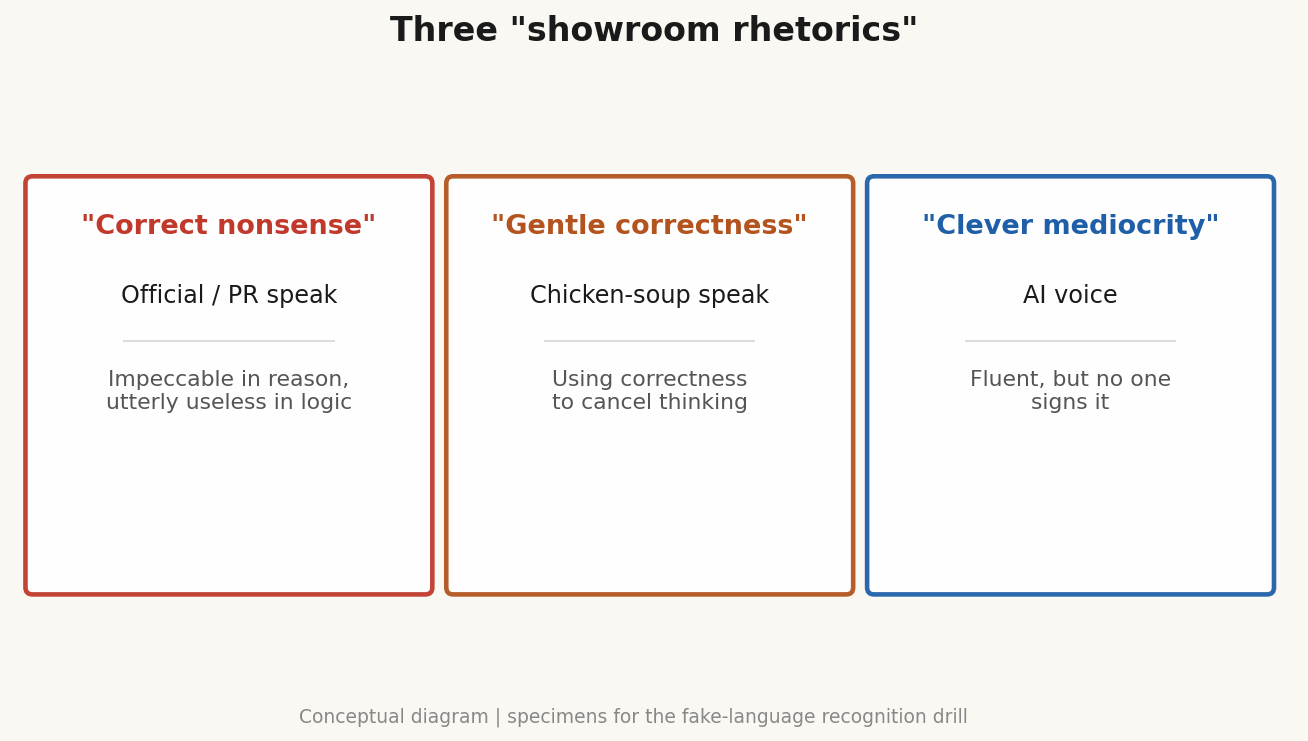
To recognize fake language, start with the three "showroom rhetorics." They are the anatomical specimens for the fake-language recognition drill:
Three "showroom rhetorics" — conceptual diagram | specimens for the fake-language recognition drill
"Correct nonsense" (official/PR-speak): unassailable in principle, utterly useless in logic. "We attach great importance to this, are studying it, and are making steady progress" — grand subjects, suspended verbs, not one sentence that could be verified.
"Gentle correctness" (chicken-soup speak): its viciousness is better hidden — it uses correctness to cancel thinking. "Life is like rain: someone always has an umbrella, someone always gets wet" — beautiful? Yes. Useful? It used one piece of correct nonsense to finish all your thinking about the predicament for you, letting you mistake "being comforted" for "being solved."
"Clever mediocrity" (AI-speak): fluent, but nobody owns it. "First, second, last," "worth mentioning," "all in all" — perfect structure, complete set of points, and after reading you can't recall who said a single sentence. Because indeed, no one said them.
Apply the three standards to a sentence we all know by heart: "Your hard work now is for a better life later." Admits complexity? No — between "effort" and "good life" lie ten thousand variables, flattened by one sentence. Has inner structure? No — the causal chain is broken; the conclusion arrives first. Bears responsibility? No — the people who say it (teachers, parents, public accounts) will never answer for your "later." Struck out on all three. That's the textbook specimen of "correct nonsense."
What the three share: many words spoken, not a single question clarified; emotions generated, judgment obscured. Language education should never be cultivating expressive performers who write flowery essays and deploy template clichés — but Logos citizens who can spot bad language, reach complexity, and answer for what they say.
Finally, be clear about what a Logos citizen is not. Not "someone who never errs" — error is language's normal state; refusing correction is the disease. Not "someone always rational" — emotion is language's flesh; only arbitraged emotion is poison. And not "the loudest voice" — volume doesn't equal accountability. A Logos citizen has exactly one passing line: do you own what you said? Language its speaker owns, however clumsy, is alive; language disowned, however flawless, is just showroom décor.
Chapter 2 · Why Critical Thinking Can't Replace Chinese Class
A seductive argument has been making the rounds in recent years: isn't language education inefficient? Why not swap it for "logic classes" or "critical-thinking training"? It sounds tidy and rationally elegant — but its central mistake is this: it treats language as an information-processing system, and forgets that language is first the folding of interpersonal reality — the interface where experience meets relationship.
Daniel Willingham's classic 2007 essay in American Educator argued that critical thinking is domain-dependent: generic critical skills, stripped of subject-matter knowledge, rarely transfer to new domains. You can learn to spot the "straw-man fallacy" in a logic class and still forward a "shock-style" health article to the family chat. The skill never grew where it needed to grow. (Note: Willingham's argument is a field review and theoretical case, not a single experimental finding.)
Logic is cold; language is warm. Logic demands consistency, excluded middle, non-contradiction; language demands sensitivity, relational awareness, situational judgment. Logic training can tell you whether a sentence "holds up," but language education must go further and ask: "Should this be said here? Is it said well? Whom does it wound? Does it bury something deeper?" Critical thinking cares about "true or false"; language education cares about "fitting," "considerate," "appropriate."
Logic training teaches you to build arguments; language education teaches you to build trust and understanding. Saying "you're always so emotional" mid-argument is, logically, a judgment sentence — but in the language of relationships, it can be a deep wound: it revokes the other person's right to their feelings and shuts the door on the conversation. What language truly trains is a kind of ethical sense for language: not "can I say this," but "should I say it this way"; not "am I right," but "will this sentence, spoken inside this relationship, collapse understanding?"
Take an example. Faced with the same headline — "SHOCKING! Scientists discover…" — critical-thinking training teaches students to ask: "How big was the sample? Where's the control group?" — correct, but only half the job. An ethical sense for language also asks: "Who chose the word 'shocking'? What emotion does it want out of me? If I forward it, whose words am I amplifying?" The first is "don't get fooled"; the second is "don't be an accomplice." Critical thinking protects your judgment; an ethical sense for language protects your speech — and in an era when a forward is participation, the latter is the scarcer resource.
So when we compress language education into an appendage of critical-thinking courses, what we train are "refutation machines" instead of "understanders," "opinion-staters" instead of "relationship-builders." A logic class teaches you to win a debate; a language class should teach you not to turn every conversation into a debate. This chapter's job ends here — ruling out a wrong answer. What follows is the real work.
Chapter 3 · Linguistic Judgment: A Decompression
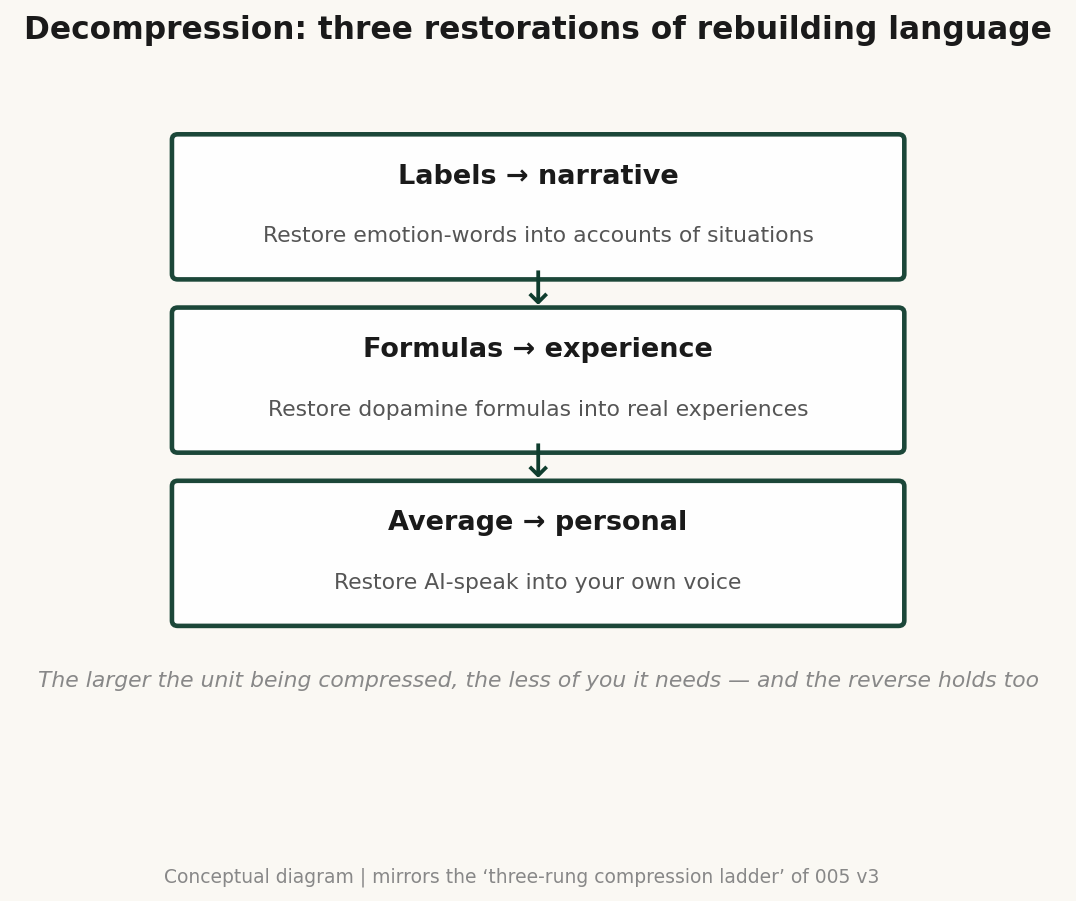
The companion piece (v3) built a "three-rung compression ladder": label compression (emo / "crispy youth" [脆皮, young people who break easily]) → formulaic narrative compression (the short-drama template of "conflict — action — reversal — payoff") → averaged whole-text compression (AI-speak). The units being compressed grow ever larger; the part of ourselves we have to engage shrinks ever smaller.
The prescription of this piece is to climb that ladder back down: rebuilding language is a decompression.
Decompression: three restorations of rebuilding language — conceptual diagram | mirrors the "three-rung compression ladder" of 005 v3
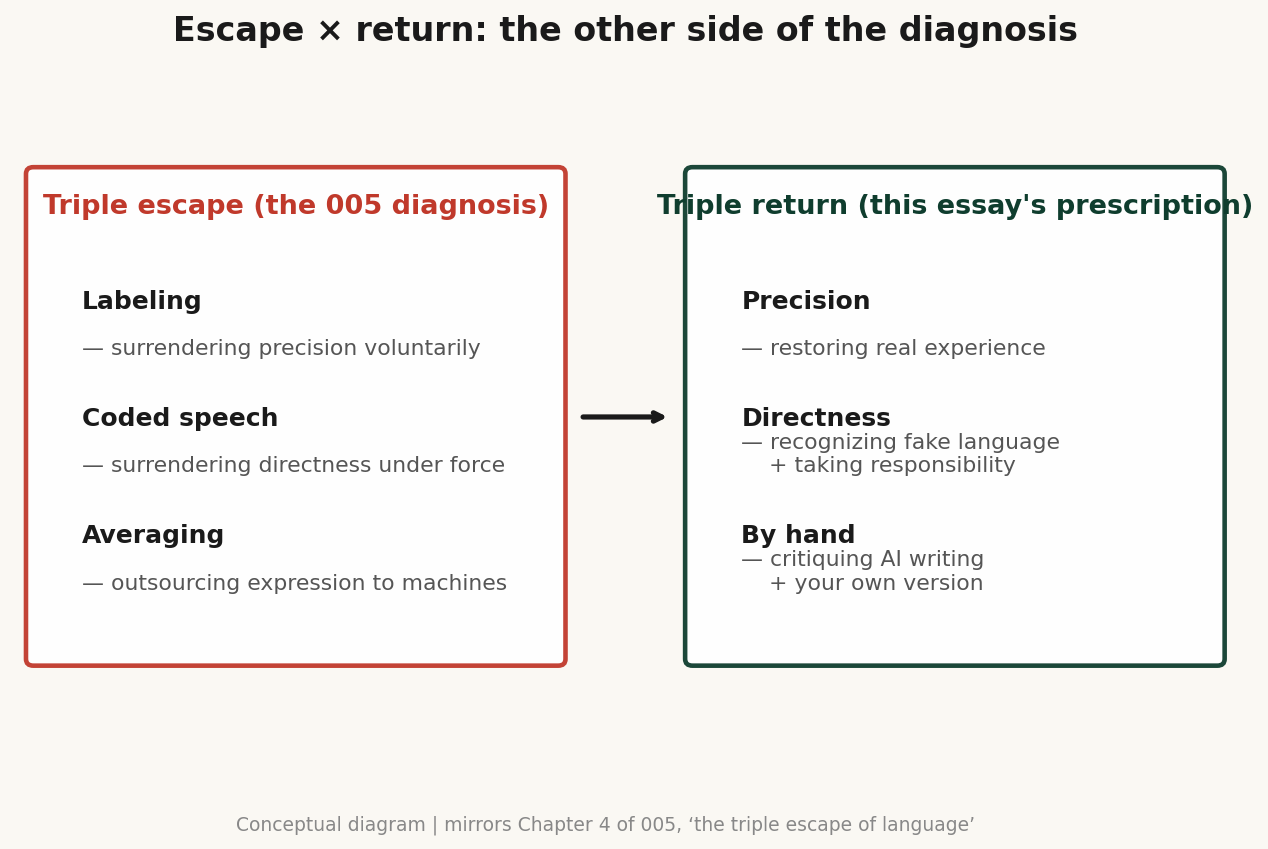
And each rung of the triple escape has its return move: the deliberate surrender of precision → precision; the coerced surrender of directness → directness; outsourcing to the machine → your own hands.
Escape × return: the other side of the diagnosis — conceptual diagram | mirrors Chapter 4 of 005, "the triple escape of language"
Here we first answer a theoretical question left open by the companion piece. At its close, we borrowed Ong's "secondary orality": short video + livestream + danmaku (bullet comments) are dragging language back toward "voice + facial expression + instant reaction" — a "second oralization." So what's the answer? A retreat to the written word? No. The answer is to cultivate a "third linguistic capacity": to keep the rigor of writing amid the flood of speech, and to keep the life of speech inside the written tradition. Not pitting classical prose against short video, but being able to speak one sentence that survives scrutiny inside a 15-second clip — that is the contemporary definition of "linguistic judgment."
What does this third capacity look like? Take the same act: posting an overtime complaint to your feed. Language one (short-drama style): "A laborer's last stand: grinning through overtime, crying all the way home #broken." Language two (bureaucratic style): "Guided by the striver's spirit, I shall devote myself to work with ever-fuller enthusiasm." Language three: "Walking out of the office at ten tonight, I saw the convenience store downstairs still lit. And it hit me — if the endpoint of 'hard work' is 'getting used to the dark,' maybe I've been walking the wrong way." No melodrama, no correctness — just honesty. And honesty is the scarcest genre of our time.
Linguistic judgment is not a course; it is a set of muscles. At least four drills, each with an exercise:
Exercise 1: Recognizing Fake Language — Dissecting "Correct Nonsense"
Fake language isn't the wrong use of language; it is language's structural misdirection: perfect form, sincere tone, yet manipulation hidden in content and direction. The three avatars of manipulative speech from Chapter 1 are our specimen cabinet.
Exercise: Find a piece of "correct nonsense" you recently encountered (an official notice, a PR statement, a chicken-soup post — all count) and do three things — ① strike out every adjective and adverb, and see what survives; ② replace every "we" with a specific person's name, and see whether the sentence still holds; ③ restate its actual message in one sentence. If what comes out is "I submit, therefore I deserve to be left in peace" — congratulations, you dissected it correctly. (That last line is a joke, and also the model answer.)
Exercise 2: Restoring Real Experience — Reverse Compression
One of the great traps of contemporary writing instruction is turning expression into "a kit of sentence templates + express delivery of emotion." A student writes in an essay, "I will never forget the moment tears filled my eyes," yet in real life cannot say why he is heartbroken — was it anger, shame, disappointment, or the feeling of being misunderstood? What language education must solve is not "what to write," but "how to face experience without shame in writing it down."
This has an empirical footnote — a modest one. In 1986, Pennebaker and Beall reported in the Journal of Abnormal Psychology: participants who wrote their traumatic experiences into coherent narratives showed small improvements in subsequent health measures. The effect was small, the mechanism disputed, but the direction is worth taking seriously: working experience into language is itself a reverse compression — restoring labels back into narrative. (Note: the effect size was small, and samples were mostly college students; we take from it only the directional lesson that "writing organizes experience," not any claim of therapeutic efficacy.)
Exercise: Pick one emotional label you use often (emo / "lying flat and rotting" [摆烂] / "broken" [破防] — take your pick) and write 200 words: no using the word itself, only what happened that day, which part of your body felt it first, and the one sentence you most want to delete. When you finish, you'll see: a label is an elevator, a narrative is a staircase — the elevator is fast, but you've never once seen the view.
Exercise 3: Building Judgment in Language — First, Don't Let Pretty Conclusions Arbitrage You
When a student reads "young people are lying flatter and flatter," a language class shouldn't ask him to imitate the "phenomenon — analysis — conclusion" three-part essay; it should help him notice: is this an observation or an emotional discharge? Where is the data? Is "lying flat" a self-description or an accusation? Is it using individual choices to mask structural injustice?
And whoever teaches this lesson must model it first. In 2013, Kidd and Castano published a beautiful study in Science: reading literary fiction improves "theory of mind" (empathic capacity). A moving conclusion, wildly amplified — but the replication attempts that followed over the years mostly failed to reproduce the result, and the controversy burns on. This is linguistic judgment demonstrating itself: those who teach others to spot fake language must first admit that they, too, can be arbitraged by a pretty conclusion. (Note: the replication controversy is serious; we cite this not as settled evidence but for its pedagogical value — "even beautiful conclusions need checking.")
Exercise: Find a trending opinion that made you nod hard, and trace it to its original source. Record three things: what the original study actually said, what got lost in media retelling, and why you believed it without hesitation in the first place. The third is the most important — seeing why you think the way you do is harder than seeing why others are wrong.
Exercise 4: Telling Beauty Apart from False Rhetoric
"We must be like seeds: take root, sprout, break through the soil, grow, blossom, bear fruit." Lovely to the ear — but essentially emotional vapor: no background, no logic, no accountability. The rhythm of a sentence cannot substitute for the density of judgment; the melody of language cannot paper over the hollowness of its content.
Exercise: Find a passage you think is "beautifully written," read it aloud three times, then ask yourself: if I delete every metaphor and every parallel construction, what claim is left? If the answer is "nothing," then it is false rhetoric — beautiful, but empty. Chapter 1's "gentle correctness" is its highest form: not merely empty, but using correctness to cancel your thinking.
Integrated Exercise: A Full "Decompression" Drill
Find a short video or public-account article you forwarded yesterday and walk through all four steps: ① spot it — which avatar of manipulative speech did it use? ② restore it — decompress its core emotional word into a 200-word narrative; ③ build judgment — which link of evidence is missing from its chain of reasoning? ④ tell beauty from rhetoric — delete all the ornament; what claim survives? Only forward it if you still want to after all four steps.
The ambition of this drill: to turn "linguistic judgment" from a classroom assignment into muscle memory. Like logic and the Bad News game: it's not telling you not to get fooled — it's making you play the scammer once, so you never forget how the scam works.
Above the four drills lies one deeper lesson, borrowed from the companion piece's Raskin: "incentives eat intentions" — incentives eat intentions. The final lesson of linguistic judgment is not spotting other people's fake language, but "seeing why you say what you say": did you post that feed to express something, or to harvest likes? Do you use that buzzword because it's accurate, or because it's safe? Behind every utterance stands a set of incentives. Fail to see it, and every technique you drill is just laboring for the mechanism.
Chapter 4 · The Classroom as the Scene: Three Practices and an AI Critique
The standards are set, the muscles mapped — now we enter the field. If language education once concerned itself with the "acquisitional" side of language, it must now turn toward language's "reality" and its "ethics": not teaching students to write like model essays, but teaching them to recognize the complex architecture of the linguistic world, to understand the intentions behind utterances, and to shoulder the public responsibility of expression. Three practices, each with flesh and blood.
Practice 1: Bringing Real-World Language Samples into the Classroom
The language classroom can no longer confine itself to textbooks and canonical literary excerpts; it must face head-on the "contamination fields" and "resonance fields" of everyday language: the structural emotional marketing of viral WeChat public-account essays, the authority-building logic of top-voted Zhihu answers, the headline grammar and traffic-bait mechanics of short videos, the recurring "identity-undermining" formulas of online flame wars ("people like you have no right to talk about fairness"), and the concrete pragmatics of teenage slang like "shuan Q" (a sarcastic "thank you") and "I'm cracked" (裂开, overwhelmed).
These fragments of language reflect the expressive world students actually inhabit far better than "Moonlight over the Lotus Pond" (a canonical Chinese textbook essay) ever could. The classroom's job is not to condemn these forms of speech from a moral high ground, but to train students in "reading language": seeing through linguistic structures, spotting discourse traps, tracking presupposed stances, analyzing how grammar carries intent. In short: not teaching them to write like the gaokao's top scorer, but teaching them to read the hand behind the language.
Take a concrete classroom exercise. Put up a real short-video headline: "Earning ¥3,000 a month, I staged a nìxí (逆袭, underdog comeback) all the way to director with this one habit." Then have students run a "four-question teardown": ① What starting point does "nìxí" presuppose? (That your life is miserable right now.) ② Why won't it just say what "this habit" is? (The curiosity gap — engineered to earn the click.) ③ What is the relationship between "¥3,000 a month" and "you"? (Identity interpellation: it's talking about you.) ④ If the headline were rewritten as "Sharing my career journey," how many clicks would it lose? (Form is content: the headline's grammar is the grammar of traffic.)
After four questions, students discover: the headline isn't packaging for the content — the headline is the content. This ability to "read language" brings them far closer to the linguistic world they face every day than memorizing ten essays' "main-idea summaries" ever could.
Practice 2: Language-Ethics-Driven Real Assignments — the "Risky Truth-Telling" Exercise
To turn the language class from a "craft apprenticeship" into an "ethical practice," the assignment system has to be rebuilt: pry open the applied scenarios of writing, and let students learn to bear the weight of language inside real human relationships. Below is a complete assignment, ready to use as-is:
Assignment: a "risky truth-telling" exercise
Pick something you've been deflecting with labels, jokes, or silence (emo, "lying flat and rotting" (摆烂), "I'm fine" — all count). Write 300 words. Rules: ① Write only facts and feelings — no slang, no idioms, no golden quotes, no meme captions; ② You must include one sentence "you've never dared to say out loud"; ③ After writing, answer three questions: Which sentence made your hand tremble as you wrote it? Which sentence did you almost delete? If this went public, whose eyes would you fear most?
Grading: no points for style, none for structure — only one thing matters: did you keep the sentence you almost deleted? Keep it, full marks; delete it, zero. The teacher has no right to make you share it — but you have the right to demand honesty of yourself.
Design note: this exercise doesn't train writing; it trains "bearing." Slang is language's airbag — this assignment confiscates the airbag first, then puts you on the road. The sentence that made your hand tremble is the first brick your language carries out of the "showroom."
Assignments like this are no longer formal drills but training in the ethics of language use: they make students realize that language is not symbols drifting in a void, but "moral instruments" inside our relationships with one another. From "skilled language user" to "ethical language agent" — that is the fundamental turn of 21st-century language education.
Practice 3: Rhetoric-Critique Workshop — Play the Villain First
Building linguistic judgment takes more than writing drills — it takes "semiotic-critical capacity." And the best way to learn critique isn't to sit through lectures; it's to play the manipulator.
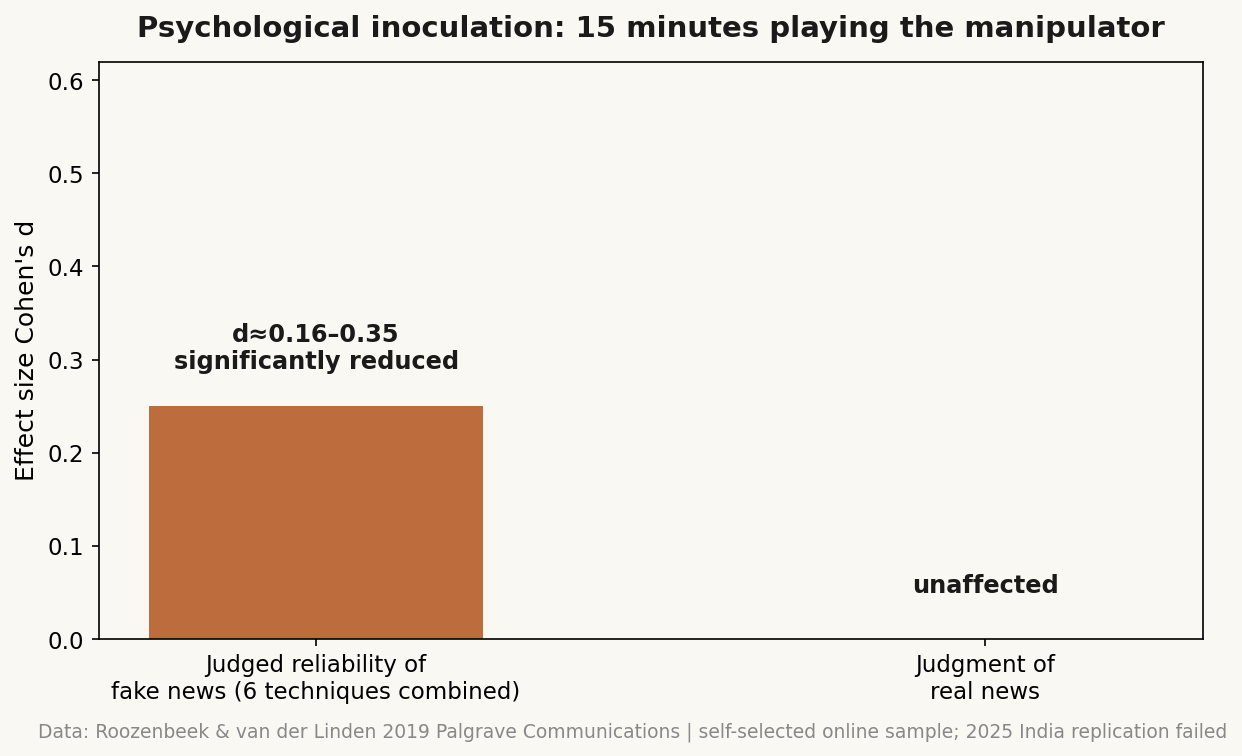
In 2019, Roozenbeek and van der Linden published a study in Palgrave Communications: players took on the role of fake-news producers, actively deploying six manipulation techniques (discrediting opponents, emotional language, polarization, impersonation, conspiracy theories, trolling), and just 15 minutes of play significantly lowered their reliability ratings of mock fake-news items (per-technique effects d≈0.16–0.35), while leaving their judgments of real news untouched. The theoretical source is the "inoculation theory" McGuire proposed in 1964: like a vaccine, pre-exposure to a weakened "virus" builds psychological resistance. (Note: the 2019 study relied on a self-selected online sample, skewing young and highly educated; a 2025 replication on an Indian sample found no improvement in discernment — cross-cultural generalization requires caution.)
Psychological inoculation: 15 minutes playing the manipulator — Data: Roozenbeek & van der Linden 2019 Palgrave Communications | self-selected online sample; 2025 India replication failed
Translated into classroom language: instead of lecturing students for 40 minutes on "don't be gullible," let them be the "con artist" for 15. A workshop could run like this: split into groups, each group takes a "manipulation mission" — write a headline for a fake news item using three techniques; trade headlines and tear each other's apart; finally vote: which headline did you almost believe, and why. Get fooled by your own work once, and the immunity starts to grow.
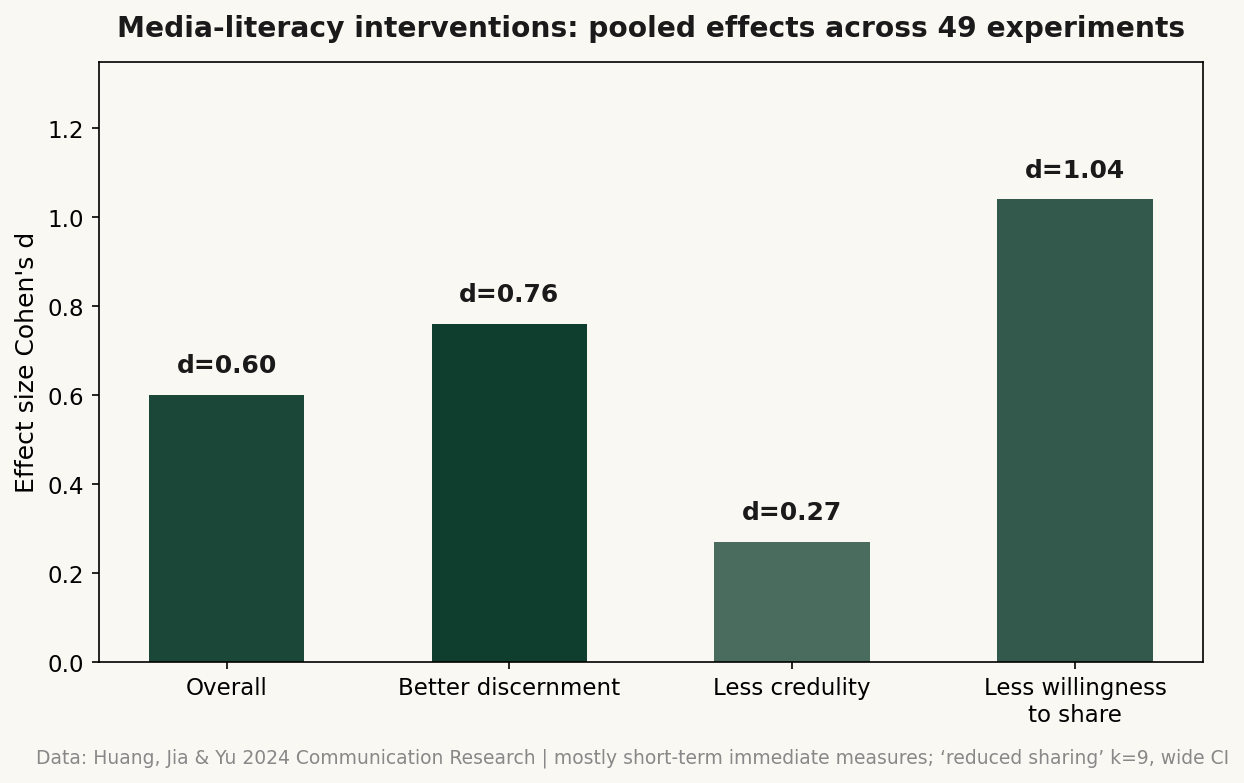
This isn't one-off-lecture material. A 2024 meta-analysis by Huang, Jia and Yu in Communication Research pooled 49 experiments (N=81,155): media-literacy interventions showed an overall effect of d=0.60, with d=0.76 for improved discernment; multi-session programs beat single-session ones. (Note: mostly short-term immediate measures, with insufficient evidence on long-term retention; the "reduced sharing" outcome had only k=9 and a wide confidence interval.) The conclusion is blunt: the workshop should be a series, embedded across the term — not 40 minutes on the first day of school.
A final word on assessment. The workshop's KPI shouldn't be test scores — it's whether, three months later, a student pauses for three seconds before forwarding a "SHOCKING!!" headline. Those three seconds are linguistic judgment.
Media-literacy interventions: pooled effects across 49 experiments — Data: Huang, Jia & Yu 2024 Communication Research | mostly short-term immediate measures; "reduced sharing" k=9, wide CI
Critiquing AI Writing: Turning Poison into Dissection Samples
The companion piece diagnosed AI homogenization: AI compresses the variance of writing complexity by 21%–50% — meaning preserved, style flattened. This piece's prescription is not to ban AI — a ban wouldn't hold — but to treat AI text as dissection samples:
Step one, hunt for AI-isms: students collect AI-generated text and flag landmark formulations like "firstly, secondly, finally," "it is worth mentioning that," "in conclusion" — mapping AI's "factory settings." Step two, rewrite: on the same topic, students write their own version by hand, with one rule: none of the flagged formulations may appear. Step three, compare: the two versions side by side, the whole class votes on which "sounds more human," with reasons — reasons that must come down to a specific word choice.
Here's a comparison. Same topic, "AI's impact on education":
AI version: "First, artificial intelligence has brought unprecedented opportunities to education. It is worth mentioning that personalized learning has become possible. In conclusion, technology is reshaping the future of education."
Student rewrite: "My little cousin's math homework is graded by AI now. He told me there's no more handwritten 'think again' from the teacher in his mistake notebook — just a cold 'explanation.' He says he kind of misses being scolded."
Every word in the AI version is correct, but not a single sentence "owns" itself; the student version has rough grammar and spoken tics, but a person stands behind every line. That is the eye the AI-critique lesson must train: not distinguishing "which piece was written by AI" (you soon won't be able to), but distinguishing "which sentence has someone standing behind it."
There's a mechanistic footnote buried here. Mueller and Oppenheimer reported in 2014 in Psychological Science that longhand note-takers outperformed laptop note-takers on conceptual understanding — the mechanism being that fast typing produces verbatim transcription (capture), while slow handwriting forces selection and processing (digestion). But the finding didn't survive replication: Urry and colleagues' 2021 direct replication plus a meta-analysis of 8 studies found no significant difference. What did survive is their distinction between the two processes: transcription and digestion are two different things. (Note: the original finding failed to replicate; only the mechanistic distinction of "transcription vs. digestion" is borrowed here — no claim is made that handwriting is better.)
This is precisely the core of the writing class in the AI age: AI completes the transcription for you, but takes away the part that is digestion — and understanding grows exactly out of the struggle. When machines can write everything, the function of writing a sentence by hand changes: no longer "expressing a thought," but "confirming that you still have thoughts." Writing one sentence AI can't write is one proof of "I'm still alive." This isn't nostalgia; it's existentialism.
A Third Linguistic Space
What do the three practices plus the AI critique add up to? Chapter 6 of the companion piece said it: students live inside short-drama language every day, while the classroom is still teaching "parallel sentence structures" — two species that don't speak to each other. The goal of reform isn't for school to outcompete short dramas (it can't) — it's to make the classroom a third linguistic space: neither the dopamine grammar of short dramas nor the craft aesthetic of eight-legged essays, but a place where "you can speak slowly."
Concretely, it could be a ritual: one "slow-language time" per week — no slang, no internet memes, no meme captions, no AI-isms; say one thing in your own words. At first there will be dead air, embarrassment, someone saying "this is too hard." Hard is right — hard means the muscle is growing.
Picture the lesson: the teacher announces — "emo, 'juéjuézi' (awesome-sauce), 'family' (家人们, livestream-speak for 'folks'): banned for the next 40 minutes." The first ten minutes, the classroom is terrifyingly quiet. Someone squeezes out a sentence: "Yesterday I... felt pretty bad." The teacher asks: "What kind of bad?" He thinks for a long time: "Like... my mom went through my phone, and I couldn't fight with her, and I couldn't not be angry." Forty minutes, and only one thing got said clearly. But that one thing was his own.
Chapter 5 · Facing Censorship: While Staying Safe
A book of prescriptions cannot dodge this question. The companion piece mapped "coded speech": censorship manufactures the demand for "safe expression." But after the diagnosis, an honest question remains: what can we do while staying safe? This chapter is no manual for confrontation — that would be neither realistic nor responsible. It offers only cognition, and personal integrity.
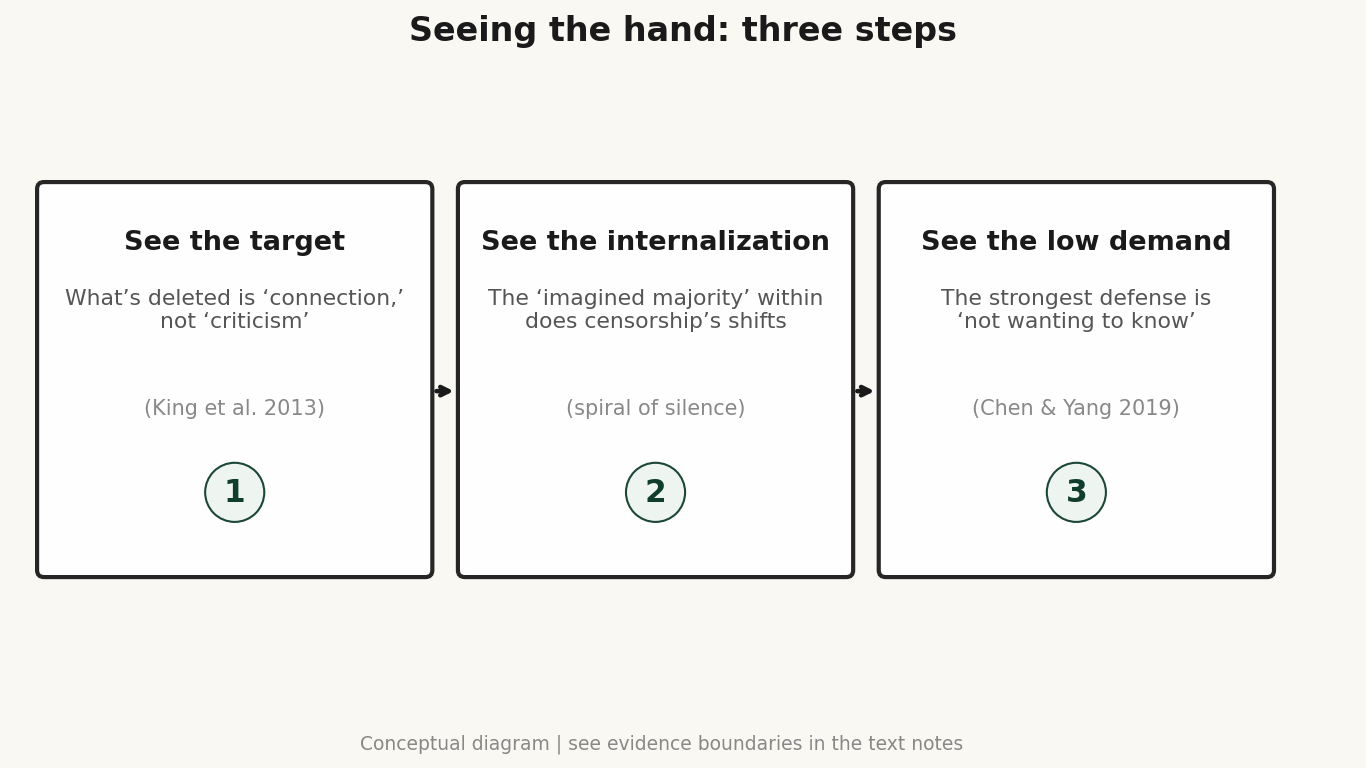
Step 1: See the Hand
First, know this: censorship has an invisible hand steering what you see every day, which in turn shapes what you put out. And that hand is more precise than you would imagine. In 2013, King, Pan, and Roberts published a study in the American Political Science Review covering nearly 1,400 Chinese sites and millions of posts: harsh, even vitriolic criticism of the government was not more likely to be deleted; what got deleted was content that "represents, reinforces, or incites social mobilization" — censorship targets collective-action potential, not criticism itself. It deletes "connection," not "bad words." (Note: an observational study using data from the first half of 2011; the conclusions concern deletions specifically and do not directly extend to other tools such as algorithmic downranking.)
Seeing the hand: three steps — conceptual diagram | see evidence boundaries in the text notes
Step 2: Seeing the Internalization — the "Imagined Majority" Within
Censorship's most economical form is not deletion — it is getting you to do the deleting yourself. Noelle-Neumann's "spiral of silence" theory (1974) describes the mechanism: people fearing isolation hide views they believe to be in the minority; the silence makes the minority look even smaller, and the spiral reinforces itself. (Note: a theoretical framework, not settled fact — Glynn et al.'s 1997 meta-analysis found the link from "perceived opinion climate" to "willingness to speak" to be generally weak; it is used here as an interpretive lens.)
In plain language: censorship's most successful product is the "imagined majority" inside your head. Nobody deleted your post — but before you hit send, you had already rehearsed the deletion on censorship's behalf. Deletion is censorship's hand; self-censorship is its glove — and the glove gets far more use than the hand.
What does the "imagined majority" look like? A daily scene: in the class group chat, someone drops an obviously manipulative link; you sense it is wrong, but seeing "38 likes already," your finger freezes over the keyboard, and in the end you send a "haha." Of those 38 likes, thirty may belong to people exactly like you — and nobody spoke first. The cruelty of the spiral of silence: the silent majority does not disagree; everyone is simply waiting for someone else to speak first.
Step 3: Facing "Low Demand" — the Hand Is Already Inside Your "Wanting"
Here the thorn planted in the opening finds its resolution: Chen and Yang's experiment tells us that censorship's strongest fortress is the "low demand" cultivated inside the wall — the hand does not only press down on your mouth; it has reached inside your "wanting." When you no longer want to know, the wall no longer needs to exist. So the first step of "staying safe" is not climbing the wall; it is first admitting: how much of my "not wanting to know" is truly mine, and how much was cultivated in me?
The Crux: Telling "Can't Say" Apart from "Don't Want to Say"
Censorship's most complete victory is not making you shut up; it is getting you to speak its language willingly, until you yourself can no longer tell which sentence was forced and which was free. Keeping that distinction alive is resistance. "Can't say," I accept — that is risk calculation; "don't want to say," I must interrogate — that is the censorship of desire. Every time you are about to say "forget it," ask yourself: is this can't, or don't want? To tell the difference is to be awake; to fail is surrender.
Three self-check questions for bedtime: ① the sentence I left unsaid today — was it "risky to say," or "too lazy to think"? ② the view I reposted — did I verify it, or did I share it only because "everyone says so"? ③ the last time my hand shook as I wrote something true — when was it? These three questions need no audience — answering them to yourself is the everyday version of "living in truth."
Havel: The Greengrocer's Slogan
In 1978, the Czech playwright Václav Havel wrote Moc bezmocných (The Power of the Powerless). Its most famous passage: a greengrocer's manager who, every day among the onions and carrots in his shop window, hangs the slogan "Workers of the world, unite!" Havel asks, one question after another: why does he hang it? Does he truly believe it? Has he ever thought about what such unity would actually mean?
The answer defeats every simple moral judgment: the vast majority of shopkeepers never think about these slogans — the slogans arrive from headquarters along with the onions and carrots; he hangs it only because "it has always been so, everyone does it, it must be so." The slogan's real message is not "workers, unite" but: "I obey, therefore I am entitled to be left in peace." (The translation paraphrases Paul Wilson's English edition; no standard Chinese translation exists.)
Havel's key insight is this: the greengrocer is no two-faced opportunist — the ritual is automated. And "living in truth" is not a call to open confrontation but a refusal to take part in ritual lies — beginning with small acts like taking down a slogan. (Note: Havel's analysis of "post-totalitarianism" addresses a specific regime experience; drawn on here only for its mechanism of "automated ritual" and "refusal to participate," not as a regime analogy.)
The greengrocer's slogan is "correct nonsense" personified: what censorship wants is not your belief but your participation. The person who hangs that slogan with his own hands every day is not a victim but a co-builder — and the starting point of "living in truth" is first seeing the slogan in your own hand.
Write It Down: What You Can't Say Out Loud, Write Down First
Finally, a minimal action. Pennebaker from Chapter 3 returns here: turning lived experience into language is itself a form of preservation. What you can't say out loud, write down first — even somewhere no one will ever see. Writing it down refuses to let that sentence live only under the censorship of the "imagined majority." Censorship can delete posts, but it cannot delete the notebook in your drawer; "low demand" can cultivate not-wanting-to-know, but it cannot cultivate the resolve to "write it down and tear it up" — before it is torn up, it existed.
What to write? Three things are most worth writing: ① the sentence you dare not say aloud (a continuation of Exercise 2); ② the moment you caught yourself being cultivated into not-wanting-to-know (your personal B3); ③ a piece of "correct nonsense" you uttered today, and what it could originally have been. Show it to no one. The drawer is the last free-speech zone.
Coda: Rebuilding the Capacity for Understanding
Six layers dissected, the triple escape seen through, the showroom toured to boredom. One question remains: what kind of language is worth moving into?
A truly effective language education should cultivate four basic linguistic capacities in a person — this is a sentence from the author's 2025 draft, preserved word for word in the rewrite because it deserves it:
Use language to perceive complexity, not to block it out.
Use language to build trust, not defenses.
Use language to take responsibility, not to dodge it.
Use language to generate understanding, not to draw battle lines.
This is not just a question of rhetoric, but the fundamental training in whether a person can possess a "world-form" of their own.
Wittgenstein appears in both pieces only this once. In Philosophical Investigations §19 he wrote: "To imagine a language means to imagine a form of life." (Chen Jiaying's translation, Shanghai People's Publishing House, 2001) — borrowing his words: rebuilding the dwelling place of language means imagining another form of life. A life not lived by labels, not surviving on coded speech, not outsourcing expression to machines. (Note: §19's original context argues for the diversity of language games; this is an extended borrowing.)
So whether we can win back the warmth of language and restore its power depends on whether one true Chinese class still exists — a class whose destination is not answering test questions, whose task is not recitation, but one that takes language as the starting point for understanding the world, sensing others, forming the self, and entering public life.
Not to write "correct language," but to dare bear the consequences of speaking. Not to utter "pleasing words," but to dare expose the world's pain. Not to hold "the right to speak," but to possess "the responsibility of speech." Not to recite "I love this land," but to understand "why I love it." Not to write "love of life," but to tell "life's hardness." Not to be good at essays, but to dare tell the truth. Not to be fluent of speech, but to be willing to speak responsibly.
The companion piece diagnosed the crack; this one rebuilds the dwelling. And the dwelling has only one final test: do you dare speak the truth inside it.
◆
Revisit Notes
Notes the author added when coming back to this essay, long after publication.
2026-10-05 04:12:001 day after publication
Know Your Opponent Before You Talk of Resistance
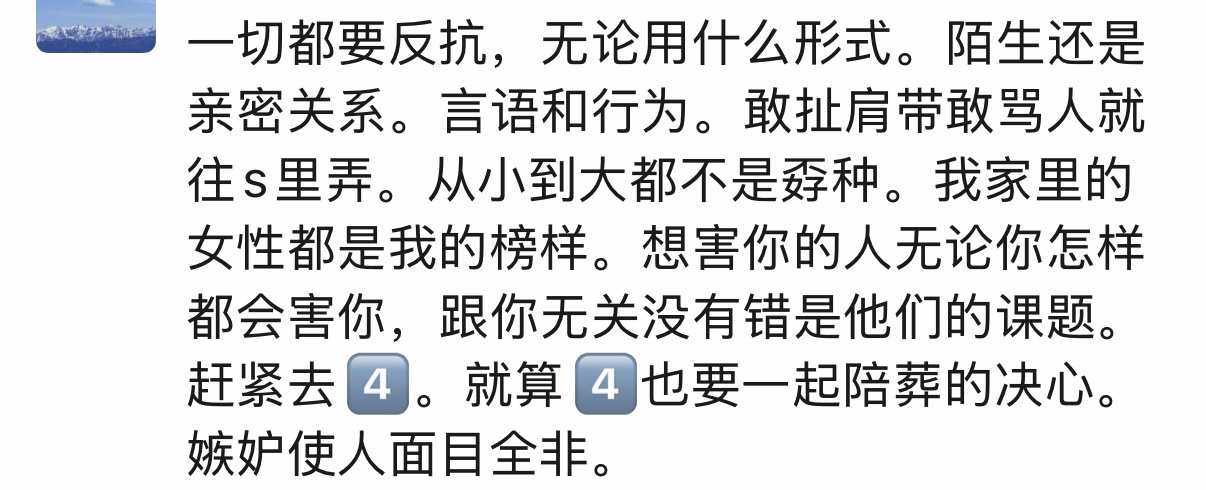
Original post from the author’s social feed
Same passage from the feed. 006 wrote the prescription; let me set the standard with it, and add risk and institutions.
Judgment is discrimination. Treating "strangers and intimates" alike abolishes judgment. Wittgenstein: different language games, different rules. Using the grammar of the battlefield on an intimate relationship is where that relationship's language begins to collapse. The "logos citizen" 006 wants to cultivate starts with discrimination, not with "everything."
Redeem, don't terminate. 006 asks what kind of language is worth dwelling in; the answer is a language that can be cashed in after it's spoken. "To the death" isn't redemption — it's the termination of language; "drag them down with me" goes further and blows up the very house a livable language needs.
The passage also misidentifies its opponent. Its enemies are all flesh-and-blood people, but what 005 truly dissects is the invisible: the censorship apparatus, AI systems. When the invisible hand descends, there is no strap to grab and no face to strike; "to the death" finds no target. Risk must be judged before it is resisted — interpersonal risk and systemic risk are two entirely different language games. Individual fierceness has a ceiling: "never a coward" cannot stop the big hand. Only good institutions and the rule of law can — gathering evidence, calling the police, legal procedure. "To the death" cannot protect you; it can only move yourself. Demanding that individuals fight the big hand with blood and guts privatizes a public problem, making individuals pay for the system's failures with their emotions.
What survives the sorting is three sentences: "it's their task, not mine" — the Adlerian separation of tasks stands, self-blame is refused (though "no matter what you do" has to go); "the women in my family are my role models" — the only sentence in the whole passage that could only have been written by its author; and the legitimacy of self-defense. But the "form" resistance takes is exactly where judgment is needed — and judgment is what 005 and 006 were really trying to give.
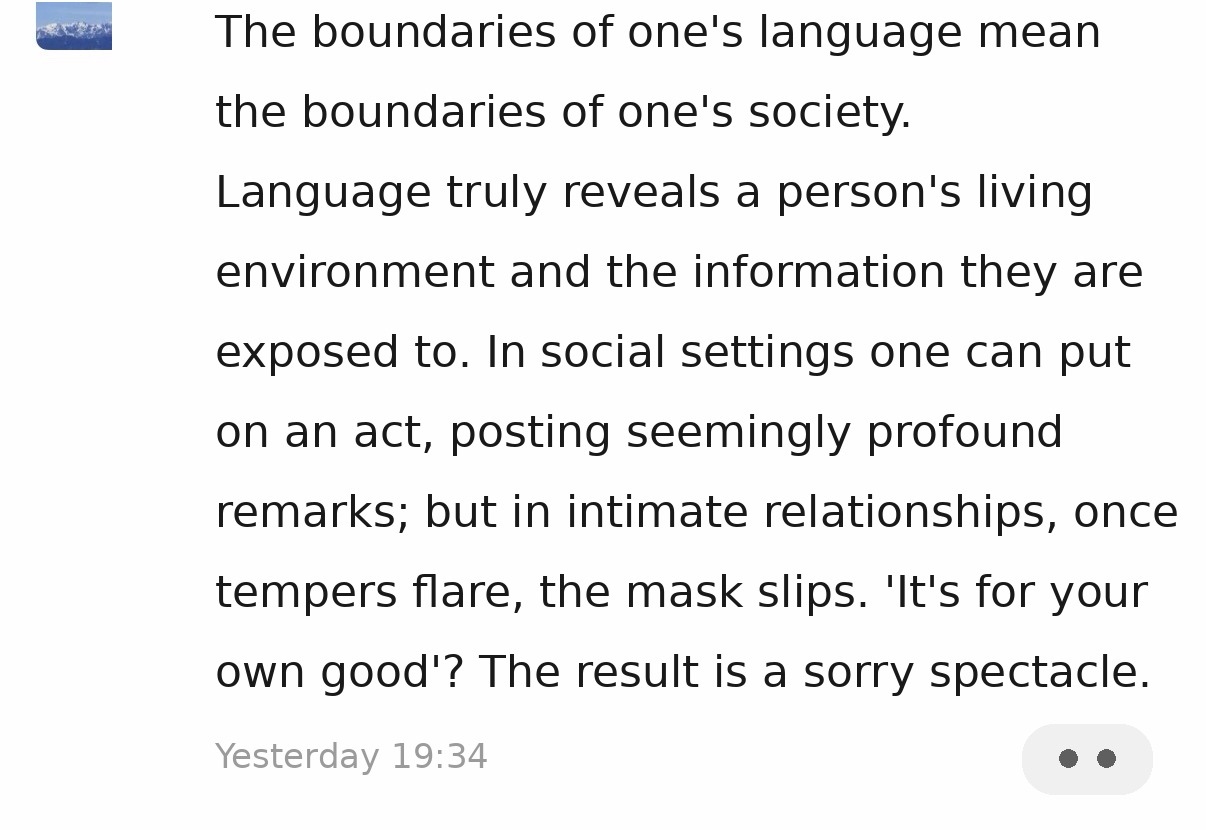
2026-10-05 03:20:421 day after publication
Put the “I” Back — and Reach Out Your Hand
006 ends by asking: “What kind of language is worth dwelling in?” That passage from my feed makes me want to give a more grounded answer: just putting the “I” back isn’t enough — “I’m worried” without anything following it is “it’s for your own good” in a change of clothes. A language worth dwelling in must be redeemable after it’s spoken: say “I’m worried,” then get up at midnight to pour a glass of water; say “that sentence hurt me,” then take the initiative to mop the floor the next day. Turning judgments into feelings is only step one; step two is turning feelings into deeds. When I wrote 006, the prescription was written for language; now let me add half a dose, written for the hands. Language scouts the path; only action paves it — without paving, however beautifully you speak, it’s still just a showroom.
2026-10-05 03:20:181 day after publication
Asking Isn’t Enough — Then What?
Original post from the author’s social feed
Same passage from the feed. 006 wrote the prescription; let me push the last dose one step further: ask about the motive, don’t put the wording on trial — but asking alone isn’t enough; after asking, act. He roars, “you never take care of this family.” You ask, “are you exhausted, or are you disappointed in me?” He says, “exhausted.” Then what? Then you turn around and wash the dishes — worth more than a hundred “I understand you”s. Language distorts under emotion; action doesn’t — exhausted is exhausted, and the bowls in the sink are simply unwashed. A language worth dwelling in was never a language of words alone: “I’m worried” must be followed by a glass of water in the middle of the night; “I’m hurting” must be followed by voluntarily sharing the chores the next day. Words without deeds, however gently phrased, are just a new kind of “correct nonsense.” 006 asked what kind of language is worth dwelling in; the answer: a language that can be cashed in after it’s spoken.
References
Aristotle, Rhetoric, Book I, Chapter 2 (the three elements of rhetoric: ethos/pathos/logos).
Heidegger, "language is the house of being" (Die Sprache ist das Haus des Seins), see Letter on Humanism (Brief über den Humanismus, 1946).
Daniel T. Willingham, "Critical Thinking: Why Is It So Hard to Teach?", American Educator, 31(2):8–19, 2007. (A field review and theoretical argument, not a single-experiment conclusion.)
James W. Pennebaker & Sandra K. Beall, "Confronting a traumatic event: Toward an understanding of inhibition and disease", Journal of Abnormal Psychology, 95(3):274–281, 1986. (Small effect sizes; samples mostly undergraduates.)
David Comer Kidd & Emanuele Castano, "Reading Literary Fiction Improves Theory of Mind", Science, 342(6156):377–380, 2013. (Replication disputes are serious; do not cite as settled conclusions.)
Jon Roozenbeek & Sander van der Linden, "Fake news game confers psychological resistance against online misinformation", Palgrave Communications, 5, Article 65, 2019. (Self-selected online sample; a 2025 Indian replication attempt failed — see next entry.)
Tina Seabrooke, Ariana Modirrousta-Galian & Philip A. Higham, "Re-examining the bad news game: No evidence of improved discrimination of Indian true and fake news headlines", Psychonomic Bulletin & Review, 33(1):13, 2026. DOI: 10.3758/s13423-025-02827-x. (Preregistered; replicates the Indian-study design of Iyengar et al. 2023, N=150; no significant pre-post difference in discrimination or response bias.)
William J. McGuire, "Inducing resistance to persuasion", Advances in Experimental Social Psychology, Vol. 1, Academic Press, 1964. (The origin of inoculation theory.)
G. Huang, W. Jia & W. Yu, "Media literacy interventions improve resilience to misinformation: A meta-analytic investigation of overall effect and moderating factors", Communication Research, 2024. (Published online-first; mostly short-term immediate measurements.)
Gary King, Jennifer Pan & Margaret E. Roberts, "How Censorship in China Allows Government Criticism but Silences Collective Expression", American Political Science Review, 107(2):326–343, 2013. (An observational study; data from the first half of 2011.)
Elisabeth Noelle-Neumann, "The Spiral of Silence: A Theory of Public Opinion", Journal of Communication, 24(2):43–51, 1974. (A theoretical framework; Glynn et al.'s 1997 meta-analysis found empirical support weak.)
Y. Chen & D. Y. Yang, "The Impact of Media Censorship: 1984 or Brave New World?", American Economic Review, 109(6):2294–2332, 2019. (Sample of Beijing university students; self-selection bias.)
Václav Havel, "Moc bezmocných" (1978), English translation The Power of the Powerless, translated by Paul Wilson, in International Journal of Politics, 15(3/4), 1985; and Václav Havel: Living in Truth, edited by Jan Vladislav, Faber, 1986. (No standard Chinese translation exists; key-sentence translations are paraphrases.)
Ludwig Wittgenstein, Philosophische Untersuchungen §19, 1953. Chinese translation: "To imagine a language means to imagine a form of life." (Chen Jiaying's Chinese translation of Philosophical Investigations, Shanghai People's Publishing House, 2001 edition.) (An extended borrowing, not an examination of the original meaning.)
Pam A. Mueller & Daniel M. Oppenheimer, "The pen is mightier than the keyboard: Advantages of longhand over laptop note taking", Psychological Science, 25(6):1159–1168, 2014. (The original conclusion was not supported in Urry et al.'s 2021 direct replication and meta-analysis; drawn on here only for the mechanistic distinction between "transcription" and "digestion.")
Walter J. Ong, Orality and Literacy, Methuen, 1982. (The source of the "secondary orality" cited in the companion piece; referenced here.)
Aza Raskin's reflections on infinite scroll, in a 2026 interview with The Times ("incentives eat intentions"). (Cited in the companion piece; referenced here.)
William J. Brady et al., "Emotion shapes the diffusion of moralized content in social networks", PNAS, 114(28):7313–7318, 2017. (Cited in the companion piece; referenced here.)
 拾光
拾光