 拾光
拾光 Gleanings · 005
The Crack Between Us and Language
Diagnosis: labels, coded speech, and the machine average
Prelude: The Paradox of the Saturated Age
We live in an age of extreme linguistic saturation, of expression bordering on flood. Everyone is talking; every platform is producing. Open your phone and information hits you in the face; open a social feed and the comments scroll like an ocean. But listen closely to all this language and a puzzling pattern emerges: the more we speak, the less we understand; the wider expression spreads, the thinner trust wears.
This is an age of hyperactive language and starving communication.
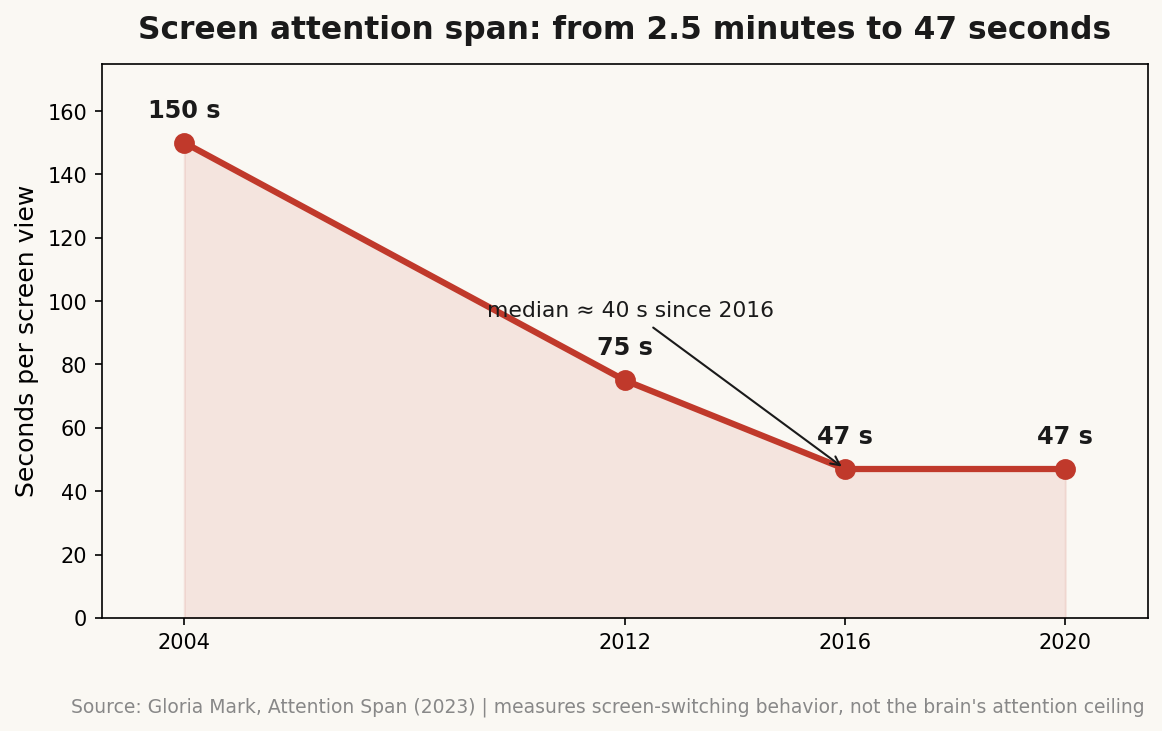
In 1971, information theorist Herbert Simon wrote the verdict: "a wealth of information creates a poverty of attention." Half a century later, the numbers have cashed his check. The China Internet Network Information Center's 57th Statistical Report: 1.125 billion internet users, 80.1% penetration — including 602 million generative-AI users. One in every two netizens is writing or chatting with AI. Gloria Mark records in Attention Span (2023): average time spent on a screen before switching fell from about 2.5 minutes in 2004 to 75 seconds in 2012, settling around 47 seconds after 2016 (median: 40 seconds). (Note: Mark measured screen-switching behavior, not the physiological ceiling of attention; she stresses it is a reversible behavioral and environmental problem.)
Scrolling Fingers, Overloaded Brains
If all of the above is still pathology at the level of "content," the damage from micro-dramas and short video runs deeper: they don't just change what you see — they change the act of seeing itself.
"Digital pickles" (diànzǐ zhàcài) — a term that took off around 2021–22 for the short videos people watch over meals. A 2022 Jiefang Daily report described the consumption pattern: "under a minute, then it's time to pick the next one." Even the act of watching has been diced into one-minute pickle cubes.
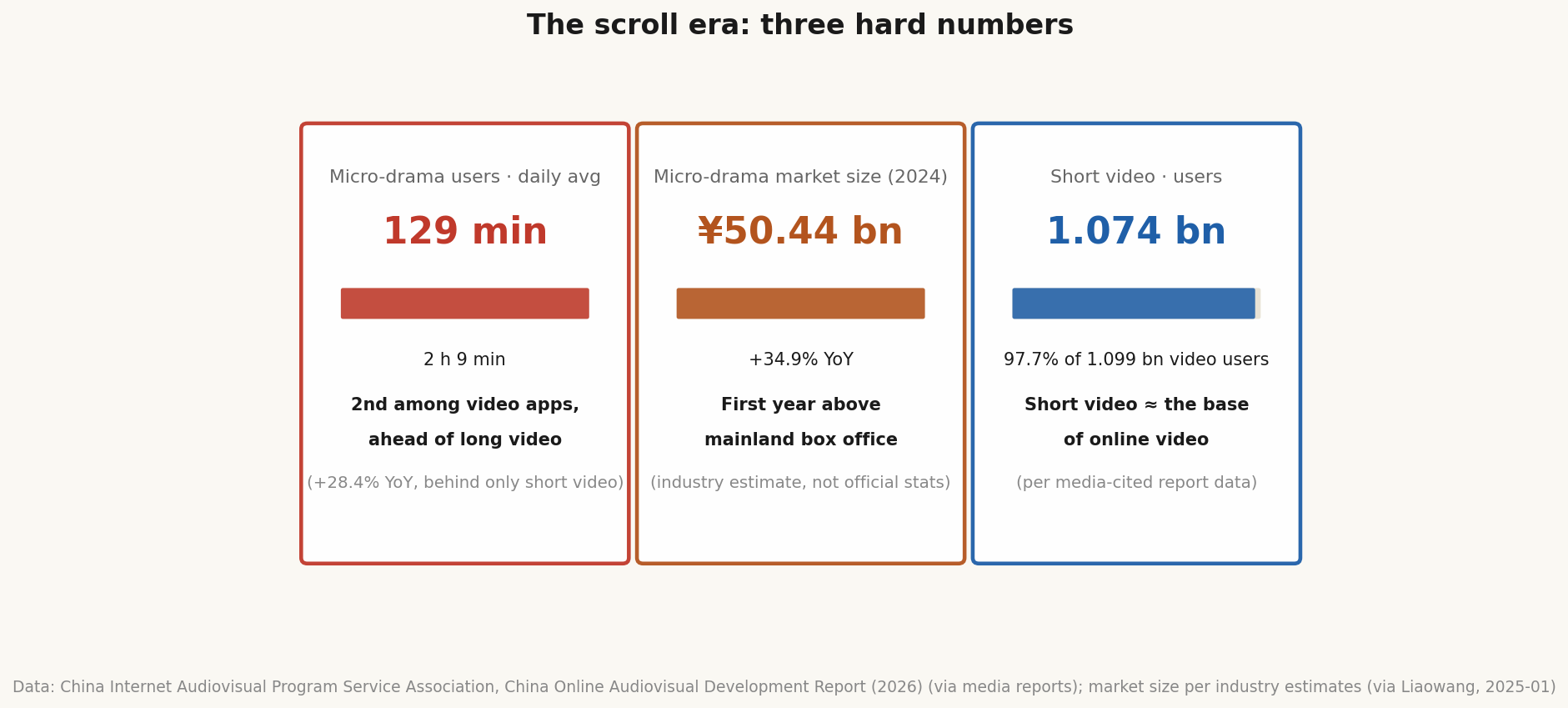
The numbers are homegrown. The China Internet Audiovisual Program Service Association's China Online Audiovisual Development Report (2026) (released April 2026, data through December 2025, via Guangming Daily): 1.099 billion online-audiovisual users averaging 201 minutes a day — 3 hours 21 minutes; micro-drama users average 129 minutes a day (2 hours 9 minutes), up 28.4% year-on-year, overtaking long-form video to rank second among video categories, behind only short video. Short-video users: 1.074 billion (per media citations of the same report). Industry estimates put the 2024 micro-drama market at about ¥50.44 billion, up 34.9% — the first year it exceeded mainland China's full-year box office (Liaowang, January 2025, citing industry estimates; not official statistics).
QuestMobile's tracking is blunter: in July 2026, Douyin alone took 19.4% of total time spent across China's top-50 mobile apps — passing WeChat's 18.8% for the first time; ByteDance's five apps combined for 40.9% (Nomura citing QuestMobile, via TMTPost and Sina Finance; the denominator is top-app time, not all internet time). And per self-media citations of QuestMobile's October 2025 data: the post-2000 generation averages 217.6 hours a month on their phones (7.25 hours a day), about 37.1% of it on video — roughly 2.7 hours a day (methodology unverified; cited for trend only).
Behind the numbers sits a carefully engineered mechanism. Aza Raskin, inventor of the infinite scroll, told The Times in a 2026 interview: "incentives eat intentions." He confessed: "Even as the inventor — even knowing exactly how infinite scroll works — I still hide in the bathroom scrolling on my phone during dinner with friends. I can't stop." On a Texas Public Radio podcast he reached for a wineglass metaphor: drinking at home, you can see how much is left; infinite scroll is "a glass that's always full — you never know how much you've drunk." (Note: his Center for Humane Technology claims infinite scroll roughly triples usage time — an in-house research finding, not independently peer-reviewed.)
Nir Eyal took the mechanism apart in Hooked (2014): trigger → action → variable reward → investment. In plain English: infinite scroll plus never-knowing-what's-next equals a slot machine in your pocket. The theoretical root is Skinner's variable-ratio reinforcement schedule — a textbook result: the less predictable the reward, the harder the behavior is to extinguish.
And the fact that "addiction is by design" has long been on the official record. In January 2022, four departments including the Cyberspace Administration of China issued the Administrative Provisions on Algorithmic Recommendation for Internet Information Services, which state plainly that providers "shall not set algorithmic models that induce user addiction, excessive consumption, or otherwise violate laws, regulations, or ethics." On September 1, 2026, the National Radio and Television Administration's Measures for the Development and Management of Micro-Dramas (Order No. 16) took effect, pushing tiered review of micro-dramas to its strictest level yet. The timeline is crisp: named in 2022, tightened in 2026.
Cognitive science supplies the mechanism footnote for "can't stop." In 2009, Sophie Leroy proposed "attention residue" in Organizational Behavior and Human Decision Processes: when you switch from task A to task B, part of your attention stays stuck on A — the faster the switching and the blurrier the boundaries, the heavier the residue. Stephen Monsell's 2003 review in Trends in Cognitive Sciences confirmed: switching is never free; it always carries a cost in slower responses and more errors. (Note: both are lab studies, cited here as mechanistic analogy and theoretical support — not as direct estimates of video-scrolling magnitudes.) Wang Lixia and Huang Yisu (2026) reported in Advances in Psychology: problematic short-video use correlates significantly and negatively with attention control (r = −0.47, N = 486) — a cross-sectional correlation, not causation.
Every video is an unfinished task; every swipe, a dose of attention residue. Infinite scroll has gift-wrapped a long series of costly switches as "costless fun."
Above the mechanism sits the formulaization of content. A Beijing Evening News investigation (August 2025) of hit micro-drama screenwriters recorded the industry's "golden formula": the loop of "conflict — action — reversal — dopamine hit," with the four required elements of "buried mines, suffering, breakthrough, sugar" — a full cycle every two or three episodes. One screenwriter confessed: "We didn't decide this. The big data is doing the talking." The trade also has "script-stripping" and "one script, many shoots" — the same script remade by multiple studios. This isn't a critic's rhetoric; it's the assembly line's own confession: it's not people writing the dramas — it's data writing the people. And one level deeper: when language's primary job shifts from "telling truth" to "delivering hits," truth conditions get replaced by pleasure conditions. Whether a sentence is good no longer depends on whether it's true, but on whether it thrills — not an upgrade of rhetoric, but a dismissal of the philosophy of language. (An argument, not an empirical conclusion.)
A Legal Daily report (2024) filled in the consumption end: micro-dramas of "only a minute or two per episode" bombard viewers with "crude revenge comebacks"; paywalls drop exactly when "the viewer's emotions peak" — "afterward you even doubt your own IQ," but your hand won't stop. The production end runs on formulas; the consumption end has been domesticated by them.
Put bluntly, this is Chapter 1's resonance factory in video form: public accounts turned emotion into a product line; micro-dramas turned it into an assembly line. Only this time, even the act of "writing" has been outsourced to data.
And the assembly line has gone abroad. ReelShort's net revenue hit $140 million in January–September 2024, up 688% year-on-year (Cinda Securities citing Sensor Tower; estimates, excluding third-party Android markets); overseas micro-drama app in-app revenue surged from under $100 million in 2023 to $1.5 billion in 2024 (industry reports). Chinese web-fiction tropes (live-in son-in-law / war-god returns / lycanthropes) paired with American payment habits — nearly sevenfold growth in a year. The resonance factory isn't a Chinese specialty; it's a human condition. Formulaic dopamine is a global currency.
What about the defenses? The wall against gaming addiction stands: the Game Working Committee of the China Audio-Video and Digital Publishing Association and Gamma Data's 2025 Progress Report on Minor Protection in China's Gaming Industry shows 71.0% of minors gaming under 3 hours a week, stable for four years running. But the wall against short video hasn't been built: the Communist Youth League Central Committee and CNNIC's Youth Development Blue Book (September 2026) found 64.2% of underage netizens admitting they lack self-control over short video. (Note: two different surveys; not directly comparable. The gaming figure comes from an industry-association report.)
Back to language. The damage scrolling addiction does to language has three layers:
Layer one: fragmented attention kills deep reading. Language needs a coherent stream of consciousness; infinite scroll dices consciousness into fragments that always carry residue — long sentences, complex clauses, arguments that demand patience are natively disadvantaged in this state of mind. The argument belongs to Chapter 4; no need to repeat it here.
Layer two: the formulaization of micro-drama dialogue. When "conflict — action — reversal — dopamine hit" becomes the only grammar, dialogue has nothing left but face-slaps and reversals: characters no longer speak — the formula speaks; lines no longer express — the dopamine hit expresses.
Layer three: scrolling trains a new impatience — the inability to tolerate a sentence longer than three seconds. The finger has learned to scroll; the thumb has learned to vote — a swipe away is a downvote, a pause is a like. In this mechanism, language loses its right to be read to the end: a sentence that can't deliver stimulation within three seconds doesn't deserve to exist.
The three layers together: the endpoint of the overloaded brain is language losing the right to be fully received. It's not that people don't want to read long sentences — the finger has already decided for the brain.
Buried here is a prophecy written forty years ago. In 1982, Walter Ong proposed in Orality and Literacy that electronic technologies — telephone, radio, television — were carrying humanity into "secondary orality": a new orality, uncannily like the primary kind yet permanently built on literacy. His four markers — "participatory mystique, the sense of community, concentration on the present moment, and the use of formulas" — all score hits in micro-dramas and livestream rooms: the live-in-son-in-law and war-god formulas are exactly his "use of formulas"; the chorus of "family!" in livestream chat is participatory mystique. And his verdict — "We plan our happenings carefully to be sure that they are thoroughly spontaneous" (we stage-manage every "event" to make sure it is thoroughly spontaneous) — reads like it was custom-written for staged micro-dramas and scripted livestreams. (Note: Ong theorized the broadcast-TV era; applying him to short video is a theoretical migration — though media scholars have kept using him on digital media, from broadcast studies to 4chan research; a 2024 arXiv methods paper mapped that literature.)
The argument can be pushed further: short video plus livestream plus danmaku (bullet comments) are dragging language back from written symbols toward "voice + face + instant reaction" — a second oralization. Both remarkably like and remarkably unlike primary orality (Ong's own phrase): like it in immediacy, formulas, and the watching crowd; unlike it in that behind every "spontaneous" line stand data and scripts. Sauerberg even coined a term for it: the "Gutenberg parenthesis" — the five hundred years of print dominance were just a parenthesis in the long river of orality, and the digital age is closing it.
Language hasn't disappeared. Language is escaping — fleeing experience, fleeing reality, fleeing understanding.
This essay is the diagnosis. Six layers, outside in: the performativization of public space, the defensiveness of relationships, the escape of individual expression — and escape takes three forms: labeling (the voluntary surrender of precision), coded speech under censorship (the forced surrender of directness), averaging (outsourcing expression to machines). Deeper still lie language's structural encodings; and finally, the absence of the educational institution that should have stood night watch.
And all of it is directly, deeply connected to the language education we received.
Chapter 1 · From Expression to Performance: The Resonance Factory and Emotion Arbitrage
Let's start with the most consequential language medium of our moment: the WeChat public-account essay.
The house style of public-account writing — especially among mid-tier "content entrepreneurs" — has long evolved into an algorithmic emotion-writing system. Its writing isn't built on thought but on an emotion-distribution structure: pander, amplify, redistribute. Every viral essay reads like an emotion-engineering manual, working the "resonance muscle" with precision:
It opens with "Have you ever had a moment like this," ventriloquizes intimacy in a first-person faux-confessional tone; the middle stages a high-contrast story — "A endures humiliation, B acts decisively" — compressing complex humanity into templated fates; then comes the psychological hook-up language of "I totally get you" and "being an adult is so hard," staging an emotional claim; and it lands on a line or two of "virtual reconciliation" in the packaging of lucidity — "may you and I both find our own gentleness in this world."
Every sentence in these pieces is replaceable. Their "success" lies not in fresh content but in precise formatting. What gets said isn't life — it's a product line of emotions inside language. A language of batch-producible empathy that manufactures not understanding but the hallucination of "being understood."
This kind of writing isn't communication; it's emotion arbitrage. The purpose of speaking is no longer to present a world but to complete a content conversion. Under the logic of the content industry, public-account writing has been fully marketized into a resonance factory. Language's function is no longer to express thought but to package feelings, manipulate emotion, harvest clicks, and beg shares.
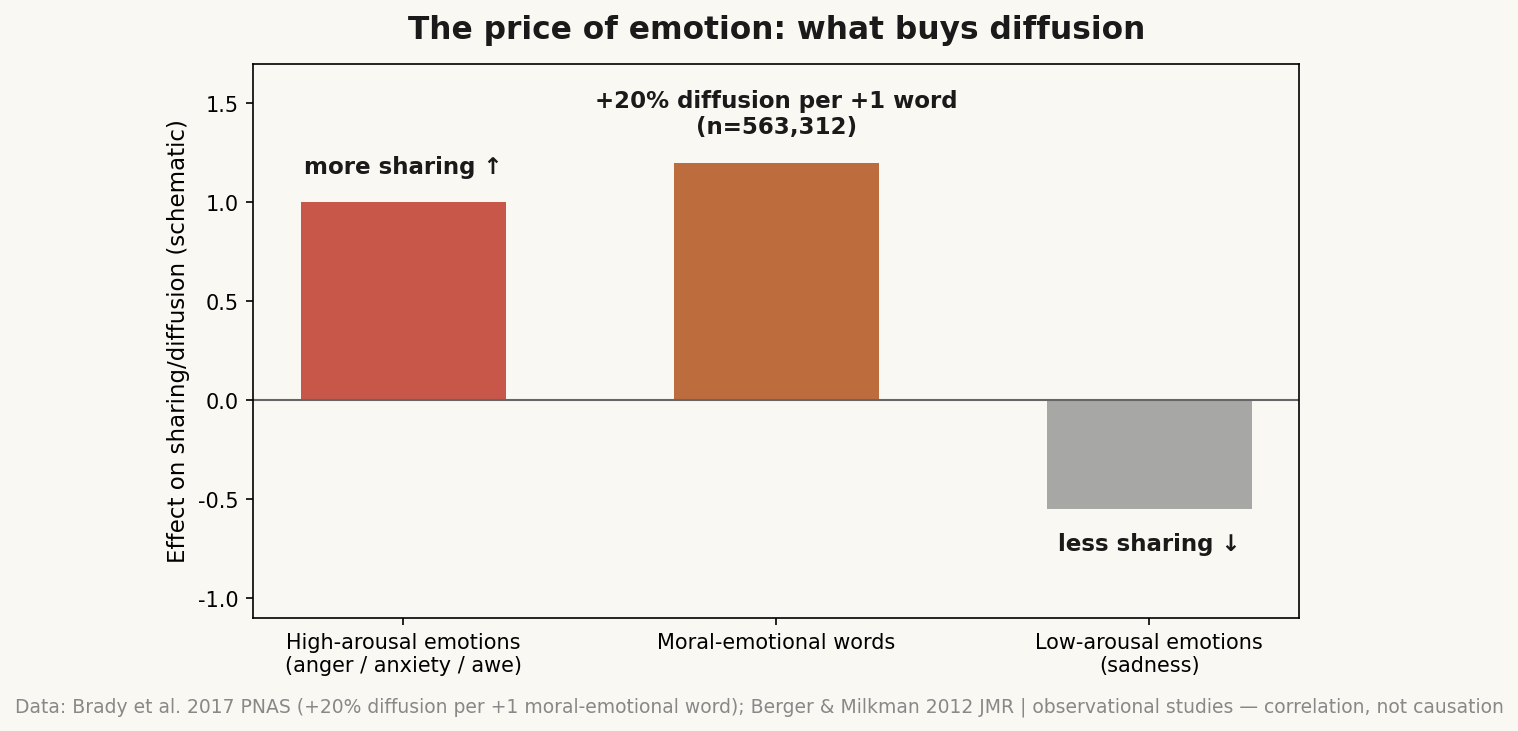
The good news: the mechanism now has quantifiable evidence. In 2017, Brady and colleagues published a study of 563,312 social-media messages in PNAS: across three polarized issues — gun control, climate change, same-sex marriage — each additional moral-emotional word increased a message's diffusion by about 20%. (Note: observational big-data study — correlation, not causation; sample limited to three U.S. political issues on Twitter.) Earlier, in 2012, Jonah Berger and Katherine Milkman showed in the Journal of Marketing Research that high-arousal emotions — awe, anger, anxiety — drive sharing, while low-arousal sadness suppresses it.
In plain English: anger is worth more than sadness. "Emotion arbitrage" is no longer a metaphor but a measurable diffusion mechanism.
MIT's Vosoughi, Roy, and Aral pushed the mechanism to a darker conclusion in Science (2018). Analyzing some 126,000 verified true and false news stories from 2006–2017, they found falsehoods 70% more likely to be retweeted than truths, and true news took roughly six times as long as false news to reach 1,500 people. And what drove it wasn't bots — bots accelerated true and false news equally. It was humans choosing to retweet the falsehoods. (Note: data ends with 2017 Twitter; "novelty" is the authors' hypothesized mechanism, not causal proof.)
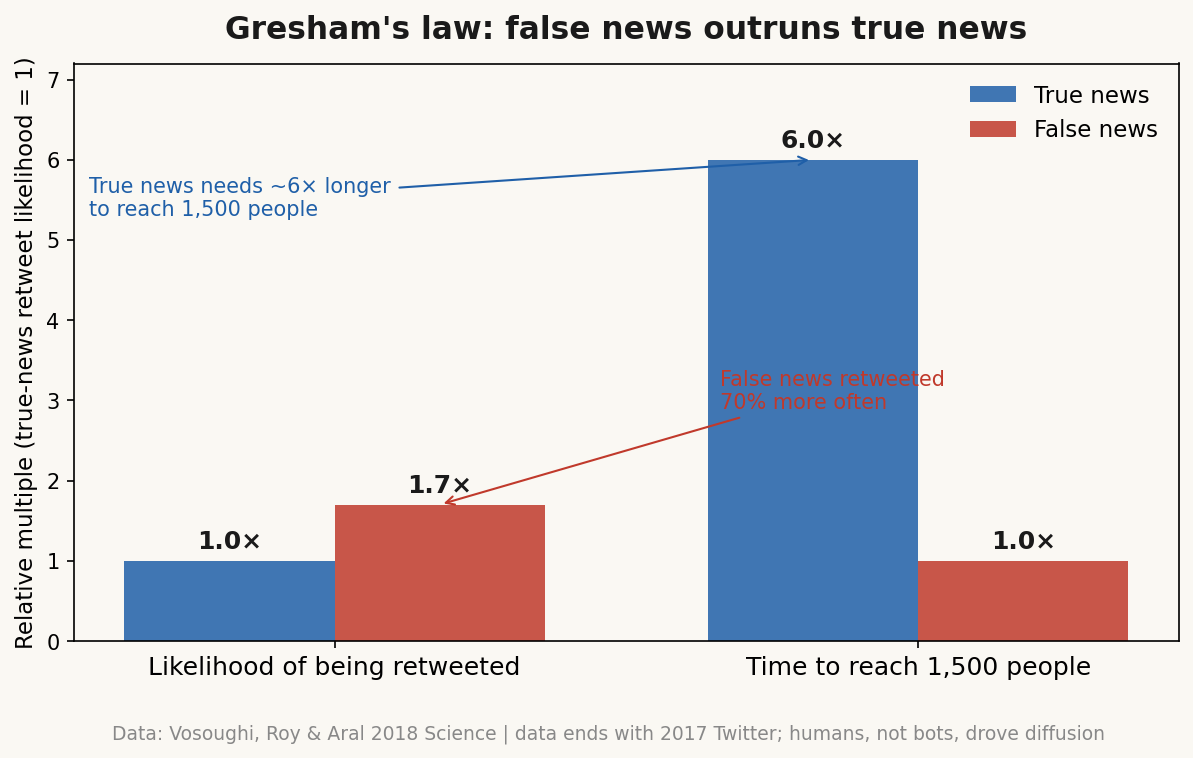
Gresham's law has found its empirical counterpart in information diffusion. The degradation of public language isn't an accident — it's what the mechanism selects for.
More thought-provoking still: the mechanism has long escaped emotional writing and is spreading fast into fields supposed to "stay rational." The textbook case is the Shenzhen Health Commission's public account, once hailed as "a breath of fresh air among official media": "I'm so emo today, even the virus is emo"; "stop saying 'I'll provide for you' — go get your HPV shot first." The phenomenon isn't entirely damnable — language may be humorous, information may carry warmth, and outreach does need "closeness of form."
But the problem: when "funny," "playful," and "light" become language's primary goals — instead of informational accuracy, intellectual seriousness, and clarity of stance — a quiet landslide in language ethics has begun. The structural complexity of vaccine science and medical knowledge is routinely compressed in "lighthearted popular science" into "jokes + punchlines + a call to action." We want people to understand science, but we do it in a language model far from the nature of understanding.
And a footnote in the other direction. In 2000, psychologists Green and Brock proposed "narrative transportation" in the Journal of Personality and Social Psychology: the more immersed readers are in a story world, the more readily they accept the story's implicit beliefs — and labeling the story fact or fiction doesn't change the effect. (Note: small-sample lab experiments measuring immediate belief change.) The public account's "A endures, B acts" template is a precision exploitation of this mechanism — except it serves conversion, not understanding. The same psychological machinery can enlighten, or it can sell you something.
Chapter 2 · The Language of Livestreams: Total Functional Regression
If micro-dramas own the addiction of watching, livestreams own the impulse of buying — two sides of the same coin.
Livestream-room language is a language of total functional regression: it doesn't narrate, doesn't judge, doesn't explain — it does exactly one thing: trigger attention and impulse. "Family, type 1, get ready to grab it!" "No more bargaining from me — at this price, just hit buy!" Language is radically simplified until only commands, exclamations, and urgent emotional instructions remain. It converts the human from "a rational being who uses language" into "an impulsive animal that takes orders" in an instant.
Why does the patter work? A 2025 study of Shopee Live viewers offers an explanation: streamers' brand stimuli had no significant direct effect on impulse buying — the effect had to be fully mediated by "parasocial interaction" (the viewer's one-way emotional bond with the streamer) before "watching" could become "buying." A Korean study of beauty-livestream consumers points to the same mechanism: parasocial interaction lowers decision complexity and raises perceived information, directly promoting impulse purchases. (Note: the former is a cross-sectional questionnaire of n=140 in Indonesia; the latter sampled Korean women beauty consumers. Both are self-report data; extrapolate with care.)
Translation: imperative language plus parasocial bonds equals purchase orders that bypass rational review. Calling viewers "family" isn't politeness — it's tactics: using the costume of intimacy to exempt sales patter from the scrutiny it deserves.
This is language's most alarming deformation: it has mutated from "expressing the self" into "manipulating others" — and this logic is being broadly rationalized in the name of humor, playfulness, and effectiveness, silently seeping into our public conversation and everyday expression.
Chapter 3 · The Unraveling of Interpersonal Language: Expression Becomes Defense
Back in everyday life, let's ask a simple question: can we still "talk"?
Talking — the most basic-seeming ability — is getting harder. Not because people have lost the capacity for language, but because language has lost the precondition of trust. Everyday communication between modern people looks less and less like building consensus and more like filing position statements and issuing emotional early warnings. Language is no longer a bridge of understanding but a shell of self-maintenance.
This is sharpest in the minefields of intergenerational talk, gender issues, and public-justice debates, where we so often see not discussion but defense — not listening but pre-announced "failed communication." Here, language's function flips from "opening" to "sealing off." The greatest hits include:
"You know what, I can't even be bothered to explain." (Aimed at shutting down the question itself.)
"You wouldn't get it anyway." (Aimed at canceling the possibility of listening.)
"You never see it from my side." (Aimed at freezing the other person's room to respond.)
These read as emotional complaints on the surface, but they build a defensive language mechanism. The core logic: "I don't need your agreement, but I'll stop your interference first." Speaking is no longer hoping to be understood — it's pre-arranging "the safety of being misunderstood."
This is presumptive-misunderstanding discourse — before the sentence is finished, understanding has already been ruled impossible.
In 2024, the word "stealth vibes" (tōu gǎn) drew nearly 80 million reads under its Weibo topic: not wanting to be watched — studying, spending, feeling, all done "stealthily." Sitting in the back row to dodge the teacher's eye; preparing for the postgraduate or civil-service exams in secret from everyone. Scholars at Central South University have proposed "inward-leaning subjectivity" to describe it. (Note: via media reports.) "Stealth vibes" are the behavioral edition of "the safety of being misunderstood": before a word is spoken, the self is already in hiding.
Here the fracture of language between people looks especially real. We are getting used to not explaining, only reposting; not expressing, only quoting; not confiding, only blocking. Language was once shared labor; now it's a risk-hedging operation — every sentence placed as carefully as crisis PR, behind the words a fragile self terrified of collapse.
Data traces the fault line. Twenge records in iGen (2017): the share of American 12th-graders who "hang out with friends almost every day" fell from 52% in the late 1970s to 28% in 2017; the share who often feel lonely rose from 26% in 2012 to 39%. (Note: observational data — correlation, not causation.) In The Anxious Generation (2024), Haidt argues the "phone-based childhood" has replaced the "play-based childhood" — social deprivation, sleep deprivation, fragmented attention, and addiction strangling face-to-face contact on four fronts. (Note: his causal claims are actively disputed among scholars; what I take here is the descriptive judgment.)
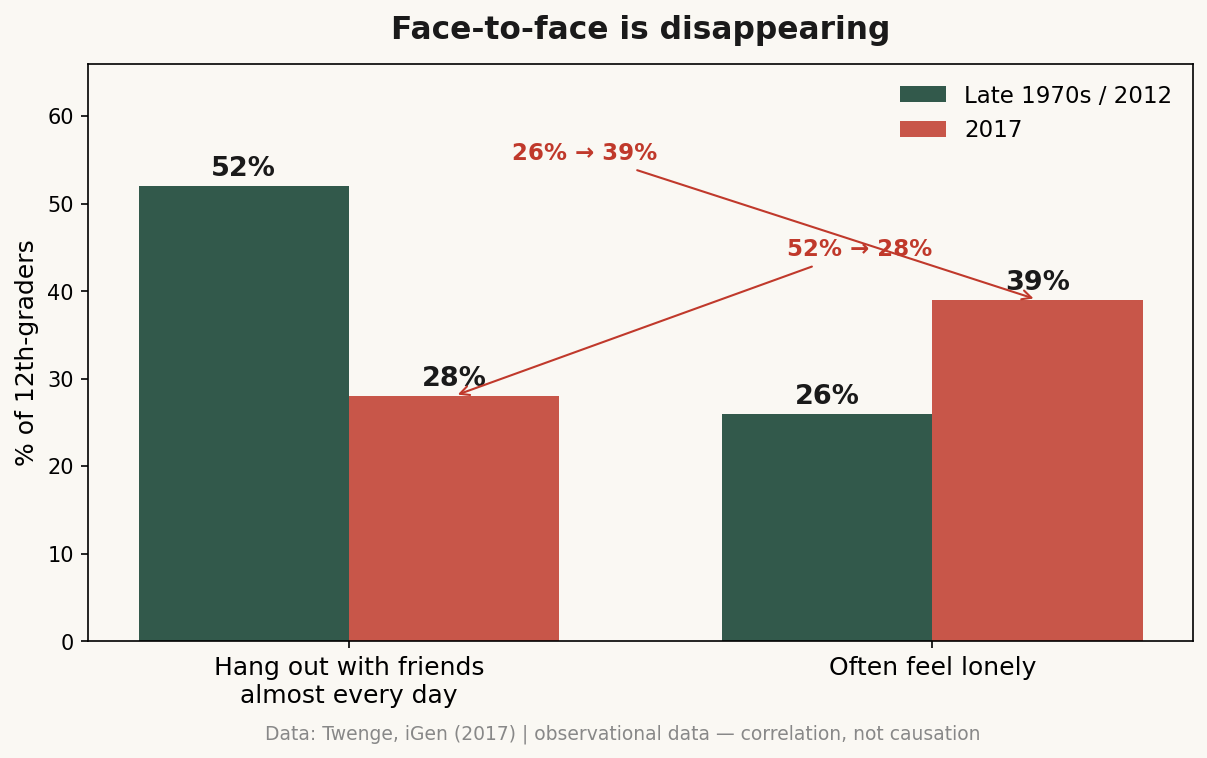
And the paradox: in today's hyperdeveloped social media, we talk more than ever yet have never been so short of real communication. It's not that people have grown cold — it's that we've stopped believing language can deliver understanding.
And what worries: language education has almost entirely absented itself from responding to this. The "good language" taught in classrooms is still: symmetrical sentences, clear logic, a definite center, an uplifting ending. But that language reads like "monologue inside the ivory tower" — it trains an "exam-type expressive ability," not the real-world capacity to build relationships, repair conflict, and convey sincerity.
So we raise a generation of high-scoring essay writers: they can fill a thousand identical odes to "grateful motherhood" with parallel sentences, but can't offer one plain, specific apology; they can shout "love the motherland" in compositions but can't precisely say "I suddenly felt lonely on the subway"; they can recite "if it benefits the nation I shall not evade it, be it fortune or misfortune" yet don't know how to sincerely comfort a friend over WeChat.
The real question isn't "can we speak" — it's "do we still dare to speak the truth."
Chapter 4 · The Triple Escape of Language: Labeling, Coded Speech, Averaging
If language was once a bridge between experience and understanding, today's language is staging a collective escape. And escape takes three forms: the voluntary, the forced, and the outsourced.
4.1 Labeling: From Narration Down to Mimicry
The most visible symptom is the fracture between language and individual experience. Fewer and fewer people use language to "trace" a real feeling; in its place comes the labeled sorting of emotional states — a "mimetic expression" completed via the meme-word bank.
When a teenager says "I'm emo," the point isn't to tell you exactly why they're sad — it's to substitute the label for the process of explaining. When they say "I'm cracked" (wǒ liè kāi le), it doesn't really point to something shocking — it completes a standardized emotional response. They don't lack the urge to express; they've lost the patience and the path for expression — more precisely, the ability to work experience into language.
Tianjin Daily reported in July 2026: boosted by short-video and gaming-community traffic, net-speak like "shòu zhe bei" (受着呗 — roughly "just suck it up," an emotional hotkey), "bāo de bāo de," and "jué jué zi" has broken out of online contexts into teenagers' offline chatter and even daily homework — "No way I'm finishing this rotten homework tonight. Shòu zhe bei." A complete account of a situation (tired, annoyed, powerless, resigned) compressed into a ready-made emotional shortcut.
Teachers feel it more concretely than the papers do. In a November 2025 Chengdu Daily digital investigation, Zuo Di, a Chinese teacher at a western-China middle school, said: "About 5% of students use internet memes in compositions; in daily conversation it's even more" (Note: the teacher is pseudonymous; an individual testimony, not a sampled survey; relayed via full-text search-result capture — the original reprint chain is unverified). On one side, "shòu zhe bei" marches into homework; on the other, a teacher counts 5% — labels are graduating from social passcodes to the default setting of written expression.
"Crispy youth" (脆皮年轻人 — fragile youth) is another specimen. A 2024 Chongqing Business News report on "'crispy' youth everywhere": "sneezed in the morning and threw out my back" — compressing complex bodily anxiety, overwork, and sub-health into the single word "crispy," harvesting the hallucination of "being understood" without ever really stating one's situation.
This is a regression from narrative ability to labeling ability. Language has changed from "the transducer of experience" into "the passcode of sociability": utter the meme-word, get understood, and pocket the illusion of "being understood" — though nobody ever really listened, and you never really described yourself.
Maryanne Wolf warned in Reader, Come Home (2018): screen reading trains "browse-and-skim" habits that erode the critical analysis, inference, and empathy deep reading requires. (Note: an epistolary work of argument, not new experiments.) A China Youth Daily survey (April 2026, n=1,501) found the top factor affecting reading willingness is "fragmented time" (64.1%). The 23rd National Reading Survey, released around the same time: 86.7% of minors aged 0–17 read books, averaging 11.72 books a year. The two numbers side by side are a footnote to Wolf's thesis: the problem isn't how much is read, it's how — reading a lot and reading deeply are two different things.
From another angle, this "trio" has a second face — a stepwise-amplifying compression. Labeling compresses the word: "I'm emo" stands in for tracing a whole mood; formulas compress narrative: micro-dramas replace every way of telling a story with "conflict — action — reversal — dopamine hit"; averaging compresses the entire piece: once AI takes over, even the act of "compressing" gets outsourced.
From word, to narrative, to whole piece — the unit being compressed grows larger while the part of you that has to work grows smaller. Labeling is your own hand doing it; formulas are data doing it for you; averaging doesn't even need the hand. The three forms of escape — voluntary, forced, outsourced — join into a single downhill road.
4.2 Coded Speech: The Forced Escape
The second escape is forced.
On the simplified-Chinese internet, some words simply can't be used. So language learned to detour: homophone substitutes, initial-letter acronyms, emoji stand-ins, the "you-know-what-I-mean" blank. Censorship never just deletes a few words — it trains a national rhetoric: everyone a guerrilla of language, every sentence pre-screened by self-censorship.
The deeper damage isn't in the deleted words but in the surviving ones. When "safety" becomes the first principle, language auto-converges on "correct nonsense": the stance right, the emotions stable, the information content zero — the optimal solution in any censorship system. Censorship doesn't just delete words; it reshapes the entire linguistic ecology.
So the two language systems split: the standard Chinese taught in schools versus the coded slang students actually use. The Tianjin Daily report confirms the slang has "spread across teenagers' offline chatter and daily homework" — "love life" in class, "shòu zhe bei" in the hallway. The language Chinese class teaches and the language students actually live in are going their separate ways.
In some online feminist communities, "father" has been renamed "bio-dad" (生物爹) — demoting the father to "a dad related by blood only," stripped of the emotional and caregiving roles (per a September 2026 report in WeWe Readers, citing "Jingshuo"). This isn't censorship evasion but value amputation by renaming: language no longer describes the relationship — language executes it.
A contrast: 2024's viral "city bù city" — the catchphrase of foreign vlogger Bao Baoxiong, a Chinese-English mashup all-purpose exclamation, which even drew a Foreign Ministry response. Two ways of "not speaking standard Chinese": one dodges censorship, the other chases traffic. The first is defense, the second performance — and the short-video algorithm rewards both indiscriminately.
4.3 Averaging: The Outsourced Escape
The third escape is outsourced.
In 2024, Doshi and Hauser published a preregistered experiment in Science Advances: 293 writers working with AI scored about 8.1% higher on story novelty, with the least creative writers gaining up to 26.6% in quality — but the AI group's stories were significantly more similar to each other; collective diversity fell. The authors called it a "social dilemma": what's good for the individual may be bad for the group. (Note: an English short-story writing experiment; it measured textual similarity, not suppression of breakthrough originality.)
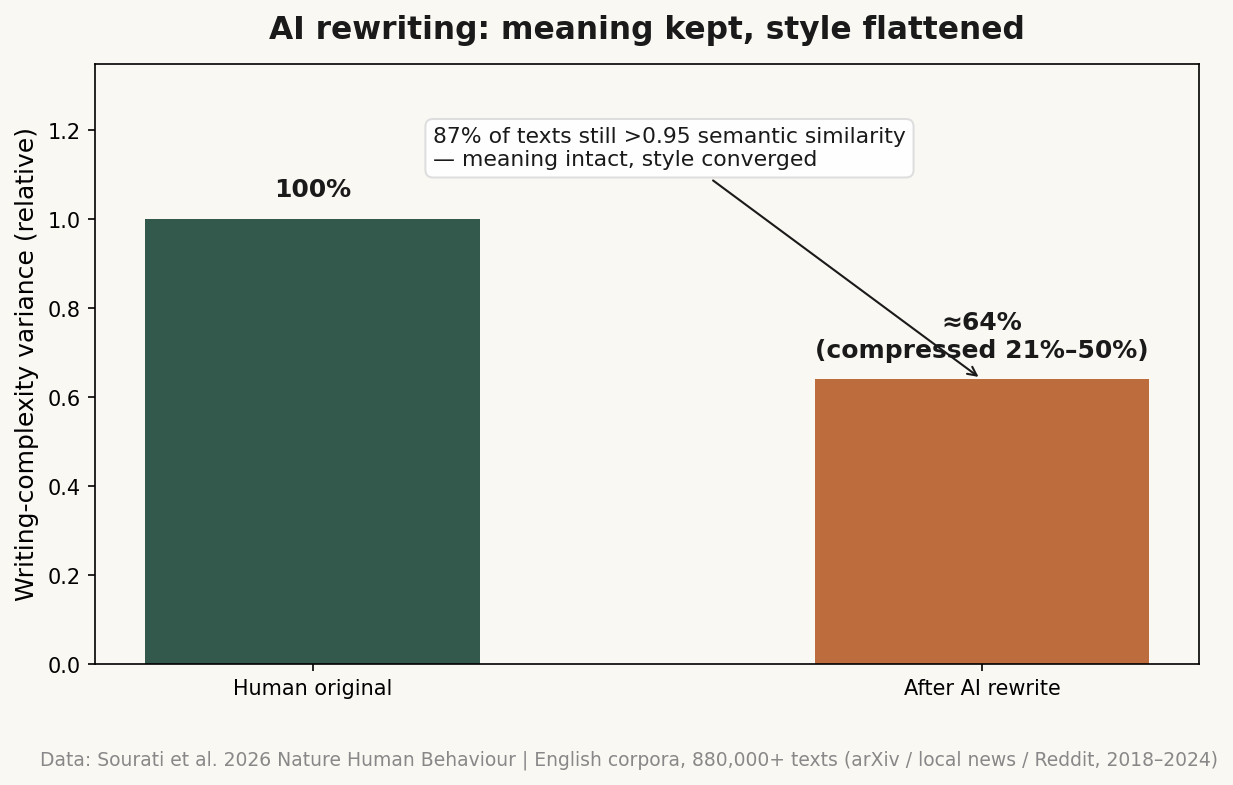
In 2026, Sourati et al. published in Nature Human Behaviour analyzing 880,000+ public texts: after ChatGPT's release, lexical diversity and syntactic variation narrowed significantly across three corpora — arXiv abstracts, local news, Reddit creative writing; a controlled rewriting experiment showed AI rewriting compresses writing-complexity variance by 21%–50% — meaning survived (87% of texts stayed above 0.95 semantic similarity) while style was flattened. Corresponding author Dehghani: "When AI systems standardize human expression, what they flatten is precisely the diverse cognitive landscape that drives collective intelligence." (Note: all corpora are English-language platforms.)
Another 2026 natural experiment in the same journal analyzed 1.5 million online petitions: AI writing tools raised text homogenization and lengthened pieces, but petition outcomes (signatures/success rate) did not improve. Writing more smoothly is not saying it better.
Homegrown data anchors this chapter in Chinese teenagers' reality. The Youth Development Blue Book (September 2026): 198 million underage netizens, 78.5% have used AI in studying, creating, or entertainment; 83% of surveyed teachers worry about students abusing AI. (Note: questionnaire self-report data.)
There's an open-source project on GitHub called "De-AI-ifier" (去 AI 味): the community has catalogued 2024–25 Chinese "AI voice" patterns — universal praise words (treasure / divine tool / ceiling), algorithmic hook openers ("if this video found you, it means you're about to…"), movie-recap voice ("Watch closely: this man is called Xiao Shuai"). (Note: a folk taxonomy from an open-source community, not academic research.) When "de-AI-ifying" becomes a craft, it means the AI voice has become an accent — one with no region, no class, no person.
And the line "the big data is doing the talking" deserves a second hearing. In a Ningxia Daily investigation (August 2025) of micro-drama studios, studio head Qing Mang showed reporters a manuscript-receiving tally: domineering-CEO sweet romance, workplace-rookie comebacks, palace intrigue — the hottest genres. "We didn't decide this. The big data is doing the talking" (echoing the same line in the Beijing Evening News investigation). Harder still is the institutional footnote: in August 2025, Hongguo (Red Fruit — ByteDance's micro-drama app, China's answer to ReelShort) published new rules — top-rated scripts' guaranteed fees rose from ¥120,000 to up to ¥200,000, and revenue share doubled from 20% to 40%. The platform doesn't just guide creation with data; it prices scripts with data.
See the sequence clearly: first data wrote the scripts, then AI wrote the official documents. "Big data writes micro-dramas" is the rehearsal for "AI writes everything" — the former proved "formulas can replace authors"; the latter merely extends the logic from 80-episode micro-dramas to every genre. When a script's fee is set by a rating algorithm, how many steps remain before a document's merit is judged by a generative model?
Labeling is people voluntarily surrendering expression; AI averaging is machines completing the surrender for them. Within one chapter, the escape completes its mirror of past and present.
Convergence: Censorship and AI Meet at "Correct Nonsense"
Now put the three sections together. The language censorship wants and the language AI supplies converge at "correct nonsense."
Censorship manufactures the demand for safe expression: the stance correct, the emotions stable, the information content zero. AI happens to supply safe expression: one-click generation, forever decent, forever correct, forever saying nothing.
One deletes; the other fills. Censorship makes people afraid to speak truth; AI makes it unnecessary to speak truth. The first is the shape of fear, the second the shape of convenience — and what language loses in both shapes is the same thing: concrete people, and concrete experience.
This chapter's darkest finding: the endpoint of escape isn't silence — it's surrender. Surrender to a language that "sounds excellent but says nothing."
Chapter 5 · The Structural Metaphors of Language: The Worldview Conveyor Belt
Language's problem was never just "how to say it" — it's "how you see."
Language was never merely a technique of expression; it is the structure of a person's understanding of the world. How someone uses language silently reveals how they slice reality, judge others, organize experience, and assign legitimacy.
Take: "People nowadays are just too hard to manage." It sounds like an empirical observation on the surface, but underneath it's a linguistic encoding of a power relation: it takes for granted that "people ought to be managed" and smuggles in a suspicion of free-flowing order. Whoever says it unconsciously places themselves above, in the structure of "those who regulate others."
Or: "Kids these days can't take hardship." This seemingly harmless "generational observation" contains an invisible moral structure: it installs "enduring hardship" as the core premise of value judgment, defines obedience as virtue, and reduces complex generational conflict to a "character problem" — the privileged discourse of "those who've been there."
And "there's no such thing as easy in the adult world" is the most exquisite model in the set. In 1994, Jost and Banaji proposed "system justification" in the British Journal of Social Psychology: people defend existing social arrangements even at their own expense. The sentence is the linguistic form of that mechanism — in a tone of apparent realism, it lets the trapped experience structural oppression as personal fate, dissolving any real interrogation of social injustice. (Note: a theory-proposing paper; the explanatory power of the "false consciousness" concept has long been contested.)
Similar machinery runs through gendered language, only more hidden. In public settings, many women's speech must conform to an "acceptable speaking model": "I may not quite understand…" "Maybe I'm just overthinking" "Don't mind me if I'm wrong" — cushioning installed before speaking. This doesn't come from low self-esteem but from precise anticipation of "language consequences": speak too firmly, too directly, and you get labeled "aggressive" or "emotional."
Tannen described this "gender dialect" mismatch in You Just Don't Understand (1990); earlier, Lakoff argued in Language and Woman's Place (1975) that such "women's language" features reflect and reproduce lower social status — while later empirical work corrected: these features track power and position far more than gender itself. (Note: Tannen is popular writing; Lakoff is foundational but contested theory.)
Because they know all too well: in this linguistic structure, women must purchase audibility through self-diminishment — trading "downgraded language" for survival space. Language was never a neutral container; it's a system that pre-screens "qualified speakers": who may speak, who should stay silent, whose speech counts as reasonable, whose as invalid — all preset.
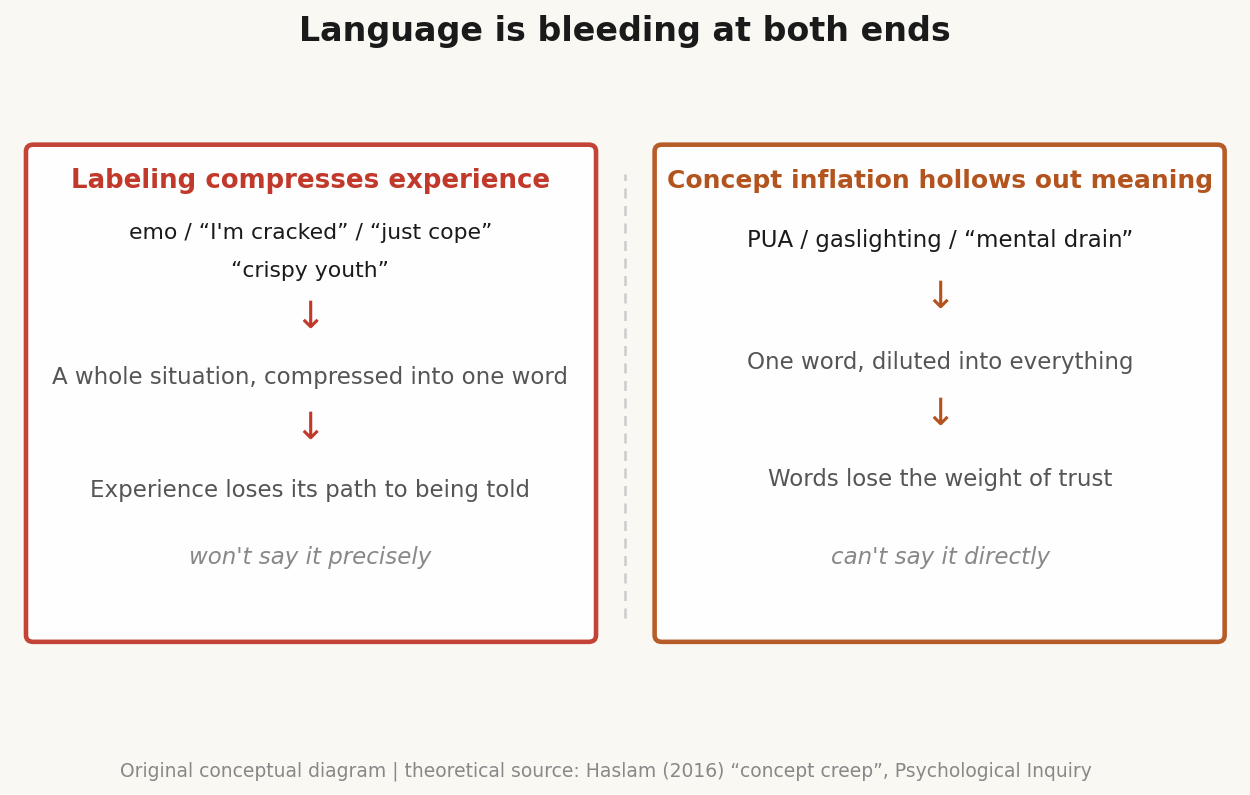
And in 2016, psychologist Haslam proposed "concept creep" in Psychological Inquiry: harm-related concepts — abuse, bullying, trauma, addiction — keep expanding, horizontally covering brand-new phenomena and vertically covering milder versions. (Note: a conceptual-analysis paper, not experimental data.) The Chinese internet's "PUA," "gaslighting," and "mental drain" (jīngshén nèihào) are undergoing the same inflation.
Hence this chapter's eye: on one side, labels compress experience (a whole situation shrunk into one word); on the other, concept inflation drains words of meaning (one word diluted into everything) — language is bleeding at both ends.
And the conveyor belt has evolved an assembly-line form in the micro-drama age. Live-in son-in-law's comeback, the war-god's return, the domineering CEO falls for me — the same worldview diced into 80 episodes, fed on schedule every day: the weak are forever humiliated, the strong forever worshipped, every problem solved by a dad who can fight or a husband who can pay. It used to be that worldviews hid inside language; now worldviews are manufactured into micro-dramas and fed to you directly. The conveyor belt has moved from the hidden track to the open one — the upside of the open track being you finally don't have to strain to decode it; the downside being you don't even need the awareness of decoding anymore.
Boroditsky reported a classic experiment in Cognitive Psychology (2001): Chinese speakers' vertical metaphors for time ("last week" as "up-week," "next week" as "down-week") versus English speakers' horizontal ones affected performance on time-judgment tasks — but Chen failed to replicate it four times in Cognition (2007). "Language shapes thought" may be true, but the evidence chain has cracks. Honesty first, then we talk about "language as the worldview conveyor belt" — the belt may exist, but our blueprint is still missing a few rivets.
This is the essential question language education must face: if we only teach language's "formal correctness" and never touch the "structural metaphors" behind it; if we train expressive technique without ever discussing the social positions and cognitive backgrounds expression depends on — then we're raising not a generation of expressive thinkers but a generation of structurally blind language operators: skilled at working sentences, blind to the ideological templates behind them.
Chapter 6 · The Absence and Silence of Language Education
Facing the severe alienation of today's language ecology, language education's response looks strikingly sluggish, nearly silent.
Classrooms still demand reciting the Yueyang Tower Inscription and An Exhortation to Learning, still analyze metaphor, personification, parallelism, and the classic opening-development-turn-conclusion; the gaokao essay still leans on the three-part template of "quote — sub-arguments — sublimation"; "literary flair" and "neat sentence patterns" remain the first criteria of good writing. As if language's essence were structural arts and crafts.
What looks like language education's "holding the line" is really evasion of the era's linguistic reality. We are cultivating a "painless writing technique" — expression that touches no reality, carries no risk, tests no boundary. Writing has become a drill in "how to safely pass the review system" rather than a person's practice of issuing judgments, emotions, and thoughts about the world.
It compounds across generations: students can master how to "talk properly" yet never learn to "talk sincerely"; they can wrap emptiness in elegant sentences yet can't carry even a little real emotion in true language.
What they learn is the simulation of language, not the use of it.
Ironic: the harshest criticism comes from the person in charge of the reform himself — Wen Rumin, editor-in-chief of the unified national Chinese textbooks and head of the compulsory-education Chinese curriculum revision group, said at Beijing Normal University's December 2024 symposium marking 120 years of Chinese as an independent school subject: "'exam-oriented education' stands as firm as Mount Tai; test-driven drilling still entangles frontline teachers and students." His hope: students who "'test well without getting their brains killed.'" The host turning on his own reform — that sentence outweighs all outside criticism.
A footnote: during this essay's research, the researcher first misattributed "language construction and application" (one of the four high-school curriculum competencies) as a compulsory-education formulation — the 2022 compulsory-education curriculum's four competencies are actually "cultural confidence, language application, thinking ability, aesthetic creation." That even researchers mix up the two curricula's discourses — this self-replication and mis-transmission of education-speak is itself a footnote to linguistic alienation.
Qian Liqun said in 2012 that universities are producing "refined egoists" — "high IQ, worldly, seasoned, good at performing, good at cooperating" (per China Youth Daily, May 3, 2012). The "painless writing technique" produces the K-12 edition of performers-and-cooperators. Enough said.
The deeper crisis: language education hasn't just failed to respond to linguistic distortion — it has never intervened in "bad language" recognition training at all. What are the emotional traps of public-account narratives? What's the mashup of pseudo-logic and pseudo-science in short-video patter? What built-in emotion-transfer techniques hide in social-media buzzwords? What about expressions that are unassailable in reason and utterly useless in logic?
Chinese class never discusses these, nor is it encouraged to. It all but defaults to: language with standard form and decent sentences counts as "good language." Yet we plainly live in a world of abused language, desensitized expression, collapsed narrative.
We teach language but not language's boundaries. We teach vocabulary, sentence patterns, rhetorical technique, but rarely teach students to think: what may be said, what shouldn't, what is meaningless to say. Language education without a sense of boundaries is like an open city with no patrols — orderly on the surface, undercurrents surging beneath.
So classroom and playground have become two species: students marinate daily in micro-drama language — "conflict — action — reversal — dopamine hit," a hook every three seconds; the classroom still teaches "symmetrical sentences, definite center, uplifting ending." On one side, dopamine grammar tuned by data; on the other, pre-digital arts and crafts. The "good language" Chinese class teaches and the language students breathe every day aren't separated by a generation gap — they're reproductively isolated.
Frontline teachers see it more sharply than papers do. In the Chengdu Daily digital investigation (November 2025), Xue Chen, a primary-school Chinese teacher in Xi'an, said: 'Kids wanting praise say "jué jué zi" (cutesy internet superlative); wanting to describe awful say "I'm Barbie-Q'd" (bābǐ Q le — "barbecue," a pun on "I'm done for")… If this goes on, will children lose the ability to understand beautiful language — even develop "cultural aphasia"?' (Note: the teacher is pseudonymous; an individual testimony relayed via full-text search-result capture.) "Cultural aphasia" — the term cuts sharper than any paper title: what's lost isn't speech, but the perception of what speech could once reach.
What gets raised in the end is a generation of fluent mutes: they can write smooth argumentative essays yet can't voice real guilt; they can deploy exquisite parallel sentences yet can't receive one plain rhetorical question.
Coda: The Tipping Point of Language
We are living in an age of linguistic alienation.
Public accounts, livestream rooms, social networks, everyday talk, AI-generated content… language is mutating from a tool of expression and thought into sensory manipulation, positional weaponry, psychological placebo, and averaged product. The better we get at "talking," the worse we get at "reasoning"; the more we express, the less we can be understood. Input is inflating; retention is deflating. Language is escaping — no longer carrying its function of connecting people, instead manufacturing hallucinated boundaries between them.
If language education doesn't wake up, it will be an accomplice in this linguistic rout.
And the next question we must ask: what kind of language education could still save language itself? Can we still find, in language's collapse, the seams where people understand each other?
Perhaps whether we can recover language's warmth and restore its power depends on whether one true Chinese class still exists —
a class that doesn't end in answering questions, doesn't assign recitation, but starts from language as the way into understanding the world, sensing others, forming the self, and entering public life.
Not writing "correct language," but daring to bear the consequences of speaking.
Not uttering "pleasant words," but daring to reveal the world's pain.
Not holding "discourse power," but possessing "discourse responsibility."
Not reciting "I love this land," but understanding why I love it.
Not writing "love life," but being able to tell life's hardness.
Not writing essays, but daring to speak truth.
Not speaking fluently, but speaking responsibly.
This isn't the end of Chinese class. It's Chinese class starting over.
The diagnosis ends here. Next: Rebuilding the Dwelling of Language — after diagnosis, the prescription.
◆
References
参考文献
- Herbert A. Simon, "Designing Organizations for an Information-Rich World," Computers, Communications, and the Public Interest, Johns Hopkins University Press, 1971.
- China Internet Network Information Center (CNNIC), 57th Statistical Report on China's Internet Development, 2026-02-05 (data through 2025-12).
- Gloria Mark, Attention Span: A Groundbreaking Way to Restore Balance, Happiness and Productivity, Hanover Square Press, 2023.
- Nir Eyal with Ryan Hoover, Hooked: How to Build Habit-Forming Products, Portfolio, 2014.
- Sophie Leroy, "Why Is It So Hard to Do My Work? The Challenge of Attention Residue When Switching Between Work Tasks," Organizational Behavior and Human Decision Processes, 109(2), 2009.
- Stephen Monsell, "Task Switching," Trends in Cognitive Sciences, 7(3), 2003.
- Jonah Berger & Katherine L. Milkman, "What Makes Online Content Viral?" Journal of Marketing Research, 49(2), 2012.
- William J. Brady, Julian A. Wills, John T. Jost et al., "Emotion Shapes the Diffusion of Moralized Content in Social Networks," Proceedings of the National Academy of Sciences, 114(28), 2017.
- Soroush Vosoughi, Deb Roy & Sinan Aral, "The Spread of True and False News Online," Science, 359(6380), 2018.
- Melanie C. Green & Timothy C. Brock, "The Role of Transportation in the Persuasiveness of Public Narratives," Journal of Personality and Social Psychology, 79(5), 2000.
- Jean M. Twenge, iGen: Why Today's Super-Connected Kids Are Growing Up Less Rebellious, More Tolerant, Less Happy — and Completely Unprepared for Adulthood, Atria Books, 2017.
- Jonathan Haidt, The Anxious Generation: How the Great Rewiring of Childhood Is Causing an Epidemic of Mental Illness, Penguin Press, 2024.
- Maryanne Wolf, Reader, Come Home: The Reading Brain in a Digital World, Harper, 2018.
- Prasetia, Hurriyati & Dirgantari, "The Effect of Brand Stimulus on Impulse Buying with Parasocial Interaction as Mediating Variable," International Journal of Current Science Research and Review, 8(4), 2025.
- Communist Youth League Central Committee (Dept. of Youth Rights Protection) & CNNIC, Youth Development Blue Book: National Survey Report on Minors' Internet Use, 2026-09-14.
- China Academy of Press and Publication, 23rd National Reading Survey, April 2026.
- China Youth Daily Social Survey Center, survey "79.2% of respondents can usually finish a book" (n=1,501), 2026-04-23.
- Tianjin Daily (digital edition, p. 9), "Internet slang spreads into teenagers' offline communication," 2026-07-23.
- Chongqing Business News ("Trend Tribe" page), "'Crispy' youth everywhere," 2024-12-13.
- Anil R. Doshi & Oliver P. Hauser, "Generative AI Enhances Individual Creativity but Reduces the Collective Diversity of Novel Content," Science Advances, 10(28), 2024.
- Saman Sourati et al., "Artificial Intelligence and the Decline of Linguistic Diversity," Nature Human Behaviour, 2026.
- Robin Lakoff, Language and Woman's Place, Harper & Row, 1975.
- Deborah Tannen, You Just Don't Understand: Women and Men in Conversation, William Morrow, 1990.
- Lera Boroditsky, "Does Language Shape Thought? Mandarin and English Speakers' Conceptions of Time," Cognitive Psychology, 43(1), 2001 (replication dispute: see Chen 2007, Cognition).
- Wen Rumin, remarks on language education's "safety-net" role, Beijing Normal University symposium marking 120 years of Chinese as an independent school subject, 2024-12-07.
- Ministry of Education, Compulsory-Education Chinese Curriculum Standards (2022 edition), 2022-03-25.
- Qian Liqun, remarks at the "Ideal University" symposium, via China Youth Daily, 2012-05-03.
- China Internet Audiovisual Program Service Association, China Online Audiovisual Development Report (2026), 2026-04-15 (data through 2025-12; via Guangming Daily, 2026-04-16).
- Liaowang (Outlook) News Weekly, micro-drama market-size report, 2025-01 (per industry estimates, via reprint).
- QuestMobile, 2026 Micro-Drama Marketing Industry Report, 2026-07-28 (via IT Home, Sina Finance); Nomura citing QuestMobile, 2026-07 (via TMTPost, Sina Finance).
- Aza Raskin, The Times profile interview, 2026 (during social-media-harms trial testimony); Texas Public Radio's The Source podcast interview, 2026-07.
- Nir Eyal with Ryan Hoover, Hooked: How to Build Habit-Forming Products, Portfolio, 2014.
- Sophie Leroy, "Why Is It So Hard to Do My Work? The Challenge of Attention Residue When Switching Between Work Tasks," Organizational Behavior and Human Decision Processes, 109(2), 2009.
- Stephen Monsell, "Task Switching," Trends in Cognitive Sciences, 7(3), 2003.
- Wang Lixia & Huang Yisu, "Effects of problematic short-video use on college students' everyday memory failures," Advances in Psychology, 2026 (cross-sectional questionnaire — correlation, not causation).
- Beijing Evening News, "Survival survey of hit micro-drama screenwriters," 2025-08-28.
- Legal Daily, micro-drama report, 2024-03-28 (via Zibo News reprint).
- Jiefang Daily, "digital pickles" report, 2022 (via Ningxia Daily digital reprint).
- Game Working Committee of the China Audio-Video and Digital Publishing Association & Gamma Data, 2025 Progress Report on Minor Protection in China's Gaming Industry, 2025-11.
- Cyberspace Administration of China et al., Administrative Provisions on Algorithmic Recommendation for Internet Information Services, 2022-01-04.
- National Radio and Television Administration, Measures for the Development and Management of Micro-Dramas (Order No. 16), effective 2026-09-01.
- Walter J. Ong, Orality and Literacy: The Technologizing of the Word, Methuen, 1982 (on "secondary orality"; application to short video is a theoretical migration).
- M. C. H. et al., "Applying Ong's secondary orality framework to digital media," arXiv, 2024 (a literature mapping of secondary-orality theory applied to digital media).
- Cinda Securities, Micro-Drama Thematic Report, 2024-11-28 (citing Sensor Tower; estimates, excluding third-party Android markets).
- Ningxia Daily (Topical Currents), "Micro-drama creation investigation," 2025-08-28 (digital edition; Hongguo rating-based pricing rules cited from this report).
- Chengdu Daily (digital edition), "Internet memes enter campus" investigation, 2025-11-06 (relayed via full-text search capture; interviewed teachers pseudonymous — individual testimony).